1. Direct Answer: What Is the Small Company Definition in India?
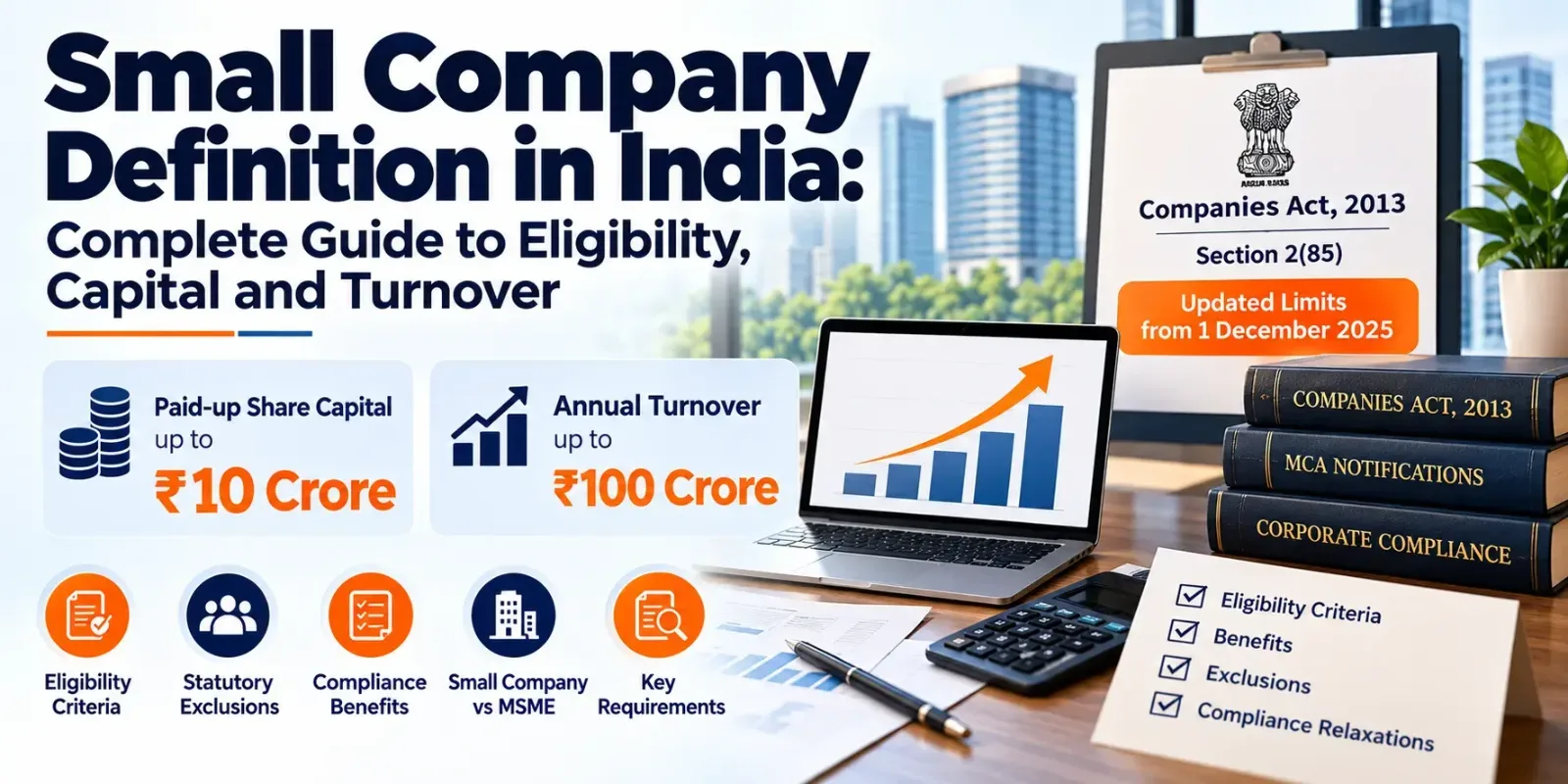
Definition of Small Company under Section 2(85) of Companies Act, 2013. Eligibility of a company to avail simplified corporate compliance in India. The prescribed limits are paid-up share capital of up to ₹10 crore and turnover of up to ₹100 crore, subject to the statutory exclusions and eligibility conditions, from 1 December 2025.
2. Quick Summary
- Applicable law: Section 2(85) of the Companies Act, 2013.
- Paid-up share capital limit: ₹10 crore.
- Turnover limit: ₹100 crore.
- Effective date of revised limits: 1 December 2025.
- Turnover assessment: Turnover as per the profit and loss account for the immediately preceding financial year.
- Company type: The company must meet the statutory eligibility conditions and cannot fall within the excluded categories.
- Key exclusions: Public companies, holding companies, subsidiary companies, Section 8 companies, and companies or bodies corporate governed by special Acts, as specified in Section 2(85).
- Main benefit: Eligible small companies receive certain compliance relaxations under company law.
- Important distinction: A small company under the Companies Act is not necessarily a small enterprise under the MSME framework.
The Ministry of Corporate Affairs announced the enhanced small-company thresholds in December 2025. The paid-up capital limit increased from ₹4 crore to ₹10 crore, and the turnover limit increased from ₹40 crore to ₹100 crore.
3. Small Company Definition Under the Companies Act, 2013
Section 2(85) of the Companies Act, 2013 gives the definition of Small Company. It sets out the monetary thresholds and exclusions to determine when a company is a small company for the purposes of the Act.
Some qualifying companies have lighter compliance obligations than larger companies, which is why this classification is important.
Small Company Definition: Latest Capital and Turnover Limits
The applicable financial limits are as follows:
| Particulars | Applicable limit from 1 December 2025 |
|---|---|
| Paid-up share capital | Not more than ₹10 crore |
| Annual turnover | Not more than ₹100 crore |
| Turnover reference period | Immediately preceding financial year |
| Main legal provision | Section 2(85) |
| Relevant rules | Companies (Specification of Definitions Details) Rules, 2014, as amended |
| Revised threshold effective date | 1 December 2025 |
Companies (Specification of Definitions Details) Amendment Rules, 2025, have revised the said limits.
Note: Both financial criteria have to be met. A company cannot assume that it is eligible just because its turnover is less than Rs 100 crore or its paid-up share capital is less than Rs 10 crore. Its eligibility also has to be considered in light of the statutory exclusions.
Example 1: Company Meets Both Limits
ABC Private Limited has:
- Paid-up share capital: ₹5 crore
- Turnover in the immediately preceding financial year: ₹60 crore
- No statutory exclusion applies.
The company meets both financial thresholds. Subject to verification of the remaining legal conditions, it may qualify as a small company.
Example 2: Turnover Exceeds the Limit
XYZ Private Limited has:
- Paid-up share capital: ₹3 crore
- Turnover in the immediately preceding financial year: ₹120 crore.
Although its paid-up share capital is within the prescribed limit, its turnover exceeds ₹100 crore. It would not qualify under the prescribed financial thresholds.
Example 3: Paid-Up Capital Exceeds the Limit
PQR Private Limited has:
- Paid-up share capital: ₹12 crore
- Turnover: ₹50 crore.
Its turnover is within the prescribed limit, but its paid-up share capital exceeds ₹10 crore. Therefore, it would not qualify under the financial thresholds.
4. Small Company Definition: Eligibility Conditions
Meeting the financial limits is necessary, but it is not sufficient in every case. Section 2(85) also excludes certain categories of companies.
4.1 The Company Must Not Be a Public Company
A public company does not qualify as a small company under Section 2(85), even if its paid-up share capital and turnover fall within the prescribed limits.
A company should verify its legal classification rather than rely solely on its financial figures.
4.2 Holding Companies Are Excluded
A holding company is excluded from the small-company definition.
This means a company cannot claim small-company status merely because it satisfies the financial thresholds if it falls within the excluded holding-company category.
4.3 Subsidiary Companies Are Excluded
A subsidiary company is also excluded under Section 2(85).
For example, a private company with paid-up share capital of ₹2 crore and turnover of ₹25 crore may satisfy the financial limits. However, if it is a subsidiary company, the statutory exclusion must be considered.
4.4 Section 8 Companies Are Excluded
Companies licensed under Section 8 of the Companies Act, 2013, are excluded from the definition.
Section 8 companies are generally established to promote charitable or other specified objectives, with their income applied towards those objectives and restrictions imposed on the distribution of dividends.
4.5 Companies Governed by Special Acts
Companies or bodies corporate governed by special Acts are also excluded as specified under Section 2(85).
Businesses should review their governing legislation and legal structure before concluding that they qualify.
Small Company Definition: Eligibility Checklist
Before classifying a company as a small company, verify the following:
- The entity is a company registered under the applicable company-law framework.
- It is not a public company.
- Its paid-up share capital does not exceed ₹10 crore.
- Its turnover for the immediately preceding financial year does not exceed ₹100 crore.
- It is not a holding company or subsidiary company.
- It is not a Section 8 company.
- It does not fall within another statutory exclusion under Section 2(85).
The relevant legal provision and amended rules should be reviewed together when making the final determination.
5. Difference Between Small Company and Small Enterprise Under MSME
One common source of confusion is the difference between a small company under the Companies Act and a small enterprise under the MSME framework.
These are separate classifications established under different laws. A business may qualify under one framework but not the other.
| Basis | Small company | Small enterprise under MSME |
|---|---|---|
| Governing framework | Companies Act, 2013 | Micro, Small and Medium Enterprises Development Act, 2006 and applicable rules |
| Main purpose | Corporate classification and compliance relaxations | MSME classification and applicable enterprise benefits |
| Paid-up share capital | Up to ₹10 crore under the prescribed small-company threshold | Not the classification criterion |
| Turnover limit | Up to ₹100 crore | Up to ₹100 crore under the MSME criteria applicable from 1 April 2025 |
| Investment criterion | Not a separate threshold in the small-company definition | Investment in plant and machinery or equipment is considered |
| Public company eligibility | Public companies are excluded | MSME classification depends on the applicable enterprise criteria |
| Registration | Small-company status is determined under company law | Udyam Registration is the official MSME registration system |
Under the MSME framework, a small enterprise must satisfy both the applicable investment ceiling of ₹25 crore and turnover ceiling of ₹100 crore. These are distinct from the Small Company Definition under Section 2(85).
Practical example: A private limited company may satisfy the Companies Act limits but have investment in plant and machinery exceeding the MSME small-enterprise ceiling. It could qualify as a small company under company law without qualifying as a small enterprise under MSME criteria.
Official MSME information is available on the Udyam Registration Portal.
6. Benefits of Small Company Status in India
Eligible small companies may receive several compliance relaxations under the Companies Act, 2013, and the rules made under it.
These relaxations are intended to reduce the regulatory burden on qualifying companies.
6.1 Simplified Financial Statements
Certain relaxations in relation to financial statements, including exemption from the inclusion of a cash flow statement where the statutory conditions are met, are available to eligible small companies.
However, the company is still required to prepare the financial statements required by applicable law.
6.2 Reduced Board Meeting Requirements
Small companies must usually hold at least one meeting of the Board of Directors in each half of the calendar year, with a minimum gap of 90 days between the two meetings.
A small company may choose to avail of this concession rather than the normal frequency of board meetings required of other companies. It’s important to check the exact statutory conditions before relying on it.
6.3 Simplified Annual Return
Section 92 provides for simplified annual-return signing requirements for a qualifying small company. Where a company does not have a company secretary, the annual return may be signed by a director, subject to the applicable statutory provisions.
This may ease the administrative burden on eligible businesses.
6.4 Auditor Rotation Relaxation
Save as otherwise provided, the mandatory auditor-rotation requirements applicable to specified classes of companies under section 139(2) shall not apply to small companies.
This does not mean that small companies can dispense with the appointment of an auditor or the conduct of their required audit.
6.5 Certain Auditor Reporting Relaxations
Eligible small companies may receive specified relief from reporting on the adequacy and operating effectiveness of internal financial controls under Section 143(3)(i), where the applicable exemptions apply.
6.6 Lower Penalties in Certain Cases
The Companies Act under certain provisions provides for specific penalty treatment to small companies and other specified categories at reduced levels.
The benefit is not a blanket exemption from all penalties. Relevant section, nature of default and statutory conditions applicable to be examined.
One of the objectives behind raising the thresholds for small companies is to reduce compliance requirements, the Ministry of Corporate Affairs has said.
Important: Small-company status does not eliminate annual filing obligations, statutory audit requirements, tax compliance, or other applicable legal duties.
7. Small Company Definition: Step-by-Step Eligibility Assessment
Businesses can use the following process to assess their eligibility.
Step 1: Confirm the Legal Structure
Check whether the entity is a private limited company, public company, Section 8 company, or another type of entity.
A proprietorship, partnership firm or LLP does not automatically fall within the small-company classification under Section 2(85).
Step 2: Review the Company's Paid-Up Share Capital
Review the company’s share-capital registers and the latest financial statements.
Current prescribed threshold: Paid-up share capital shall not exceed ₹10 crore.
Do not confuse paid-up share capital with ‘authorised’ share capital. Authorized capital is the maximum amount of share capital which a company can raise under its constitutional documents. Paid up capital is the amount which is credited as paid on the shares which have been issued.
Step 3: Check the Previous Financial Year's Turnover
Review the profit and loss account for the immediately preceding financial year.
The prescribed turnover limit is ₹100 crore.
Ensure the figure used is the relevant turnover figure under the Companies Act rather than an unrelated measure such as bank deposits, total assets, or authorised capital.
Step 4: Identify Statutory Exclusions
Determine whether the company is:
- A public company.
- A holding company.
- A subsidiary company.
- A Section 8 company.
- A company or body corporate governed by a special Act falling within the exclusion.
If an exclusion applies, the company should not claim small-company status merely because it meets the financial limits.
Step 5: Verify the Applicable Rules
Check Section 2(85) and the Companies (Specification of Definitions Details) Rules, 2014, as amended by the notification effective from 1 December 2025.
Use the latest applicable legal provisions rather than relying on articles published before the revised thresholds.
Step 6: Review the Compliance Position
Once eligibility is assessed, identify which specific relaxations apply to the company.
Do not assume that every exemption available to small companies applies automatically to every filing, audit, board meeting or tax obligation.
Step 7: Maintain Supporting Records
Keep copies of the financial statements, paid-up share-capital records, corporate structure details and relevant legal documents.
These records help support the company's classification during compliance reviews and professional assessments.
Companies can consult the official Ministry of Corporate Affairs website for company-law notifications, forms and filing information.
8. Common Mistakes When Applying the Small Company Definition
Mistake 1: Using the Old ₹4 Crore and ₹40 Crore Limits
The thresholds applicable from 15 September 2022 were ₹4 crore in paid-up share capital and ₹40 crore in turnover.
The thresholds were revised with effect from 1 December 2025. Businesses should use the updated ₹10 crore and ₹100 crore limits when assessing eligibility under the current prescribed rules.
Mistake 2: Checking Only Turnover
A company with turnover below ₹100 crore may still fail the financial criteria if its paid-up share capital exceeds ₹10 crore.
Both prescribed limits must be assessed.
Mistake 3: Confusing Authorised and Paid-Up Capital
Authorised capital and paid-up share capital are different concepts.
The prescribed threshold refers to paid-up share capital, not simply the amount of authorised capital recorded in the company's documents.
Mistake 4: Ignoring Holding or Subsidiary Status
A company can meet both financial limits and still be excluded because of its corporate structure.
Review group relationships before classifying the company.
Mistake 5: Confusing Small Company Status With MSME Registration
Small-company classification under the Companies Act and MSME classification under the MSMED Act are separate.
A business should assess each framework independently.
Mistake 6: Assuming Every Compliance Requirement Is Waived
Small-company status provides specified relaxations, not a complete exemption from corporate compliance.
Companies must continue to fulfil their applicable annual filing, accounting, audit, taxation and governance obligations.
9. Expert Advice from TaxCaller
At TaxCaller we recommend that businesses consider their corporate structure, paid up share capital and turnover in the previous financial year before using the Small Company Definition.
A misclassification can cause mistakes in compliance planning and filing decisions.
Businesses should also know the difference between classification under company law, MSME registration, GST obligations and income-tax compliance. Each comes with its own legal implications and eligibility criteria.
TaxCaller helps businesses with company registration, accounting and bookkeeping, income-tax filing, and GST related services.
Explore our services:
- Company Registration Services: Assistance with company incorporation and related documentation.
- GST Registration Services: Support with GST applicability and registration.
- Income Tax Filing Services: Assistance with applicable income-tax return filing.
- Accounting and Bookkeeping Services: Support with financial records and accounting processes.
The correct classification should be based on the latest applicable legislation and the company's actual financial and corporate position. For complex corporate structures, obtain professional advice before claiming an exemption.
10. Frequently Asked Questions About the Small Company Definition
1. What is the Small Company Definition in India?
The Small Company Definition is provided under Section 2(85) of the Companies Act, 2013. It classifies eligible companies based on prescribed paid-up share capital and turnover limits, subject to statutory exclusions. From 1 December 2025, the prescribed limits are ₹10 crore in paid-up share capital and ₹100 crore in turnover.
2. What is the small company turnover limit in India in 2026?
The prescribed turnover limit for a small company is ₹100 crore from 1 December 2025. The turnover is assessed with reference to the profit and loss account for the immediately preceding financial year. However, turnover alone does not determine eligibility. The company must also satisfy the paid-up share capital requirement and all other applicable conditions.
3. What is the paid-up share capital limit for a small company?
The prescribed paid-up share capital limit is ₹10 crore. A company whose paid-up share capital exceeds this limit will not satisfy the financial criteria for small-company classification, even if its turnover is below ₹100 crore. Businesses should verify paid-up capital rather than relying only on authorised share capital.
4. When did the new Small Company Definition become effective?
The revised thresholds became effective on 1 December 2025 through the Companies (Specification of Definitions Details) Amendment Rules, 2025. The paid-up capital limit increased from ₹4 crore to ₹10 crore, while the turnover limit increased from ₹40 crore to ₹100 crore.
5. Can a public company qualify as a small company?
No. Public companies are excluded from the Small Company Definition under Section 2(85) of the Companies Act, 2013. This exclusion applies even where a public company's paid-up share capital and turnover fall within the prescribed financial limits. The company's legal classification must therefore be verified before assessing small-company eligibility.
6. Can a subsidiary company qualify as a small company?
A subsidiary company is excluded from the small-company definition under Section 2(85). Therefore, satisfying the paid-up share capital and turnover thresholds is not sufficient when the statutory exclusion applies. Businesses should examine their corporate ownership structure, including holding-company relationships, before relying on small-company compliance relaxations.
7. Is a small company the same as an MSME small enterprise?
No. A small company is classified under the Companies Act, 2013, while a small enterprise is classified under the MSME framework. MSME classification considers investment in plant and machinery or equipment and turnover. The criteria and legal purposes differ, so a company should assess both classifications separately.
8. Does a small company need to conduct a statutory audit?
Small-company status does not generally exempt a company from statutory audit requirements under the Companies Act, 2013. Eligible small companies may receive specific compliance relaxations, but they must continue to comply with applicable audit and financial-reporting provisions. The company should review its statutory obligations rather than assume that small-company status removes audit requirements.
9. What are the benefits of small-company status?
Eligible small companies may benefit from specified relaxations relating to board meetings, financial statements, annual returns, auditor rotation, certain auditor reporting requirements and penalties under applicable provisions. These benefits depend on the relevant law and conditions. Small-company status does not eliminate every corporate filing, accounting, audit or taxation obligation.
10. How can I check whether my company qualifies as a small company?
Review the company's legal structure, paid-up share capital, turnover for the immediately preceding financial year and any statutory exclusions under Section 2(85). Then verify the current thresholds under the amended rules. A professional review of financial statements and corporate records can help determine which compliance relaxations may apply.
11. Does a small company have to file annual returns with the MCA?
Yes. Small companies must continue to meet applicable annual-return and financial-statement filing obligations under the Companies Act, 2013. Certain requirements may be simplified for eligible small companies, but this does not remove the underlying filing obligations. Companies should verify the relevant forms, deadlines and requirements for each financial year.
12. Can TaxCaller help with company registration and compliance?
TaxCaller provides services related to company registration, GST registration, income-tax filing, accounting and bookkeeping. Businesses can seek assistance in understanding their corporate structure and applicable compliance requirements. The appropriate service depends on the company's circumstances, and eligibility for small-company classification should be determined using the latest applicable legal provisions.
11. Official Government References
Use these official resources as supporting references within the published blog:
- Ministry of Corporate Affairs (MCA): MCA official website
- Government announcement on the revised Small Company Definition: Press Information Bureau — Ministry of Corporate Affairs, December 2025
- Companies Act information: Income Tax Department — Section 3, Companies Act, 2013
- Official MSME registration and classification information: Udyam Registration Portal
12. Conclusion
According to Section 2(85) of the Companies Act, 2013, Small Company is a type of classification. The prescribed limits are ₹10 crore paid-up share capital and ₹100 crore turnover from December 1, 2025.
But financial limitations are only one part of the eligibility test. Public companies, holding companies, subsidiary companies, Section 8 companies and other entities covered by the statutory exclusions cannot claim small-company status on limits alone.
It is suggested that businesses review their financial statements, corporate structure and relevant compliance obligations prior to availing of the available relaxations. Professional help can assist them in identifying the correct classification and avoiding costly compliance errors.