
Direct Answer
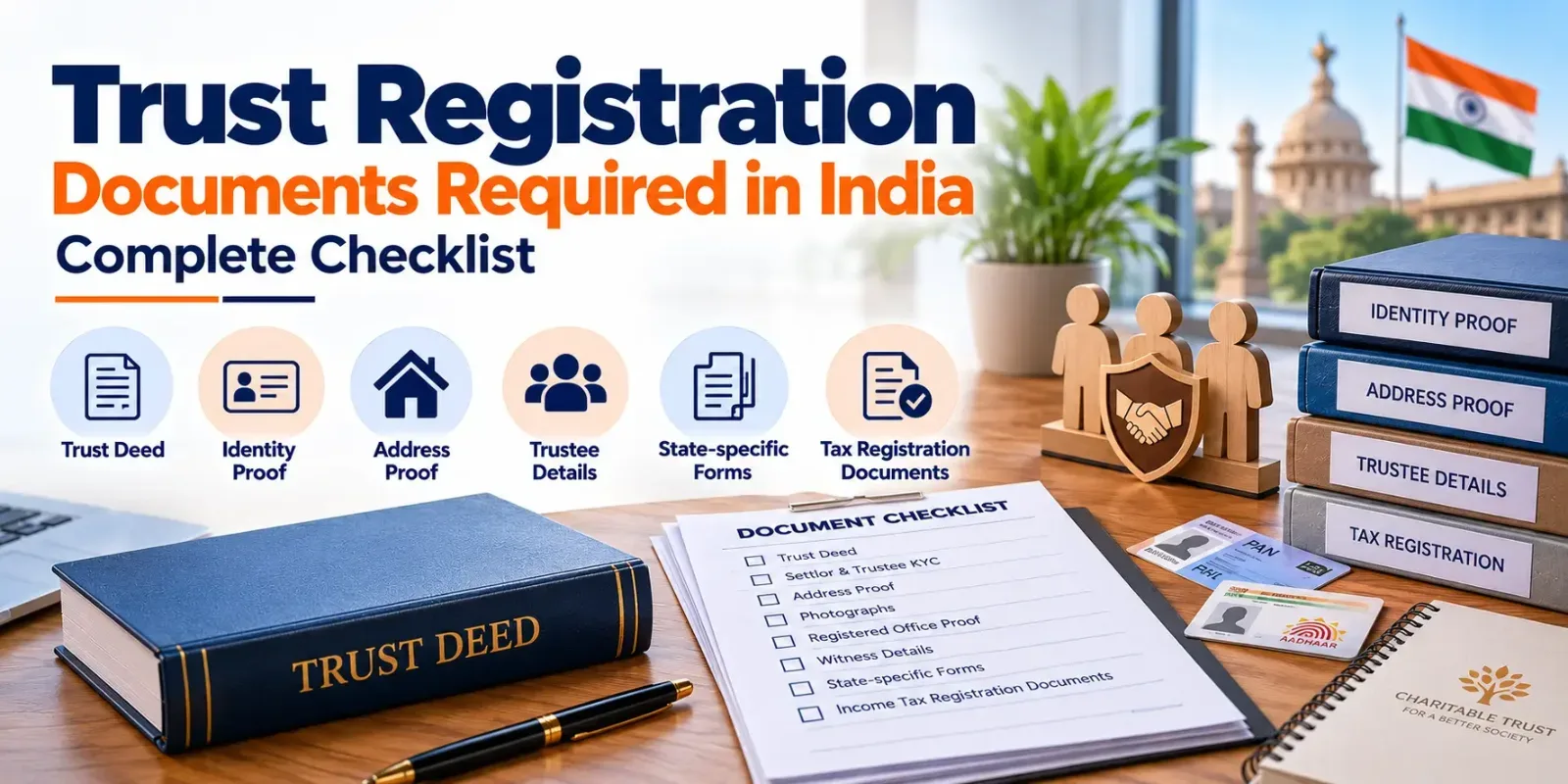
In general, you will need the trust deeds, identity and address proof of the settlor and trustees (passport-size photographs of each), proof of registered office address, and details of the witnesses to register a trust in India. Based on the type of trust and state, additional affidavits, consent letters, property documents, and forms may be necessary. Different Tax Registration Document Checklists.
Quick Summary
- A properly drafted trust deed is the primary document for most trust registrations.
- Identity and address proofs of the settlor and trustees are commonly required.
- The registered office requires address evidence and, where applicable, the property owner's No Objection Certificate (NOC).
- Witness identity documents and photographs may be requested by the registering authority.
- Public charitable trusts may need additional documents under the applicable state public trust law.
- Trust registration and income tax registration under Section 12AB are separate processes.
- Form 10A or Form 10AB may apply to income tax registration, depending on the circumstances.
- Stamp duty, registration fees, application forms, and filing procedures vary by state.
- Preparing a complete checklist before applying can reduce delays and objections.
What Is Trust Registration in India?
Trust registration involves the registration of the trust deed and also where applicable registration of the trust with the competent authority. Trusts may be established for charitable, religious, educational, medical, social welfare or private purposes.
The process depends on the objective of the trust, the nature of the trust asset, and the jurisdiction used to form the trust. Public charitable trusts may be governed by the law of public trusts of the concerned state while the other may be governed by Indian Trusts Act, 1882, Registration Act, 1908, etc.
The Indian Trusts Act, 1882, is applicable only to private trusts and trustees and does not govern certain public or private religious and charitable endowments. Therefore, they need to select an appropriate legal framework before drafting registration papers.
Official reference: India Code – The Indian Trusts Act, 1882.
Trust Registration Documents Required: Complete Checklist
The exact document list varies by state and trust category. The following checklist covers documents commonly requested during the creation and registration of a trust.
Trust Deed
The trust deed is the foundational document that records the creation, purpose, governance, and administration of the trust.
It generally includes:
- Proposed name of the trust.
- Registered office address.
- Names and details of the settlor and trustees.
- Main charitable, religious, educational, or other lawful objectives.
- Initial trust property or corpus, where applicable.
- Powers, duties, and responsibilities of trustees.
- Rules for appointing or replacing trustees.
- Procedures for conducting meetings and making decisions.
- Rules governing the use of trust funds and property.
- Provisions concerning amendments and dissolution, where appropriate.
The deed should define how the trust will operate and where trust assets will be applied. If the trust is a charitable trust and is seeking tax benefits, then the objects and relevant clauses need to be carefully examined to ensure that they are in accordance with the relevant tax provisions.
The value of the stamp paper on which the deed is to be executed is generally guided by the applicable state law. The requirement of registration and notarization will depend upon the nature of the deed, property and law.
Identity Proof of the Settlor and Trustees
The registering authority may require identity documents for the person creating the trust and its trustees.
Commonly accepted documents include:
- Aadhaar card, where accepted.
- PAN card.
- Passport.
- Voter ID.
- Driving licence.
- Other government-issued identity documents accepted by the authority.
Confirm the permitted documents with the relevant state authority before filing. Ensure that names, spellings, and other particulars match the trust deed and application form.
Address Proof of the Settlor and Trustees
Address proof helps establish the residential details of the individuals involved in the trust.
Depending on the authority's requirements, acceptable documents may include:
- Aadhaar card, where accepted.
- Passport.
- Voter ID.
- Driving licence.
- Recent utility bill.
- Bank statement or other officially accepted address evidence.
Check whether the authority requires current address proof, self-attested copies, or certified copies.
Passport-Size Photographs
Recent passport-size photographs of the settlor and trustees may be required for the application or supporting records.
Keep clear photographs available in both digital and physical formats if the registration procedure involves online uploads and physical document submission.
Registered Office Address Proof
A trust generally needs a clearly identified office address for official correspondence and administration.
Commonly used documents include:
- Electricity bill or other accepted utility bill.
- Property tax receipt.
- Ownership document or other acceptable property evidence.
- Rent or lease agreement, where applicable.
- No Objection Certificate from the property owner, if the premises are rented or used with permission.
The required combination depends on the registering authority. If the trust operates from a residential property, confirm whether residential premises are acceptable and whether the owner must provide written consent.
Identity Proof of Witnesses
Witnesses may be required when executing the trust deed or completing registration formalities.
Keep the following ready, where applicable:
- Names and addresses of witnesses.
- Identity proof of each witness.
- Signatures in the prescribed places.
- Photographs or additional details if required by the registering office.
Confirm the required number of witnesses and whether their physical presence is necessary.
Trustee Consent Letters and Affidavits
Some authorities may require written consent from trustees accepting their appointment. An affidavit or declaration may also be required to verify particular information in the application.
These documents are not universally required in the same format across India. Use the forms prescribed by the relevant authority rather than relying on a generic template.
Initial Corpus and Property Documents
If money, land, a building, or other assets are settled on the trust, supporting records may be necessary.
Depending on the circumstances, these may include:
- Details of the initial corpus.
- Evidence of transfer or settlement of assets.
- Property ownership documents.
- Property valuation or other prescribed particulars.
- Additional documents relating to immovable property.
Where immovable property is involved, obtain legal advice on applicable stamp duty, registration, and transfer requirements before executing the deed.
State-Specific Application Forms
Some states have dedicated procedures for registering public charitable trusts. The relevant authority may require prescribed application forms, schedules, affidavits, declarations, court-fee stamps, or other supporting documents.
For example, the Maharashtra Charity Commissioner publishes information about public trust registration under the Maharashtra Public Trusts Act, 1950.
Official reference: Maharashtra Charity Commissioner – FAQs.
Always check the official portal or office of the authority responsible for your state and jurisdiction.
Trust Registration Documents for Income Tax Registration
Registering a trust with a state authority and obtaining registration for income tax purposes are different processes.
A charitable or religious trust seeking applicable income tax exemptions may need to apply under Section 12AB of the Income-tax Act, 1961. The applicable application form and supporting documents depend on the trust's circumstances.
The Income Tax Department identifies the following documents for relevant applications made in Form 10A:
- A self-certified copy of the instrument creating the trust, such as the trust deed.
- If the trust was created without an instrument, a self-certified copy of the document evidencing its creation.
- A self-certified copy of registration with the appropriate authority, where applicable.
- Documents evidencing the adoption or modification of the trust's objects, if any.
- Annual accounts for relevant preceding years, where applicable, subject to the prescribed limits.
- A note describing the trust's activities.
- Copies of existing registration orders under the relevant provisions, where applicable.
- Copies of previous rejection orders, where applicable.
The precise requirements depend on the application category and the trust's registration history. Form 10AB may be applicable in certain circumstances, so the form should be selected according to the current rules rather than assumed to be the same for every trust.
Official references:
- Income Tax Department – Trust Taxation and Registration
- Income Tax Department – Rule 17A
- Income Tax Department – Form 10A
Trust Registration: Documents at a Glance
| Document | Trust deed or state registration | Income tax registration |
|---|---|---|
| Trust deed or creation instrument | Generally central to the process | Required where applicable |
| Settlor and trustee identity proof | Commonly requested | Details and supporting documents depend on the form |
| Residential address proof | May be requested | Information may be required in the application |
| Registered office proof | Commonly requested | Address details and supporting evidence may be required |
| Witness identity proof | May be required during execution | Not a universal standalone requirement |
| Trustee consent letters | State-specific | May be requested if relevant |
| Initial corpus or property records | Depends on the trust and assets | May be relevant to activities, accounts, or verification |
| Registration certificate | Issued after successful registration, where applicable | May be required if already obtained |
| Previous annual accounts | Not always required at formation | Relevant for existing trusts where prescribed |
| Activity note | Not always required at formation | Relevant to applicable tax registration applications |
This table is a general guide, not a universal list. The competent authority's current checklist takes precedence.
Trust Registration: Step-by-Step Document Preparation Process
Identify the Type of Trust
Determine whether the proposed trust is private, public charitable, religious, or established for another purpose. This helps identify the relevant legal framework and registration authority.
Confirm the State Requirements
Check the applicable state legislation, registration office, prescribed forms, stamp duty, and filing requirements. Do not rely solely on a checklist prepared for another state.
Draft and Review the Trust Deed
Include the trust's objects, trustees' details, governance rules, assets, and other necessary provisions. Ensure that the deed reflects the actual intentions of the settlor and complies with applicable law.
Collect Personal and Address Documents
Prepare identity proofs, address proofs, photographs, witness details, and trustee consent letters where required. Check that all names and addresses match across the documents.
Arrange Registered Office Evidence
Collect the appropriate ownership or occupancy documents. Obtain the property owner's NOC if required, especially where the trust operates from rented or shared premises.
Execute the Deed and Complete Formalities
Execute the trust deed according to applicable stamp and registration requirements. Arrange witnesses and supporting declarations as prescribed. If property is being transferred, confirm the additional legal formalities before execution.
Submit the Application
File the application with the appropriate authority, along with the required documents and prescribed fees. Follow the applicable online or physical submission procedure.
Respond to Objections or Queries
The authority may request clarification, additional documents, or corrections. Respond within the prescribed time and retain copies of the submission and acknowledgement.
Apply Separately for Relevant Tax Registrations
After establishing the trust, assess whether it needs a PAN, registration under Section 12AB, approval under Section 80G, or other registrations relevant to its activities. Each process has its own eligibility conditions and documentation requirements.
Common Mistakes to Avoid During Trust Registration
Using an incomplete trust deed: Missing objectives, unclear trustee powers, or inadequate governance provisions can create legal and administrative difficulties.
Submitting inconsistent details: Differences in names, addresses, dates, or signatures across forms and supporting documents may trigger objections.
Ignoring state-specific requirements: Stamp duty, forms, fees, and procedures can vary by state. A checklist used elsewhere may not be sufficient.
Providing inadequate office proof: A utility bill alone may not establish lawful use of the premises if the authority also requires an ownership document, lease, or NOC.
Confusing trust registration with tax registration: A state registration certificate does not automatically grant income tax exemption or approval under Section 80G.
Using outdated forms: Check the official authority's current application forms and instructions before submission.
Failing to retain records: Keep the executed deed, filed application, payment receipt, acknowledgement, registration certificate, and correspondence in a secure place.
Expert Advice from TaxCaller
At TaxCaller, we are believers in being prepared and encourage you to make a folder of documents before signing up. Maintain separate sections for trust deed, KYC of settlor and trustee, proof of office address, witness details, property records, and state-specific forms.
If seeking registration for a charitable or religious trust, carefully consider tax obligations, before, not after, registration. The trust's objects and registrations and exemptions should be reflected in the governing clauses of the trust as well as in the accounting records and actual activities of the trust.
Professional review is especially beneficial if the trust includes real property, multiple trustees, operates in multiple states, or intends to seek tax exemptions and donor benefits.
TaxCaller can also help businesses and organizations explore related services:
The appropriate service depends on the trust's structure, activities, and compliance needs.
Conclusion
One of the most important things you can do in Trust Registration in India is to prepare the correct documents. Having the right trust deed and KYC documents, proof of office address, and state-specific forms will help minimize errors and delays in Trust Registration.
The checklist differs across trusts and states, so applicants should look up the latest checklist of the relevant authority. Charitable and religious trusts will also have to register and comply with income tax separately. TaxCaller can help you understand what documentation and compliance requirements are required of your organization.