Company Registration in India: Choose and Register Online
Company registration online for Pvt Ltd, OPC, LLP and other structures, with structure advice, DSC, name approval, SPICe+ filing, PAN and TAN handled by our tax experts.
Content updated 15 Nov 2026 · Verified by expert 24 Oct 2026
Pay 38% to start the work. Pay the balance only after the government proof (the CIN for your company) is issued.
PAY NOW · 38%₹874
AFTER GOVT PROOF (CIN)₹1,425balance
!New company?File INC-20A within 180 days of incorporation
Since 2018Trusted Experience
980+Experts Connected
220+Cities Served
1164+Agents Available
12000+Founders Trusted
S
Srishti Magoo
★★★★★
Excellent experience with TaxCaller for filing my &
my family members ITR returns. The entire process was
smooth, quick and hassle-free. They are professional,
knowledgeable and guided me through every step with patience.
O
obeid sait
★★★★★
The team has handled my taxes for the past three years,
and it's been a wonderful, hassle-free experience.
Thank you for your consistently quick and efficient service.
P
Pushkar
★★★★★
They are among the best in their field. Their work culture
is highly professional, and their client service is smooth
and reliable. They can confidently be relied on to get the job done.
P
Prasad Sheth
★★★★★
Excellent experience with TaxCaller! The ITR filing
process was smooth, quick, and completely hassle-free.
The CA was knowledgeable, responsive, and explained everything clearly.
A
Apoorv Bansal
★★★★★
Excellent service for ITR filing. The team was highly
professional, responsive, and guided me through the entire
process smoothly. My return was filed accurately and on time.
A
Abhishek Kumar
★★★★★
I was searching for a good CA firm in Ghaziabad and found
TaxCaller. The experience was excellent from start to finish.
The team is responsive, transparent, and genuinely helpful.
U
uma pandey
★★★★★
Great service! TaxCaller India made the entire ITR filing
process quick, smooth, and hassle-free. They answered all
my queries patiently and ensured maximum accuracy.
T
tanu mittal
★★★★★
Excellent job! We've been connected for many years,
and your success truly makes me happy. You are an
incredibly intelligent person. Keep shining, keep growing.
B
Bhanu Pratap Maurya
★★★★★
I am filing my ITR since past 3 years with Abhinav and
Firm is known as TaxCaller and they are professional
interms of ITR rules. They will explain and tell you all
the information.
A
ashish Sharma
★★★★★
I am providing my honest reviews:
No.1 service ...
A
AARYAN GROUP
★★★★★
Honestly, finding a good CA firm in Ghaziabad was
confusing, but TaxCaller India made it simple.
I contacted them for GST work and the experience was smooth.
N
News Speaks
★★★★★
If you're looking for a reliable CA firm in Ghaziabad,
TaxCaller India is a great choice. They provide complete
taxation and compliance solutions including GST.
A
Anshul Chaprana
★★★★★
Got my GST registration done through TaxCaller CA firm.
Process was quite smooth, they guided properly on documents
and didn't waste time. Overall good experience.
Turnaround
24 hours
How we work
Online · Call · WhatsApp
Quick answer
Company registration in India means incorporating your business with the Ministry of Corporate Affairs through the online SPICe+ form. Most founders choose a Private Limited Company, which needs two directors, two shareholders and an office address. It usually takes 7 to 15 working days. TaxCaller's Pvt Ltd fee starts at ₹3,999 + GST; government fees are extra.
Reviewed by Abhinay Rai · Updated 15 Nov 2026
Most chosen Company Registration options
Starting fee of each option. Open any card to see every plan, documents and steps.
Most Popular
Private Limited Company
Private limited company registration through SPICe+, with DSC, DIN, name approval, MoA, AoA, PAN and TAN handled online…
₹3,999+ GST
+ Govt. fee and stamp duty at actual
Pay now (38%)₹1,520+ GSTAfter the CIN₹2,479+ GST
Handled by a TaxCaller Expert Company Registration Expert
Company registration is the legal process of incorporating your business with the Ministry of Corporate Affairs (MCA) under the Companies Act, 2013. Once the Registrar approves your application, the business becomes a separate legal person. It gets its own name, Corporate Identity Number (CIN), PAN and TAN. It can own property, sign contracts, open a bank account and raise money in its own name.
Before you register, you must choose a structure. India offers nine common options: Private Limited Company, One Person Company, LLP, partnership firm, sole proprietorship, Section 8 company, public limited company, society and trust. A few special forms, such as Nidhi and producer companies, also exist. Each has different rules for owners, liability, tax and yearly filings. This page compares all of them, explains the common MCA process and links to a detailed guide for each type.
TaxCaller has worked with founders since 2018. Our tax experts help you pick the right structure, check your documents, file the forms and follow up with the Registrar until your certificate is issued. The work is done online, so you can register from any city in India.
Complete guide
Choose a topic to open it. Every answer gives the rule or section it comes from.
01 Topic 1 of 20
What Is Company Registration in India and Why It Matters
Section 7 of the Companies Act, 2013 lays down how a company is incorporated. The founders file documents and declarations with the Registrar of Companies (ROC). New applications are processed centrally by the Central Registration Centre (CRC) of the MCA. When the Registrar is satisfied, it issues a Certificate of Incorporation. From that date, the company exists in law.
People also use "company registration" loosely for any business registration. Strictly, only companies and LLPs are registered with the MCA. Firms, societies and trusts are registered under state offices, and a proprietorship has no registration of its own. We cover all of them below so you can compare before deciding.
Key terms you will see
SPICe+ (Form INC-32): the MCA web form used to reserve a name and incorporate a company. Part A covers the name. Part B covers incorporation.
DIN / DPIN: the identity number of a company director or an LLP designated partner.
MoA and AoA: the Memorandum of Association (name, objects, capital) and the Articles of Association (internal rules) of a company.
CIN / LLPIN: the unique identity number of a company or an LLP.
Benefits of registering your business
Separate legal entity: a company or LLP owns assets and signs contracts in its own name.
Limited liability: owners are not personally liable for business debts in normal cases.
Perpetual succession: the entity continues even if an owner exits or dies.
Funding: a company can issue shares, ESOPs and convertible notes to raise money.
Credibility: clients, banks and payment gateways can verify you on official records.
Government schemes: DPIIT startup recognition, tenders and many state schemes need a registered entity.
Name protection: no other company or LLP can register the same or a too-similar name.
The MCA's own SPICe+ guide calls it an integrated web form offering ten services from three central bodies and two states. Related reforms, such as the nil fee for small capital and the combined Section 8 licence, are listed on the MCA ease of doing business page.
Who approves your registration
Companies and LLPs are approved by the Central Registration Centre of the MCA. Firms and societies go to the state Registrar, and trust deeds to the Sub-Registrar. A proprietor has no approving office and relies on Udyam, GST and local licences instead.
Company Registration Types Compared: Which Structure Fits You?
The table below compares all nine structures on the points founders ask about most. Read it with the short guide that follows.
Structure
Law
Owners
Liability
Registered with
Private Limited Company
Companies Act, 2013
2 to 200 members, 2 to 15 directors
Limited
MCA (SPICe+)
One Person Company
Companies Act, 2013
1 member plus a nominee
Limited
MCA (SPICe+)
LLP
LLP Act, 2008
2 or more partners
Limited to contribution
MCA (FiLLiP)
Partnership Firm
Indian Partnership Act, 1932
2 to 50 partners
Unlimited
State Registrar of Firms (optional)
Sole Proprietorship
No separate law
1 owner
Unlimited
No central registry
Section 8 Company
Companies Act, 2013, Section 8
2 or more members
Limited
MCA (SPICe+ with licence)
Public Limited Company
Companies Act, 2013
7 or more members, 3 or more directors
Limited
MCA (SPICe+)
Society
Societies Registration Act, 1860 or state Act
7 or more members
Property vests in the governing body
State Registrar of Societies
Trust
Indian Trusts Act, 1882 or state trust law
Settlor and trustees
Trustees answer for breach of trust
Sub-Registrar or state charity office
Structure
Compliance level
Cost approach
Income tax
Good fit for
Private Limited
High: audit, AGM, MCA returns
Nil MCA fee up to ₹15 lakh capital, plus state stamp duty and DSCs
22% option or normal company rates
Startups, investors, ESOPs
OPC
Medium: audit, no AGM
Same approach as Pvt Ltd
Company rates
Solo founders
LLP
Low to medium: two yearly forms
MCA fee by contribution, plus stamp duty on agreement
30% flat plus surcharge and cess
Consultants, agencies, professionals
Partnership
Low: income tax only
Stamp duty on deed plus a small state fee
30% flat plus surcharge and cess
Small family or trading businesses
Proprietorship
Lowest
Free Udyam and GST registrations
Owner's slab rates
Freelancers, small shops
Section 8
High, plus licence conditions
MCA fee as per the fee rules, plus stamp duty
Exemption possible as a charitable body
NGOs wanting company form
Public Limited
Highest
Name fee, stamp duty by capital, 3 or more DSCs
Company rates
Large firms, future IPO
Society
Medium: yearly list to Registrar
State Registrar fee
Exemption possible as a charitable body
Schools, clubs, associations
Trust
Low to medium
Stamp duty on deed plus registration fee
Exemption possible as a charitable body
Charity, religious work, family assets
How to choose in five questions
Is it for profit? If not, look at a Section 8 company, society or trust.
Will you raise equity or give ESOPs? Choose a Private Limited Company.
Are you alone? An OPC gives limited liability. A proprietorship is cheaper but carries personal risk.
Are you two or more professionals with no investor plans? An LLP is usually enough.
Do you want to raise money from the public or list later? Plan for a public limited company.
When registration becomes necessary
No law forces every business to be a company. But to work as a company, registration under the Companies Act is compulsory. Using "Limited" or "Private Limited" without it is an offence under Section 453. Many clients, marketplaces and tenders also ask for a registered entity. If you are unsure, start with a free call and our expert will compare costs for your case.
Shreya Company Registration Expert
Have a question on this topic? Ask Shreya on a free call.
Private Limited Company: For Startups and Growing Businesses
A Private Limited Company is the most common choice for founders who want to grow. It is defined in Section 2(68) of the Companies Act, 2013. It needs at least two shareholders and two directors, and can have up to 200 members. At least one director must stay in India for 182 days or more in the financial year, under Section 149(3).
Shares make ownership clear. You can bring in co-founders, angel investors and venture funds, and you can give ESOPs to staff. There is no minimum paid-up capital. Most founders start with ₹1 lakh authorised capital, which keeps the MCA filing fee at nil.
The trade-off is compliance. Every Pvt Ltd company needs a yearly audit, board meetings, an AGM and filings in AOC-4 and MGT-7 or MGT-7A, even with zero turnover. It must also file INC-20A within 180 days of incorporation. A domestic company can choose a flat 22% income tax rate (plus surcharge and cess) by giving up most deductions.
Choose it if: you plan to raise money, hire a team or build a brand that outlives the founders.
A One Person Company lets a single founder enjoy limited liability. It is defined in Section 2(62) and allowed by Section 3(1)(c) of the Companies Act, 2013. It has one member and at least one director. The member must name a nominee, who takes over the company if the member dies or becomes incapable.
Only a natural person who is an Indian citizen can form an OPC, whether resident in India or not. A person can form only one OPC. An OPC cannot be set up for charitable work under Section 8, and it cannot do non-banking finance investment activity.
Since a 2021 amendment to the Companies (Incorporation) Rules, an OPC no longer has to convert when its capital or turnover grows. You can convert it into a Private Limited Company whenever you add partners. An OPC does not need to hold an AGM, and one board meeting in each half of the year is enough under Section 173(5). It still needs a yearly audit and MCA returns.
OPC or Pvt Ltd? An OPC keeps one owner in full control with fewer meetings. You need a Pvt Ltd company once a co-founder, angel investor or ESOP pool comes in. Yearly costs are close, so the choice mostly turns on your ownership plans.
Choose it if: you are a single founder who wants company status and protection of personal assets.
Limited Liability Partnership (LLP): For Professional Firms
An LLP mixes the flexibility of a partnership with the limited liability of a company. It is governed by the Limited Liability Partnership Act, 2008. It needs at least two partners, with no upper limit. At least two designated partners must be individuals, and at least one of them must be resident in India, under Section 7. An LLP is a body corporate under its own Act. It is not a company under the Companies Act, and it cannot issue shares.
An LLP is incorporated on the MCA portal through the FiLLiP form. Partners then sign an LLP agreement that sets out capital, profit sharing and duties. The agreement is filed in Form 3 within 30 days of incorporation. Partners are liable only up to their agreed contribution, except in cases of fraud.
Yearly compliance is lighter than a company. An LLP files an annual return in Form 11 and a statement of accounts in Form 8. Audit is needed only when turnover crosses ₹40 lakh or contribution crosses ₹25 lakh, under Rule 24(8) of the LLP Rules, 2009. An LLP pays income tax at a flat 30% plus surcharge and cess.
Choose it if: you run a consultancy, agency or professional practice with partners and no plan to raise equity.
Partnership Firm or Sole Proprietorship: Low-Cost Starts
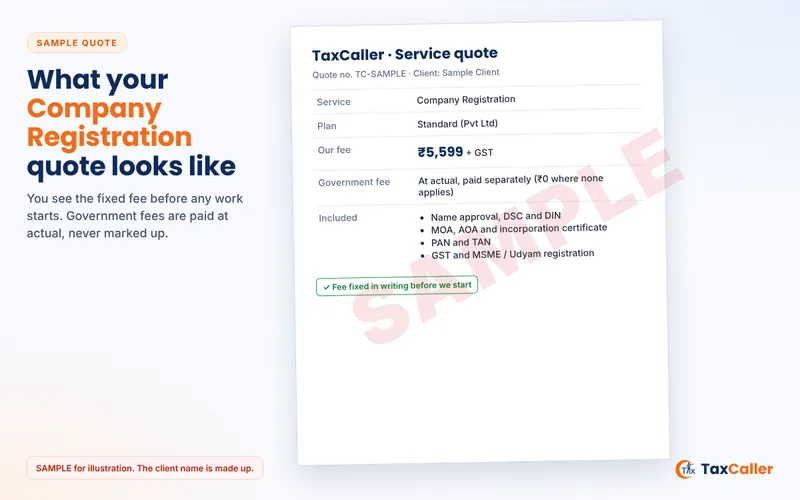
Company Registration: SAMPLE quote, for illustration only
Both forms are quick and cheap to start, and neither is registered with the MCA. The owners carry unlimited personal liability, so they suit low-risk businesses.
Partnership firm
Two or more people who share business profits form a partnership under the Indian Partnership Act, 1932. The cap is 50 partners, under Rule 10 of the Companies (Miscellaneous) Rules, 2014. The partnership deed records capital, profit share and duties. It is stamped under your state stamp law.
Registration with the state Registrar of Firms under Section 58 is optional, but skipping it is risky. Section 69 stops an unregistered firm from suing a third party to enforce a contract. Each partner is liable jointly and severally for all firm debts. The firm has its own PAN and pays a flat 30% tax plus surcharge and cess. Read more on Partnership Firm Registration.
Sole proprietorship
A proprietorship is one person trading in his or her own name. No separate law or certificate exists, and profits are taxed at the owner's slab rates. The business is proved through other registrations: Udyam (MSME), GST, a shop and establishment licence and a current account. Udyam carries no government fee on the official Udyam portal.
Personal assets are at risk if the business owes money, and the business ends with the owner. Growing owners usually move to a Pvt Ltd company or an LLP later. Read more on Sole Proprietorship Registration.
Choose one if: you are a freelancer, shop or family business testing an idea, with low risk and no investor plans.
A Section 8 company is formed to promote commerce, art, science, sports, education, research, social welfare, religion, charity, environment protection or similar objects. It is governed by Section 8 of the Companies Act, 2013. Its profits must be used only for its objects. It cannot pay any dividend to its members.
The licence and incorporation are now combined in the SPICe+ form, as the MCA notes. A private Section 8 company needs at least two members and two directors. It does not need to use "Limited" in its name. There is no minimum capital.
Compliance is close to a Pvt Ltd company: yearly audit, board meetings, AGM and MCA returns. The licence comes with conditions. If they are broken, the licence can be revoked. For tax exemption, the company must also register with the Income Tax Department as a charitable body.
Compared with a society or trust, a Section 8 company is seen as more transparent. Its filings are public on the MCA portal. That helps when you apply for CSR funds from companies.
Choose it if: you run an NGO that wants corporate governance and access to CSR funding.
Public Limited Company: For Large Shareholder Bases
A public limited company is a company that is not private. It needs at least seven members, under Section 3(1)(a), and at least three directors, under Section 149(1). There is no upper limit on members. Its name must end with "Limited".
The key difference is that a public company can invite the public to buy its shares and debentures. Its shares are freely transferable. It can list on a stock exchange after meeting SEBI rules. There is no minimum paid-up capital under the Companies Act today.
In return, compliance is the heaviest of all structures. Some public companies must appoint independent directors, a company secretary and committees, depending on size. Rules on related party deals, loans to directors and public deposits are stricter. Most small businesses start as a Pvt Ltd company and convert to public later, when they plan an IPO.
Choose it if: you need many shareholders, plan to list or have a business that must be a public company by regulation.
Nidhi, Producer and Foreign-Owned Companies: Special Cases
Three less common forms also register through SPICe+. Each has extra conditions, so we confirm scope and fee on a call before starting.
Nidhi company
A Nidhi is a public company that borrows from and lends only to its members, to build a saving habit. It is governed by Section 406 of the Companies Act and the Nidhi Rules, 2014. It needs at least seven members and three directors at the start. Within 120 days of incorporation, with 200 members and net owned funds of ₹20 lakh, it applies in Form NDH-4 to be declared a Nidhi (Nidhi Amendment Rules, 2022). It cannot take deposits from the public or run chit fund, hire purchase or insurance business.
Producer company
A producer company is owned by farmers, artisans or other primary producers. Its rules sit in Chapter XXIA of the Companies Act, 2013, added by the Companies (Amendment) Act, 2020. Ten or more individual producers, or two or more producer institutions, can form one. Members share the surplus based on the produce they supply. It is the usual form for farmer producer organisations.
Indian subsidiary of a foreign company
A foreign company usually enters India through a wholly owned Pvt Ltd subsidiary, using the same SPICe+ process. It needs at least two directors, and one must have stayed in India for 182 days or more in the year (Section 149(3)). The investment must fit the sector rules of the FDI policy. Shares issued to the parent are reported to the RBI in Form FC-GPR within 30 days of allotment. A branch or liaison office is a different route and files Form FC-1 with the MCA within 30 days of opening.
Many non-profits register under state law instead of with the MCA. Both forms can seek income tax exemption by registering with the Income Tax Department as a charitable body. Their filings are not on the MCA portal.
Society
Seven or more persons with a literary, scientific, charitable or similar aim can form a society under the Societies Registration Act, 1860. They sign a memorandum and rules and file them with the state Registrar of Societies. Many states have their own society Acts or amendments, so fees and forms vary.
Members elect a governing body, and the society's property vests in that body under Section 5. Under Section 6, the society sues or is sued in the name of its president, chairman or principal secretary. Section 4 needs a yearly list of governing body members to be filed with the Registrar. See Society Registration.
Trust
In a trust, a settlor hands property to trustees for a purpose or for named beneficiaries. Private trusts follow the Indian Trusts Act, 1882. Public charitable trusts follow state law in some states, such as Maharashtra, and a registered deed elsewhere. Under Section 5 of the Trusts Act, a trust of immovable property needs a registered written document or a will.
The deed names the settlor, trustees and objects, and sets out how trustees change. Stamp duty depends on the state. With no yearly MCA-style review, a few trustees keep tight control. See Trust Registration.
Choose a society for a member-run school, club or welfare group with elections. Choose a trust for a charity, religious body or family trust run by a small, stable board.
The name is often the slowest step, and capital choices are hard to undo. Settle both before filing.
Name rules in plain words
A Pvt Ltd name ends with "Private Limited" and a public company with "Limited". An OPC adds "(OPC)" before "Private Limited". An LLP name ends with "LLP".
The name must not match, or come too close to, an existing company, LLP or registered trademark (Section 4 and Rules 8, 8A and 8B of the Companies (Incorporation) Rules, 2014).
Adding a plural, a space, "the" or a different tense does not make a name new.
Offensive names, and names that suggest a link with the government, are refused.
Words such as Bank, Insurance, Stock Exchange or Mutual Fund need a declaration that the regulator's rules are met. Words such as National, Board or Authority need Central Government approval.
The name should hint at your real activity. A "Technologies" name for a trading firm invites a query.
SPICe+ Part A lets you propose up to two names in one application.
Before filing, search MCA records and the trademark register on the IP India website. A company name and a brand name are not the same thing in law.
Share capital decisions before filing
Authorised capital: the ceiling of shares the company may issue. Keeping it at ₹15 lakh or less keeps the MCA filing fee at nil.
Subscribed capital: the shares the founders actually take. ₹1 lakh is common, and it can be lower.
Face value: usually ₹10 a share. Some founders pick ₹1 so small stakes are easy to give later.
Founder split: agree it before filing. Changing it later needs a share transfer with stamp duty, or a fresh allotment.
Founder protections: vesting, right of first refusal and lock-in clauses can sit in the AoA or a founders' agreement.
Share money: subscribers pay into the company bank account. The INC-20A declaration needs proof of this.
Shadab Company Registration Expert
Have a question on this topic? Ask Shadab on a free call.
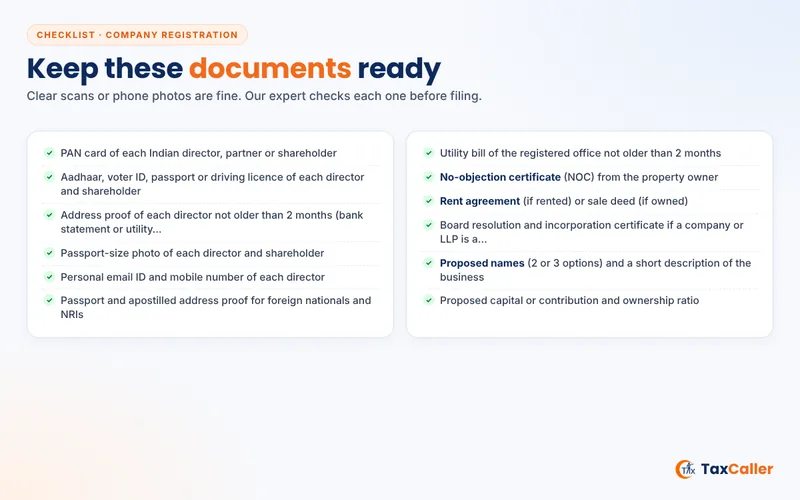
The list below covers a Pvt Ltd company, OPC, public company and Section 8 company. LLPs need almost the same set. Firms, societies and trusts need ID and address proofs of partners or members, plus their deed or memorandum. Each child guide has its exact list.
For each Indian director and shareholder
PAN card (compulsory for Indian nationals)
Aadhaar, or another ID such as voter ID, passport or driving licence
Address proof not older than 2 months: bank statement, electricity, phone or mobile bill
Passport-size photo
Personal email ID and mobile number (each director needs their own)
For foreign nationals and NRIs
Passport (compulsory)
Address proof such as a bank statement, utility bill or residence card
Notarisation and apostille, or consular attestation, of these documents
Setting up a foreign-owned subsidiary? See the special cases section above for the extra steps.
For the registered office
Latest electricity, water, gas or phone bill, not older than 2 months
Company Registration: how the work moves, step by step
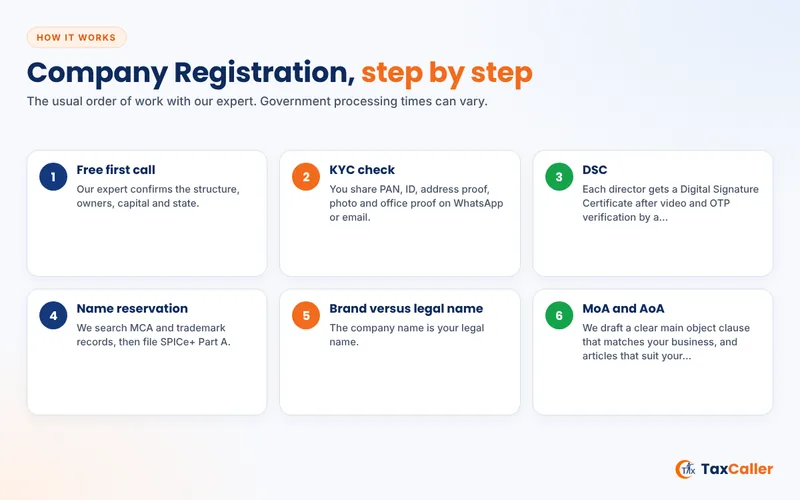
Companies (Pvt Ltd, OPC, public and Section 8) all use SPICe+. LLPs follow a similar path through FiLLiP. Here is how we file a company online. You do not need to visit any office.
Free first call: our expert confirms the structure, owners, capital and state. You get the full fee in writing before work starts.
KYC check: you share PAN, ID, address proof, photo and office proof on WhatsApp or email. We check names, dates and addresses for mismatches.
DSC: each director gets a Digital Signature Certificate after video and OTP verification by a licensed certifying authority.
Name reservation: we search MCA and trademark records, then file SPICe+ Part A. The fee is ₹1,000. The MCA states an approved name is valid for 20 days. Rule 9A of the Companies (Incorporation) Rules, 2014 allows extension to 40 days for ₹1,000 and to 60 days for a further ₹2,000.
Brand versus legal name: the company name is your legal name. Your brand or trade name can be different, but only a trademark protects it.
MoA and AoA: we draft a clear main object clause that matches your business, and articles that suit your shareholding.
SPICe+ Part B: we enter capital, office, subscribers and directors. DIN is allotted here to up to three proposed directors. INC-9 and DIR-2 are generated and signed.
AGILE-PRO-S: we add EPFO, ESIC, professional tax where your state levies it, a bank account request and GSTIN if you need it now.
Payment and filing: forms are signed with DSCs, and the fee and stamp duty are paid on the MCA portal. You get an SRN to track it.
Registrar queries: if the CRC asks for changes, we fix and refile within the time given.
Certificate: the Certificate of Incorporation (INC-11) arrives by email with the CIN, PAN and TAN. No paper copy is needed.
Bank account and handover: you open the current account and get our checklist for the first 180 days.
Can you register a company yourself?
A founder can create an MCA login and fill SPICe+ alone. But Section 7(1)(b) of the Companies Act needs a declaration from an advocate, chartered accountant, cost accountant or company secretary in practice who is engaged in the formation. Self-filers also lose most time on name objections and resubmissions.
Usual timeline for a Pvt Ltd company
Stage
Usual time
Documents and KYC check
Same day to 1 day
DSC issue
1 to 2 working days
Name approval
1 to 3 working days
Drafting and Part B filing
1 to 2 working days
CRC approval and certificate
3 to 7 working days
Total for a Pvt Ltd company
About 7 to 15 working days
How to read and verify a CIN
A CIN has 21 characters, for example U72900UP2026PTC123456. "U" means unlisted, the five digits are the industry code, "UP" is the state, "2026" is the year, "PTC" means private company and the last six digits are the registration number. Anyone can check a company by name or CIN in the free "View Company or LLP Master Data" service on the MCA portal.
The MCA's own SPICe+ walkthrough explains Part A, Part B and the linked forms in this MCA SPICe+ guide (PDF).
These amounts go to the government or to third parties. They are not part of TaxCaller's fee. We pay them at actual on your behalf and share every receipt.
SPICe+ filing fee, authorised capital up to ₹15 lakh
Nil
MCA
SPICe+ filing fee, capital above ₹15 lakh
As per the Table of Fees, based on capital
Companies (Registration Offices and Fees) Rules, 2014
Stamp duty on MoA, AoA and SPICe+
Varies by state and capital
State stamp law, paid on the MCA portal
PAN and TAN of the company
Small fees, included in the SPICe+ payment
MCA SPICe+ guide
LLP incorporation fee
Based on contribution, as per LLP fee rules
LLP Rules, 2009
Deeds for firms and trusts
State stamp duty plus registration fee
State stamp and registration laws
DSC for each director
Charged by the certifying authority
Market rate (2 included in our Pvt Ltd plans)
Why your state matters
Stamp duty: each state sets its own duty on the MoA, AoA, share certificates and deeds.
ROC jurisdiction: after incorporation, your company comes under the ROC of its state. Companies in Ghaziabad and Noida come under ROC Kanpur for Uttar Pradesh. Delhi and Gurgaon come under ROC Delhi, which covers Delhi and Haryana.
Professional tax: states such as Maharashtra, Karnataka and West Bengal levy it. Delhi and Uttar Pradesh do not.
Firms, societies and trusts: these are registered with state offices, so forms and fees differ by state.
Shifting state later: moving a company's registered office to another state needs Regional Director approval under Section 13.
For a typical startup with ₹1 lakh authorised capital, the MCA filing fee is nil. The main government cost is the name fee and state stamp duty. We tell you the exact figure for your state on the first call.
Shreya Company Registration Expert
Have a question on this topic? Ask Shreya on a free call.
TaxCaller's fee covers our professional work only, and it is always charged + GST. TaxCaller's fee is ₹3,999 + GST for the Basic Private Limited Company plan. Government fees (name fee, MCA filing fee if any, stamp duty, PAN and TAN fees, and state fees for deeds) are paid separately at actual. Nothing is added later without your approval.
Starting professional fee (+ GST), government fee extra
You can compare all options, with what each plan includes, in the cards above. Each guide then lists its higher plans in full.
Private Limited Company plans
Pvt Ltd plan
TaxCaller fee
What is included
Basic
₹3,999 + GST
Name approval, DSC for 2 directors, DIN, MoA and AoA, Certificate of Incorporation, PAN and TAN
Standard
₹5,599 + GST
Everything in Basic, plus GST registration, MSME (Udyam) registration and help opening a current account
Premium
₹7,199 + GST
Everything in Standard, plus ADT-1 auditor appointment filing and INC-20A commencement filing
Pay on Proof
On the Basic plan, you can pay 38% (₹1,520) to start the work. You pay the balance (₹2,479) only after the government issues your CIN.
When the fee can be higher
Starting fees assume a standard case. More than two directors, foreign directors or shareholders, capital above ₹15 lakh, or a Nidhi, producer company or foreign subsidiary need extra work. Our expert writes the exact fee for such cases before work starts. Government fees always stay separate. Yearly compliance such as ROC returns and bookkeeping is a separate service: see accounting and bookkeeping.
Compliance After Registration: What Each Structure Must File
Registration is the start. The table gives an overview of the main yearly duties. Each child guide covers them in detail.
Structure
Main yearly filings
Pvt Ltd, public, Section 8
Audit (Section 139), AGM (Section 96), AOC-4 within 30 days of AGM (Section 137), MGT-7 or MGT-7A within 60 days of AGM (Section 92), income tax return
OPC
Audit, AOC-4, MGT-7A, income tax return; no AGM
LLP
Form 11 (annual return), Form 8 (accounts and solvency), income tax return
Partnership, proprietorship
Income tax return; GST and TDS returns if registered
Society, trust
State filings such as the yearly governing body list; income tax return if registered for exemption
First 180 days for a new company
Registered office in place within 30 days of incorporation (Section 12(1)).
First board meeting within 30 days (Section 173(1)).
First auditor appointed by the board within 30 days (Section 139(6)).
Share certificates within 2 months (Section 56(4)(a)).
Commencement of business declaration INC-20A within 180 days (Section 10A).
Key penalties
Default
Penalty
Section
INC-20A not filed in time
Company ₹50,000; each officer ₹1,000 a day, up to ₹1,00,000
Section 10A(2)
No verified registered office
₹1,000 a day, up to ₹1,00,000, for the company and each officer
Section 12(8)
AOC-4 or MGT-7 late
Additional fee of ₹100 a day per form
Section 403
Annual return not filed
₹10,000 plus ₹100 a day; up to ₹2 lakh (company) and ₹50,000 (officer)
Section 92(5)
Financial statements not filed
₹10,000 plus ₹100 a day; up to ₹2 lakh (company) and ₹50,000 (officer)
Section 137(3)
Director KYC not filed
DIN deactivated; ₹5,000 to reactivate
Rule 12A, with the Fees Rules
Filings missed for 3 years
Directors disqualified for 5 years
Section 164(2)
Under Section 446B, OPCs, small companies and startup companies pay at most half of these penalties (not the additional fees), capped at ₹2 lakh for the company and ₹1 lakh for an officer. The ROC can strike off a company that does not start business within a year, under Section 248(1).
Most delays come from a short list of avoidable errors.
Wrong structure: starting as a proprietorship and then needing investors means a costly change later.
Weak name: a dictionary word or a name close to a known brand gets rejected.
Old address proof: bills older than two months are not accepted.
Owner mismatch: the NOC must be signed by the person named on the bill or deed.
Name spelling: PAN, Aadhaar and DSC must show the same name and date of birth.
Vague objects: the main object should describe your real business in plain words.
Regulated activity: lending, insurance or chit funds need regulator approval first.
Too much capital: high authorised capital raises stamp duty for no benefit.
Shared contact details: each director needs a personal mobile number and email.
No resident director: a board made only of people living abroad does not meet Section 149(3).
Forgetting INC-20A: founders often skip the bank deposit proof and face penalties.
Unregistered firm: partners skip registration and later cannot sue a defaulting client.
We check each of these before filing, so most of our files clear on the first or second submission.
Changing your structure later
OPC to Pvt Ltd: allowed at any time by altering the MoA and AoA and filing Form INC-6 (Rule 6, Companies (Incorporation) Rules).
Pvt Ltd to public: a special resolution and altered articles under Section 14. The company stays the same legal person, so its PAN and contracts continue.
Firm or company to LLP: a firm, private company or unlisted public company can convert under Sections 55 to 57 of the LLP Act, read with its Second to Fourth Schedules.
Firm to company: a firm can register as a company under Section 366 of the Companies Act.
Proprietorship to company or LLP: there is no direct route. The new entity takes over the business by agreement.
Each change costs fees, stamp duty and fresh registrations. Picking the right form at the start is cheaper.
Zubair Company Registration Expert
Have a question on this topic? Ask Zubair on a free call.
These official changes affect businesses registered in 2026. We follow the rules in force today and update this page when new ones are notified.
1. Director KYC moved to once in three years
The Companies (Appointment and Qualification of Directors) Amendment Rules, 2025 (G.S.R. 943(E), dated 31 December 2025) replaced the yearly DIR-3 KYC from 31 March 2026. Directors now file KYC once every three financial years, by 30 June. Any change in mobile, email or address must be updated within 30 days.
2. New Income-tax Act from 1 April 2026
The Income-tax Act, 2025 replaced the 1961 Act from 1 April 2026. It uses "tax year" in place of previous year and assessment year. The 22% option for domestic companies, earlier in section 115BAA, is in section 200 of the new Act from tax year 2026-27. Returns for financial year 2025-26 are still governed by the 1961 Act.
3. Revised startup definition
DPIIT notification G.S.R. 108(E), dated 4 February 2026, revised the startup definition. A Pvt Ltd company, LLP, registered partnership firm or eligible cooperative can be recognised for up to 10 years from incorporation, if turnover has not crossed ₹200 crore in any year. A new deep tech category can stay recognised for up to 20 years, with a ₹300 crore turnover limit.
4. Higher small company limits apply to 2026 filings
From 1 December 2025, G.S.R. 880(E) raised the small company limits to ₹10 crore paid-up capital and ₹100 crore turnover. In 2026, more companies can file MGT-7A, hold two board meetings a year and pay lower penalties under Section 446B.
5. Proposed incorporation reforms (draft)
In April 2026 the MCA published draft Companies (Incorporation) Amendment Rules, 2026 for public comment. The draft proposes DIN for up to five directors in SPICe+, no separate DIR-12 for first directors and optional EPFO and ESIC at incorporation. As of November 2026 we have not seen them notified as final rules. Until they are, the current three-DIN limit applies.
Your work is handled by experienced professionals who explain every step, check your documents and keep you updated.
Registered company
TaxCaller is run by TaxCaller India LLP (LLPIN AAQ-7388), serving clients since 2018.
Fee told upfront
You know the complete fee, our professional fee and the government fee, before any work starts. No hidden charges.
Support after the work
Notices, renewals, returns and compliance reminders: we stay with your business after the registration is done.
Reviewed By
Reviewed & Verified Company Registration
Abhinay Rai
Advocate
Abhinay Rai is a Advocate specialising in Company Registration. The process, documents, timelines and fees on this page are checked against the current rules and government portals, and updated whenever the law, forms or fees change.
What is company registration, and is it mandatory?
Company registration is incorporating your business with the MCA under the Companies Act, 2013, through the SPICe+ form. No law forces every business to become a company. You can trade as a proprietor or a firm. But to work as a Private Limited Company, or to use "Limited" in your name, registration is compulsory.
Can a salaried person become a director of a company?
In most cases, yes. Company law sets no bar on employees holding a directorship or shares. The usual limit is your employment contract. Many employers ask for prior approval or forbid outside business. Government staff generally need permission under their conduct rules. Check your appointment letter, and tell your employer if it requires you to.
How much does company registration cost in India?
Our starting fee depends on the structure: ₹1,299 + GST for a proprietorship, ₹2,999 + GST for an LLP and ₹3,999 + GST for a Private Limited Company. Government fees are separate. The MCA filing fee is nil for authorised capital up to ₹15 lakh. You still pay the ₹1,000 name fee and state stamp duty at actual.
How many days does it take to register a company?
A Private Limited Company usually takes about 7 to 15 working days once documents are complete. DSCs take one to two days and name approval one to three. CRC approval normally takes three to seven working days. Delays mostly come from name objections, old address proofs or late replies to Registrar queries.
Can I register a company alone, with no partner?
Yes. A single founder can register a One Person Company. You are the only member, and you name a nominee who takes over if something happens to you. Only an Indian citizen who is a natural person can form an OPC. You can convert it into a Private Limited Company later when partners join.
What is the minimum capital for a Private Limited Company?
There is no minimum paid-up capital for a Private Limited Company since the 2015 amendment to the Companies Act. Most founders start with ₹1 lakh authorised capital and shares of ₹10 each. Keeping authorised capital at ₹15 lakh or less avoids the MCA filing fee. You can increase it later through Form SH-7.
Can I use my home address as the registered office?
Yes. A residential address can be the registered office of a company or LLP. You need a recent electricity, water, gas or phone bill not older than two months. You also need a no-objection certificate from the owner. If the property is rented, add the rent agreement. You can shift to a commercial office later.
Can an NRI or foreign national register a company in India?
Yes. NRIs and foreign nationals can be directors and shareholders of an Indian Private Limited Company. At least one director must stay in India for 182 days or more in a financial year. Foreign documents must be notarised and apostilled. Share allotments to foreign investors must be reported to the RBI in Form FC-GPR.
Is GST registration mandatory for a new company?
No, a company does not need GST just because it is registered. GST becomes compulsory when turnover crosses the threshold, or for interstate supply of goods, e-commerce sales and some other cases. Many companies still apply early because clients want GST invoices. You can request a GSTIN through AGILE-PRO-S during incorporation itself.
Which is better for a startup: Pvt Ltd or LLP?
Choose a Private Limited Company if you plan to raise investment, offer ESOPs or grow fast. Investors prefer shares. An LLP suits professional firms and small partnerships that will not raise equity, because it has lighter audit and filing rules. Both give limited liability. Our expert can compare costs for your case on the call.
Do I need a professional to register a company, or can I do it myself?
You can make the MCA login and fill SPICe+ on your own. Even then, Section 7(1)(b) needs a declaration from a practising advocate, chartered accountant, cost accountant or company secretary engaged in the formation. Most founders also want help with the name, objects and drafts. Our expert prepares the full file for you.
How can I check whether my company is registered?
Search your company name or CIN in the free View Company or LLP Master Data service on the MCA portal. It shows the status, date of incorporation, capital, directors and filings. Your Certificate of Incorporation in Form INC-11 is also the official proof. It is a digitally signed PDF, and no paper copy is issued.
Can I convert my proprietorship or partnership into a company?
Yes. A proprietor can form a new Private Limited Company and transfer the business through a business transfer agreement. A registered partnership firm can convert directly under Part I of Chapter XXI of the Companies Act. Plan the transfer of GST, licences, bank accounts and contracts carefully. Our expert explains the steps on a call.
What happens if my company does no business after registration?
Compliance continues even with zero turnover. You still need an audit, AGM, AOC-4, MGT-7 and an income tax return every year. If the company does not start business within a year, or skips INC-20A, the ROC may strike it off under Section 248. A company can also apply for dormant status instead.
Do I need to visit any government office to register a company?
No. Company registration is fully online from start to finish. Directors complete DSC verification by video and OTP on their phones. All forms are signed digitally and filed on the MCA portal. The Certificate of Incorporation, PAN and TAN arrive by email. You only share scanned documents with us on WhatsApp or email.
Book a free call to pick the right structure and confirm your total cost. Fees start at ₹1,299 + GST for a proprietorship and ₹3,999 + GST for a Pvt Ltd, with government fees shown separately.