
GST on Bike 2026: 18% up to 350cc, 40% Above, EV 5%, HSN 8711
Government data: GST portal HSN directory and CBIC rate notifications. Rates as per 01/2026-Central Tax (Rate), 30 Apr 2026 (in force from 1 May 2026). Last checked 20 Nov 2026.
No code found for “Bike spare parts”
Try a simpler word (for example "shirt" instead of "cotton formal shirt"), the first 4 digits of the code, or switch between goods and services.
HSN codes and GST rates for bike
From the GST portal HSN list, with the rate from the current CBIC notification. Tap Copy to use the code on your invoice.
- 8711HSN18% or 40%
Motorcycles (including mopeds) and cycles fitted with an auxiliary motor, with or without side-cars;
- 18% Motorcycles (including mopeds) and cycles fitted with an auxiliary motor not exceeding 350 cc, with or without side-cars; side-cars
- 40% Motorcycles of engine capacity exceeding 350 cc
Special cases
- 5% Fuel Cell Motor Vehicles including hydrogen vehicles based on fuel cell technology
- 5% Electrically operated vehicles, including two and three wheeled electric vehicles. Explanation. - For the purposes of this entry, “Electrically operated vehicles” means vehicles which are run solely o
Notification 9/2025-CT(Rate), Schedule II, S. No. 546
- 8712HSN5%
Bicycles and other cycles (including delivery tricycles), not motorised
Special cases
- 5% Fuel Cell Motor Vehicles including hydrogen vehicles based on fuel cell technology
- 5% Electrically operated vehicles, including two and three wheeled electric vehicles. Explanation. - For the purposes of this entry, “Electrically operated vehicles” means vehicles which are run solely o
Notification 9/2025-CT(Rate), Schedule I, S. No. 456
- 8714HSN5% or 18%
Parts and accessories of vehicles of headings 8711 to 8713
- 5% Parts and accessories of bicycles and other cycles (including delivery tricycles), not motorised, of heading 8712
- 18% Parts and accessories of vehicles of heading 8711
Special cases
- 5% Fuel Cell Motor Vehicles including hydrogen vehicles based on fuel cell technology
- 5% Electrically operated vehicles, including two and three wheeled electric vehicles. Explanation. - For the purposes of this entry, “Electrically operated vehicles” means vehicles which are run solely o
Notification 9/2025-CT(Rate), Schedule I, S. No. 458
Quick answer
GST on bikes is 18% for motorcycles and scooters up to 350cc, 40% above 350cc and 5% for electric two-wheelers, all under HSN 8711. These rates apply from 22 September 2025 under Notification 9/2025-Central Tax (Rate). The old cess on big bikes has been removed, spare parts now carry 18%, and plain bicycles are taxed at 5%.
GST on bikes in India now turns on one number: engine capacity. From 22 September 2025, a motorcycle, scooter or moped with an engine of up to 350 cc is taxed at 18%, and a motorcycle above 350 cc is taxed at 40%. Electric two-wheelers stay at 5%. The old 28% slab is gone for two-wheelers, and so is the 3% compensation cess that used to sit on top of it for big bikes. Bicycles without a motor dropped from 12% to 5% on the same day.
This guide shows how the rate is chosen, which popular models fall on each side of the 350 cc line, how to work out the GST inside a bike price, where GST sits in the on-road price, and how the law treats spare parts, helmets, servicing, insurance, used bikes and input tax credit. Every rate is checked against Notification 9/2025-Central Tax (Rate) and the official GST 2.0 FAQs published by the GST Council. If you are buying a car instead, see our separate guide to GST on cars.
GST on bike rates in 2026 by type of two-wheeler
Motorcycles, scooters and mopeds all fall under heading 8711 of the customs tariff, which GST uses for classification. The rate comes from Notification 9/2025-Central Tax (Rate), dated 17 September 2025, with matching State and Integrated Tax notifications, in force from 22 September 2025.
| Two-wheeler | HSN | GST rate | CGST + SGST | IGST | Entry in Notification 9/2025 |
|---|---|---|---|---|---|
| Motorcycle, scooter or moped, engine up to 350 cc (with or without side-car) | 8711 | 18% | 9% + 9% | 18% | Schedule II, S. No. 546 |
| Motorcycle, engine above 350 cc | 8711 | 40% | 20% + 20% | 40% | Schedule III, S. No. 8 |
| Electric scooter or motorcycle (battery only), including e-bicycles | 8711 60 | 5% | 2.5% + 2.5% | 5% | Schedule I, S. No. 441 |
| Parts and accessories of motorcycles and scooters | 8714 | 18% | 9% + 9% | 18% | Schedule II, S. No. 547 |
| Bicycle, not motorised | 8712 | 5% | 2.5% + 2.5% | 5% | Schedule I, S. No. 456 |
| Parts and accessories of bicycles | 8714 | 5% | 2.5% + 2.5% | 5% | Schedule I, S. No. 458 |
Three points decide the rate on almost every invoice. The fuel: a bike that runs only on battery power is an "electrically operated vehicle" at 5%, whatever its size or price. The engine: for petrol bikes, 350 cc or less is 18%, and anything above is 40%. The supply: a new bike from a dealer is taxed on the full price, while a used bike sold by a registered dealer is usually taxed only on the dealer's margin. Price, brand and body style (scooter, commuter, cruiser, sports bike) do not change the rate.
Many websites and some AI answers still show 28% for bikes, or 31% (28% plus 3% cess) for bikes above 350 cc. Those figures applied only up to 21 September 2025. Any new bike invoice dated on or after 22 September 2025 should show 18%, 40% or 5%, with no cess line.
GST on bikes 350cc and below vs above 350cc: where each model falls
The 18% entry covers motorcycles "not exceeding 350 cc", and the 40% entry covers motorcycles "exceeding 350 cc". So a bike of exactly 350 cc is at 18%. The Ministry of Finance confirms this in its GST 2.0 FAQs (Q34): the 40% rate applies only to motorcycles exceeding 350 cc. The engine capacity to use is the one the maker declares, which also appears on the registration certificate.
That is why the 350 cc line splits some brands down the middle. A Royal Enfield Classic 350 or Hunter 350 has a 349 cc engine and pays 18%, while the Royal Enfield Himalayan 450, at about 452 cc, pays 40%. Here is how common models line up (engine sizes are the makers' published figures, rounded):
| Model (example) | Engine | GST on bike |
|---|---|---|
| Hero Splendor Plus, Honda Shine 100, Bajaj Platina 100 (100cc class) | About 97 to 102 cc | 18% |
| Honda Activa 125, TVS Jupiter 125, Suzuki Access 125 (125cc class) | About 124 cc | 18% |
| Bajaj Pulsar 150, Yamaha FZ-S, TVS Apache RTR 160 (150cc class) | About 149 to 160 cc | 18% |
| TVS Apache RR 310, Honda H'ness CB350 | About 312 to 348 cc | 18% |
| Royal Enfield Classic 350, Hunter 350, Bullet 350, Meteor 350 | 349 cc | 18% |
| KTM 390 Duke, Triumph Speed 400 | About 398 to 399 cc | 40% |
| Harley-Davidson X440 | About 440 cc | 40% |
| Royal Enfield Himalayan 450, Guerrilla 450 | About 452 cc | 40% |
| Royal Enfield Interceptor 650, Continental GT 650 | About 648 cc | 40% |
Industry estimates put bikes and scooters up to 350 cc at roughly 98% of what Indians buy, so for most buyers GST on two-wheelers fell. The tax went up only for the premium segment above 350 cc. Model line-ups and engine sizes change, so check the cc on the brochure or the dealer's invoice before you work out the tax.
What changed in GST on bikes on 22 September 2025
The 56th GST Council meeting, held on 3 September 2025, recommended the new two-rate structure (5% and 18%) with a 40% rate for a short list of luxury and sin goods. The Central Board of Indirect Taxes and Customs (CBIC) issued the notifications on 17 September 2025, effective 22 September 2025.
| Item | Before 22 Sep 2025 | From 22 Sep 2025 |
|---|---|---|
| Bikes and scooters up to 350 cc | 28% | 18% |
| Bikes above 350 cc | 28% GST + 3% compensation cess (31% in all) | 40%, no cess |
| Electric two-wheelers | 5% (since 1 August 2019; 12% before that) | 5%, no change |
| Motorcycle parts and accessories (8714) | 28% | 18% |
| Two-wheeler tyres | 28% | 18% |
| Bicycles (8712) | 12% | 5% |
| Bicycle parts and accessories | 12% | 5% |
| Bike insurance premium | 18% | 18%, no change |
Compensation cess removed from big bikes
Since 1 July 2017, motorcycles above 350 cc paid a 3% compensation cess under S. No. 53 of Notification 1/2017-Compensation Cess (Rate), on top of 28% GST. Notification 2/2025-Compensation Cess (Rate), dated 17 September 2025, made that rate Nil from 22 September 2025. The GST 2.0 FAQs (Q38) explain that the cess was merged into the GST rate, which is why the big-bike rate jumped to 40% rather than staying at 31%. The net effect is a rise of 9 percentage points for bikes above 350 cc.
Notifications that set the rates
- Notification 9/2025-Central Tax (Rate): the new goods rate schedules (Schedule I at 2.5%, II at 9%, III at 20% central tax), replacing Notification 1/2017-Central Tax (Rate). The matching IGST notification is 9/2025-Integrated Tax (Rate).
- Notification 2/2025-Compensation Cess (Rate): Nil cess on motorcycles above 350 cc and on cars.
- Notification 12/2025-Central Tax (Rate): updates the used-vehicle notification (8/2018) to point to the new schedules.
- The 2019 electric vehicle cut: on the 36th GST Council's recommendation, electric vehicles moved from 12% to 5%, and chargers from 18% to 5%, from 1 August 2019.
Bikes in stock and bookings around the change
A dealer selling a bike from old stock on or after 22 September 2025 charges the new rate; the date the bike was made or bought by the dealer does not matter. When a booking straddled the change, Section 14 of the CGST Act decides the rate by comparing three dates: delivery, invoice and payment. The GST 2.0 FAQs (Q4 and Q5) say the same rule applies to advances. If you paid part of the price before 22 September 2025, ask the dealer how each part was taxed.
How to calculate GST on a bike
The ex-showroom price you see in a dealer's quote already includes GST. To work out the tax yourself, start from the value before tax.
- Adding GST: GST = price before tax × rate. Price with GST = price before tax × (1 + rate). For an 18% bike, multiply by 1.18; for a 40% bike, by 1.40; for an electric scooter, by 1.05.
- Removing GST from an ex-showroom price: price before tax = ex-showroom price ÷ (1 + rate). An ex-showroom price of ₹1,18,000 on an 18% bike is ₹1,00,000 before tax plus ₹18,000 of GST.
- Splitting the tax: when the dealer and the buyer are in the same state, GST is split equally into CGST and SGST (or UTGST). When a bike is sold to a buyer in another state, the full rate is charged as IGST.
Worked example: a 125 cc scooter has a value before tax of ₹80,000. GST at 18% is ₹14,400, so the ex-showroom price is ₹94,400. Bought from a dealer in the same state, the invoice shows CGST ₹7,200 and SGST ₹7,200. If a business in Uttar Pradesh bought it from a dealer in Haryana and had it delivered to Noida, the invoice would show IGST ₹14,400 instead. The total is the same; only the split changes. You can run your own numbers in the GST calculator, which adds or removes GST at any rate.
Bike price example: GST before and after the change
The same value before tax gives very different invoices under the old and new rates. These examples use round figures to show the tax effect only; real showroom prices also move with the maker's own pricing.
| Bike | Value before tax | Old tax (to 21 Sep 2025) | Old price | New tax (from 22 Sep 2025) | New price | Change |
|---|---|---|---|---|---|---|
| 125 cc scooter | ₹80,000 | ₹22,400 (28%) | ₹1,02,400 | ₹14,400 (18%) | ₹94,400 | ₹8,000 less |
| 349 cc motorcycle | ₹1,60,000 | ₹44,800 (28%) | ₹2,04,800 | ₹28,800 (18%) | ₹1,88,800 | ₹16,000 less |
| 452 cc motorcycle | ₹2,40,000 | ₹74,400 (28% + 3% cess) | ₹3,14,400 | ₹96,000 (40%) | ₹3,36,000 | ₹21,600 more |
| Electric scooter | ₹1,00,000 | ₹5,000 (5%) | ₹1,05,000 | ₹5,000 (5%) | ₹1,05,000 | No change |
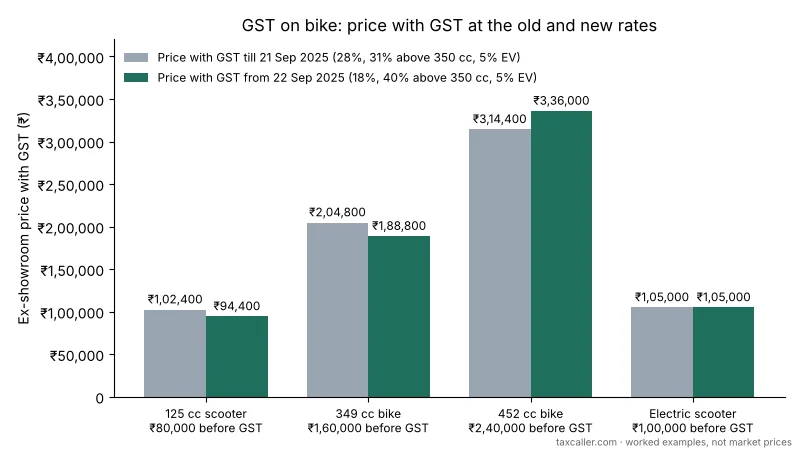
For a bike up to 350 cc, the cut from 28% to 18% lowers the price with tax by about 7.8% when the base price stays the same (1.18 ÷ 1.28). For a bike above 350 cc, the move from 31% to 40% raises it by about 6.9% (1.40 ÷ 1.31). Most makers announced new prices in September 2025 to pass on the change, so the price lists you see today already reflect the new rates.
On-road price breakup: where GST sits
The on-road price adds state charges and insurance to the ex-showroom price. GST is charged on the bike and on the insurance premium, but not on road tax or RTO fees, which are state levies rather than supplies. The breakup below is illustrative for the 125 cc scooter above; road tax rates, fees and insurance premiums differ by state, insurer and model.
| Component | Amount | GST inside |
|---|---|---|
| Value of scooter before tax | ₹80,000 | - |
| GST at 18% (CGST ₹7,200 + SGST ₹7,200) | ₹14,400 | ₹14,400 |
| Ex-showroom price | ₹94,400 | ₹14,400 |
| Road tax (illustrative 8% of ex-showroom) | ₹7,552 | Nil |
| Registration, number plate and RTO fees (illustrative) | ₹1,500 | Nil |
| Insurance: premium ₹6,000 + 18% GST | ₹7,080 | ₹1,080 |
| On-road price | ₹1,10,532 | ₹15,480 |
Most states work out road tax as a percentage of the vehicle's cost, so a lower GST also lowers the road tax a little. A new two-wheeler must carry long-term third-party cover, which is why the first premium is larger than a renewal. Items the dealer adds, such as extended warranty, accessories or a "handling" charge, are taxable supplies: accessories at 18%, an extended warranty as a service at 18%, and any charge for delivering the bike itself at the bike's own rate. If you finance the purchase, our EMI calculator shows the monthly instalment on the on-road amount.
GST on electric scooters and electric bikes
An electric two-wheeler is taxed at 5% under Schedule I, S. No. 441 of Notification 9/2025, which covers "electrically operated vehicles, including two and three wheeled electric vehicles". The explanation to that entry says these are vehicles run solely on electrical energy from an external source or from batteries fitted to the vehicle, and that the term includes e-bicycles. The rate has been 5% since 1 August 2019, so GST 2.0 did not change it.
- Battery sold with the scooter: part of the vehicle, at 5%.
- Charger or charging station for electric vehicles (8504): 5%, under Schedule I, S. No. 438.
- Replacement battery bought separately (8507): 18%, as an electric accumulator. That is a big difference on a costly lithium-ion pack, so check the line item.
- Parts and accessories for an electric scooter (8714): 18%, like those of a petrol bike.
- Petrol-electric hybrids: a two-wheeler with a petrol engine and an electric motor is not "solely" electric, so the 5% entry does not apply; it follows the engine-capacity entries for 8711.
GST on bike spare parts, helmets, tyres and accessories
The GST Council's 56th meeting moved all auto parts to a uniform 18%, regardless of HSN code. For two-wheeler owners, that means most of what you buy at a spare-parts shop dropped from 28% to 18%.
| Item | HSN | GST rate |
|---|---|---|
| Bike parts and accessories: brake shoes, clutch plates, chain sprocket kits, mirrors, seats, silencers, crash guards | 8714 | 18% (was 28%) |
| Two-wheeler tyres | 4011 | 18% (was 28%) |
| Two-wheeler inner tubes | 4013 | 18% |
| Bicycle tyres and tubes | 4011, 4013 | 5% |
| Helmets (safety headgear) | 6506 | 18% |
| Batteries: lead-acid (was 28%) and lithium-ion | 8507 | 18% |
| Engine oil and lubricants | 2710, 3403 | 18% |
| Electric vehicle charger | 8504 | 5% |
Helmets did not change: the "other headgear" entry for heading 6506 sits in the 18% schedule both before and after 22 September 2025. When a helmet or a set of accessories is sold together with a new bike at one price, it may become a mixed supply taxed at the highest rate in the bundle. For a 40% bike, that would pull the helmet to 40%, so ask for separate lines on the invoice. For HSN codes of other items, use the HSN code finder.
Bike service and repair: 18% on labour and parts
Repair and servicing of a two-wheeler is a service under SAC heading 9987 (maintenance, repair and installation). It falls in the residual entry of the services rate notification (Notification 11/2017-Central Tax (Rate)), taxed at 18%. GST 2.0 did not change it. A service bill usually has two kinds of lines:
- Labour: 18% under SAC 9987.
- Parts and consumables: billed as goods at their own rate. Since motorcycle parts, engine oil and tyres are now all 18%, most bills end up at 18% on every line.
Example: a service bill of ₹3,300 (labour ₹800, parts ₹2,000, engine oil ₹500) carries GST of ₹594, for a total of ₹3,894. Free services under the maker's warranty carry no charge to you; the service centre settles the cost with the maker. For a business, credit on repair and servicing of a bike is blocked in the same way as credit on the bike itself (see input tax credit below).
Bike insurance and bike loans: where 18% applies
Two-wheeler insurance carries 18% GST on the premium, for both third-party and own-damage cover. The GST 2.0 changes exempted individual life and health insurance, not motor insurance. A lower ex-showroom price after the change can reduce the insured declared value (IDV) of a new bike, which may lower the own-damage premium a little, but the 18% tax on the premium stays the same.
On a bike loan, interest is exempt from GST, because services of extending loans are exempt where the consideration is interest. The EMI itself, which repays principal and interest, carries no GST. Processing fees, documentation charges, late-payment charges and foreclosure charges are taxed at 18%.
GST on used bikes: tax on the margin
A second-hand bike sold by a GST-registered person is taxed under Notification 8/2018-Central Tax (Rate). S. No. 4 of that notification covers "all old and used vehicles" of chapter 87 other than the large cars listed above it, so it includes motorcycles and scooters. The rate was 12% (6% central tax) until 15 January 2025. Notification 4/2025-Central Tax (Rate) raised it to 18% (9% central tax) from 16 January 2025, and Notification 12/2025-Central Tax (Rate) kept the scheme going after GST 2.0 by linking it to the new schedules.
| Who sells | GST | Value taxed |
|---|---|---|
| Individual selling a personal bike to another person | None | Not a supply in the course of business |
| Registered used-bike dealer (no credit taken on the bike) | 18% | Selling price minus purchase price; nil if negative |
| Business selling its own old bike, having claimed income-tax depreciation | 18% | Sale price minus depreciated value on the date of sale; nil if negative |
| Registered seller that claimed input tax credit on the bike | Normal rate (18%, 40% or 5%) | Full sale value; the margin scheme does not apply |
Example: a dealer buys a used 150 cc bike from an individual for ₹50,000 and sells it for ₹62,000. GST is 18% of the ₹12,000 margin, which is ₹2,160. If a company sells an old delivery bike with a depreciated value of ₹55,000 for ₹60,000, GST is 18% of ₹5,000, which is ₹900. If it sells below the depreciated value, no GST is due.
Used electric two-wheelers follow the same rule. The 55th GST Council, which recommended the January 2025 increase, said the 18% rate applies to the sale of all old and used vehicles, including EVs, and only on the margin. So a registered dealer selling a used electric scooter pays 18% on its margin, as for a used electric car.
Can a business claim input tax credit on a bike?
Usually not. Section 17(5)(a) of the CGST Act blocks credit on motor vehicles for transport of persons with an approved seating capacity of not more than 13 (including the driver). A motorcycle or scooter is such a vehicle. CBIC's Circular 231/25/2024-GST restates the three exceptions where the block does not apply, which are when the vehicle is used for:
- further supply of such vehicles (a dealer buying bikes for resale);
- transportation of passengers (for example, a licensed bike-taxi operator); or
- imparting training on driving such vehicles (a driving school).
Section 17(5)(ab) extends the block to general insurance, servicing, repair and maintenance of these vehicles. Credit on those services is allowed only when the bike is used for one of the three purposes above, or when the person receiving the service makes such vehicles or insures them.
| Business | Credit on bike? | Credit on insurance and repair? |
|---|---|---|
| Two-wheeler dealer buying stock for sale | Yes | Yes, for the bikes it deals in |
| Driving school using bikes for training | Yes | Yes |
| Bike-taxi operator charging GST at the rate with full credit | Yes | Yes |
| Bike-taxi operator charging 5% on rides | No; the 5% rate allows credit only on input services from the same line of business | Only same-line input services |
| Company bike for sales staff or a field engineer | No | No |
| Delivery business using ordinary bikes | Doubtful; see below | Doubtful |
| Two-wheeler manufacturer | Yes, as inputs and stock | Yes |
Delivery fleets are where most disputes arise. The block in Section 17(5)(a) is limited to vehicles for transport of persons, and goods-carrying vehicles are outside it. But an ordinary motorcycle or scooter is built to carry a rider and a pillion, and goods delivery is not one of the listed exceptions, so tax officers tend to treat credit on such bikes as blocked. A purpose-built cargo two-wheeler is easier to defend. Some websites say delivery use always qualifies; that is too broad, so take advice before claiming. The rules for cars work the same way and are covered in more detail in our GST on cars guide.
Where credit is blocked, the GST on the bike becomes part of its cost for income-tax purposes and is depreciated with the bike.
GST on bicycles (HSN 8712)
Bicycles and other cycles without a motor, including delivery tricycles, fall under heading 8712 and are taxed at 5% from 22 September 2025, down from 12%. Their parts and accessories under 8714, and bicycle tyres and tubes, are also at 5%. The GST 2.0 FAQs (Q36) confirm the cut for bicycles and their parts.
- Example: a bicycle worth ₹10,000 before tax now costs ₹10,500 with GST, against ₹11,200 at the old 12% rate.
- Electric bicycles: e-bicycles are named in the definition of electrically operated vehicles, so they are at 5% under S. No. 441 rather than under 8712. The rate is the same; the HSN line on the bill differs.
- Carriages for disabled persons (8713): also 5%, under Schedule I, S. No. 457.
A cycle shop with turnover under the registration threshold need not register, but most shops supplying schools, institutions or other dealers register to issue tax invoices. Check rates for other items with the GST rate finder.
Who pays GST on a bike and what to check on the bill
The buyer bears the tax, but the dealer collects it and pays it to the government in its GST return. The maker charges GST to the dealer, and the dealer takes credit for it, so the tax falls only once on the final price. Buying a bike is a forward-charge supply: there is no reverse charge for the buyer. Reverse charge does reach two-wheeler dealers on some of their own costs, such as freight paid to a goods transport agency that has not opted to charge GST itself. The dealer then pays 5% on the freight under reverse charge (Notification 13/2017-Central Tax (Rate)) and can take credit for it.
Check these points on a new bike invoice:
- HSN code 8711 (and 8714 for accessories): at least 4 digits on B2B invoices if the dealer's turnover was up to ₹5 crore, and 6 digits on all invoices above that.
- The rate matches the bike: 18% up to 350 cc, 40% above 350 cc, 5% for an electric two-wheeler, with no compensation cess line.
- CGST plus SGST for a sale within the state, or IGST for a bike billed to a buyer in another state.
- Discounts shown before tax, and helmets or accessories on separate lines.
- Chassis and engine numbers, which the RTO and the insurer rely on.
- Your GSTIN if you are a business. Even where credit is blocked, the invoice is your record of cost. You can check the dealer's GSTIN with our GSTIN validator.
Imported motorcycles pay IGST at the same rate as a similar bike made in India, plus basic customs duty, which is added to the value before IGST is worked out.
Two-wheeler dealers, used-bike traders, service centres and spare-parts shops must register once they cross the turnover threshold, or from the first sale to another state. Our team handles GST registration and monthly GST return filing for such businesses.
Related GST rates: motor insurance for your bike carries 18% GST, an AC is 18%, ready-made clothes are 5% up to ₹2,500 a piece and 18% above, and silver is 3%.
Official sources: Notification 9/2025-Integrated Tax (Rate) (CBIC) · GST 2.0 FAQs, GST Council · 56th GST Council recommendations · Notification 4/2025-Central Tax (Rate) (used vehicles) · 55th GST Council press release · Circular 231/25/2024-GST (Section 17(5)(a)).
Frequently asked questions
What is the GST on bikes in 2026?
GST on a bike is 18% if the engine is up to 350cc, 40% if it is above 350cc, and 5% for an electric two-wheeler. These rates have applied since 22 September 2025 under Notification 9/2025-Central Tax (Rate). Within a state, 18% is billed as 9% CGST and 9% SGST on the invoice.
Is 40% GST charged on all bikes?
No. The 40% rate applies only to motorcycles with engines above 350cc, such as 400cc, 450cc and 650cc models. Bikes and scooters of 350cc or less, which make up most of the market, pay 18%. Electric scooters and motorcycles pay 5% whatever their size, and bicycles without a motor also pay 5%.
What is the GST for a 350cc bike?
A bike of up to and including 350cc pays 18%. The 18% entry covers motorcycles not exceeding 350cc, and the Ministry of Finance's GST 2.0 FAQs confirm that 40% applies only above 350cc. So the Royal Enfield Classic 350, Hunter 350 and Bullet 350, all 349cc, are at 18%. Only bikes from 351cc pay 40%.
How much GST is charged on the Activa 125?
The Honda Activa 125 has an engine of about 124cc, so it pays 18% GST, down from 28% before 22 September 2025. If its value before tax were ₹80,000, GST would be ₹14,400 and the ex-showroom price ₹94,400. Road tax, registration and insurance are added on top to reach the on-road price.
What is the GST on electric scooters and bikes?
Electric two-wheelers that run only on battery power pay 5% GST under Schedule I of Notification 9/2025. The rate has been 5% since 1 August 2019 and did not change in GST 2.0. Chargers for electric vehicles are also 5%, but a replacement battery bought separately is taxed at 18% as an accumulator.
Was the compensation cess on bikes removed?
Yes. Motorcycles above 350cc paid 28% GST plus a 3% compensation cess, or 31% in all. Notification 2/2025-Compensation Cess (Rate) made that cess Nil from 22 September 2025, and the cess was folded into the new 40% GST rate. Bikes up to 350cc never carried compensation cess, so for them only the rate changed.
What is the GST on bike insurance?
Two-wheeler insurance carries 18% GST on the premium, for both third-party and own-damage cover. GST 2.0 exempted individual life and health insurance, not motor insurance, so the rate did not change. A lower bike price can reduce the insured declared value and the own-damage premium slightly, but the 18% tax stays the same.
What is the GST on bike spare parts and helmets?
Motorcycle and scooter parts under HSN 8714 dropped from 28% to 18% on 22 September 2025, and two-wheeler tyres moved from 28% to 18%. Helmets under heading 6506 stayed at 18%. Engine oil and batteries are 18%. Bicycle parts, tyres and tubes are taxed at 5%, the same rate as bicycles under heading 8712.
What is the GST on bike service and repair?
Labour for servicing and repairing a two-wheeler is taxed at 18% under SAC heading 9987. Parts and engine oil fitted during the service are billed at their own rates, which are now also 18% for motorcycle parts. A business using the bike for staff travel cannot claim credit on this GST, because Section 17(5)(ab) blocks it.
How much GST is charged on a used bike?
A registered dealer selling a used bike pays 18% GST only on its margin, the selling price minus the purchase price, under Notification 8/2018-Central Tax (Rate) as amended. If a dealer buys at ₹50,000 and sells at ₹62,000, GST is ₹2,160. No GST is due if the margin is negative or nil.
Do I pay GST when I sell my old bike?
No. An individual selling a personal bike to another person is not making a supply in the course of business, so no GST applies. GST arises only when a registered business sells it. A business that claimed income-tax depreciation pays 18% on the sale price minus the depreciated value, and nothing if it sells below that value.
Can a business claim input tax credit on a bike?
Usually not. Section 17(5)(a) of the CGST Act blocks credit on motor vehicles for carrying persons, which includes bikes and scooters. Credit is allowed only to dealers buying bikes for resale, driving schools, and passenger operators such as bike taxis that charge the GST rate allowing full credit. A bike used by sales staff or field engineers gets no credit.
What is the GST on bicycles?
Bicycles without a motor fall under HSN 8712 and are taxed at 5% from 22 September 2025, down from 12%. Bicycle parts, tyres and tubes are also at 5%. Electric bicycles are treated as electrically operated vehicles and are also taxed at 5%. A bicycle worth ₹10,000 before tax now costs ₹10,500 with GST.
Is GST charged on a bike loan EMI?
No. Interest on a loan is exempt from GST, and the EMI repays principal and interest, so it carries no GST. Lenders do charge 18% GST on processing fees, documentation charges, late-payment charges and foreclosure charges. Check the loan sanction letter, because these fees and the GST on them are often deducted from the loan amount.
What is the HSN code for bikes?
Motorcycles, scooters, mopeds and electric two-wheelers fall under HSN 8711, and electric models use 8711 60. Their parts and accessories fall under 8714. Bicycles without a motor fall under 8712. A dealer with turnover above ₹5 crore must print at least six digits on every invoice, and smaller dealers four digits on B2B invoices.
Sources: GST portal HSN/SAC directory (updated 23 Oct 2026) · CBIC rate notifications: 9/2025-Central Tax (Rate) as amended up to 01/2026-Central Tax (Rate), 30 Apr 2026 (in force from 1 May 2026); services under 11/2017-Central Tax (Rate) as amended. Rates are the total GST (CGST + SGST, or IGST). Content updated .
Reviewed By

Expert for this topic GST classification and rates
Abhinay Rai
Advocate
Abhinay Rai is a Advocate specialising in GST classification and rates. The codes, rates and examples on this page are checked against the GST portal HSN directory and the current CBIC rate notifications, and are updated when a new notification is issued.