
GST on Flight Tickets 2026: 5% Economy, 18% Business, SAC 9964
Government data: GST portal HSN directory and CBIC rate notifications. Rates as per 01/2026-Central Tax (Rate), 30 Apr 2026 (in force from 1 May 2026). Last checked 20 Nov 2026.
1 result for “Tour package”
- 998552SAC18%
Support services
Reservation services for accommodation, cruises and package tours
Notification 11/2017-CT(Rate)
HSN codes and GST rates for flight tickets
From the GST portal HSN list, with the rate from the current CBIC notification. Tap Copy to use the code on your invoice.
- 996425SAC18%
Passenger transport services
Domestic/ international scheduled air transport services of passengers
Notification 11/2017-CT(Rate)
- 996426SAC18%
Passenger transport services
Domestic/ international non-scheduled air transport services of passengers
Notification 11/2017-CT(Rate)
Quick answer
GST on flight tickets is 5% for economy class and 18% for premium economy, business and first class, under SAC 9964 (996425 for scheduled flights). The 18% applies from 22 September 2025, replacing 12%. Tax is charged on the airline's base fare and fuel surcharge, and economy flights touching the North-East or Bagdogra are exempt.
A flight ticket is a supply of a service, not of goods, so it carries a SAC (Services Accounting Code) under heading 9964 instead of an HSN code. The GST rate turns on one fact printed on your boarding pass: the cabin. Economy class is taxed at 5%, and every other cabin (premium economy, business and first) at 18% from 22 September 2025. Until then, seats outside economy were taxed at 12%. The rates sit in serial number 8 of Notification 11/2017-Central Tax (Rate), and the business-class increase came through Notification 15/2025-Central Tax (Rate).
This page sets out which part of the fare is actually taxed, how the airline splits the tax into CGST and SGST or IGST, what happens on international routes, when a company can take credit for the GST on a work trip, how travel agents and booking apps add their own GST, and how cancellations and add-ons are billed. Each rule is tied to the notification, circular or section it comes from, with links at the end.
On this page: Rates by cabin · Rate history · What is taxed · Calculation · CGST, SGST or IGST · International · Exempt routes · ITC for business · Airline credit · Agents and apps · Cancellation · Invoices
GST on flight tickets: rates by cabin class in 2026
The table below covers air travel booked on or after 22 September 2025. The percentages are the total GST; the airline pays half to the Centre and half to the state when the supply is within one state, or the full amount as IGST when it crosses a state line.
| Type of air travel | Total GST | Intra-state split | Entry in 11/2017-CT(R), S. No. 8 |
|---|---|---|---|
| Scheduled flight, economy class | 5% | 2.5% CGST + 2.5% SGST | Item (iii), airline may not take credit on goods |
| Premium economy, business or first class | 18% | 9% CGST + 9% SGST | Item (v), "other than economy class", no condition |
| Flight starting or ending at a Regional Connectivity Scheme (UDAN) airport | 5% | 2.5% CGST + 2.5% SGST | Item (iv) |
| Non-scheduled or charter flights for government-arranged religious pilgrimages | 5% | 2.5% CGST + 2.5% SGST | Item (iva) |
| Helicopter ride on a seat-share basis | 5% (exemption for North-East, Sikkim and Bagdogra routes recommended in October 2026) | 2.5% CGST + 2.5% SGST | Item (ivb), from 10 October 2024 |
| Helicopter charter (whole aircraft) | 18% | 9% CGST + 9% SGST | Circular 234/28/2024-GST, para 5 |
| Economy class to or from the North-East or Bagdogra | Nil (exempt) | Not applicable | 12/2017-CT(R), S. No. 15(a) |
Premium economy is often assumed to sit with economy because of its name. The notification does not work that way: its wording splits air travel into "economy class" and "other than economy class", with nothing in between. No CBIC circular names premium economy, but because it is sold as a separate cabin, airlines bill it under the second entry at 18%; Cathay Pacific's India advisory, for example, lists premium economy, business and first at 18% from 22 September 2025. The GST Council's FAQ on the September 2025 changes (Q59) also confirms that air travel has no choice of two rates: economy is 5% and other classes are 18%, and an airline cannot pick a different rate for a cabin.
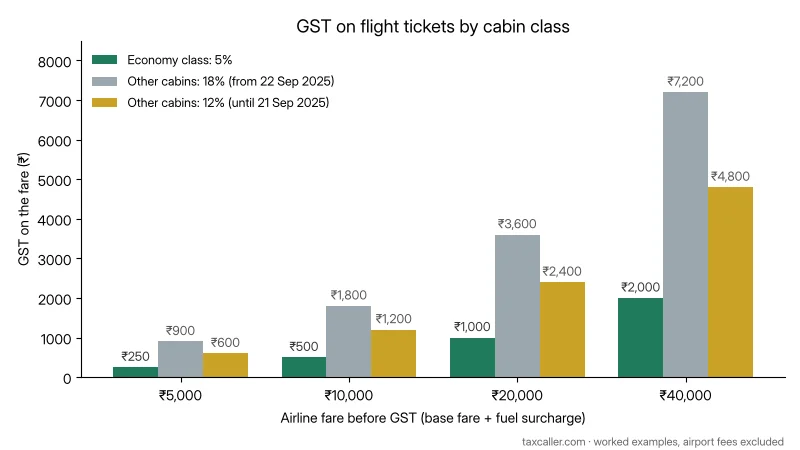
Several popular guides still print 12% for business class. That rate stopped applying to tickets issued and paid for from 22 September 2025. If an invoice dated after that shows 12% on a business-class fare, ask the airline for a corrected one.
Air ticket GST rate history and notifications
Air fares moved from service tax to GST on 1 July 2017. The changes since then are listed in order, with the notification that made each one.
| Effective date | Change | Official source |
|---|---|---|
| 1 July 2017 | Economy at 5% and other classes at 12%; flights to and from the eight North-Eastern states and Bagdogra exempt for every cabin | Notifications 11/2017-CT(R) and 12/2017-CT(R), both dated 28 June 2017 |
| 18 July 2022 | North-East and Bagdogra exemption cut back to economy class only; business class on those routes became taxable | Notification 04/2022-CT(R) dated 13 July 2022 |
| 10 October 2024 | Helicopter seat-share flights placed at 5%; GST paid on them from 1 July 2017 to 9 October 2024 regularised "as is where is" | Notification 07/2024-CT(R) dated 8 October 2024; Circular 234/28/2024-GST |
| 22 September 2025 | Premium economy, business and first class raised from 12% to 18%; economy unchanged at 5% | Notification 15/2025-CT(R) dated 17 September 2025 (IGST: 15/2025-Integrated Tax (Rate)) |
| 8 October 2026 (recommendation) | 57th GST Council recommended exempting helicopter seat-share passenger transport from or to airports and helipads in the North-Eastern states, Sikkim and Bagdogra | 57th GST Council press release |
For a ticket bought before 22 September 2025 for a flight after that date, the rate followed the time of supply rules in Section 14 of the CGST Act. When the booking was both invoiced and paid before the change, the old 12% stayed on the ticket even though the passenger flew later. A date change or re-issue made after 21 September 2025 is a new transaction, and any fare difference billed then is taxed at 18%.
The 57th Council item on helicopters is a recommendation, and it covers only seat-share flights from or to airports and helipads in the North-East, Sikkim and Bagdogra. Seat-share helicopter rides elsewhere stay at 5%. Before treating a North-East helicopter seat as exempt, confirm on the GST Council notifications page that the recommendation has been notified.
Which part of the air fare attracts GST?
A ticket total is a stack of separate amounts collected by the airline for different people. GST at 5% or 18% applies only to the airline's own price for carrying you. The rest is collected on behalf of the airport operator or the government.
| Line on the ticket | Whose charge | How GST works |
|---|---|---|
| Base fare | Airline | Taxed at 5% or 18% according to the cabin |
| Fuel or carrier surcharge (codes YQ or YR) | Airline | Part of the airline's consideration, so it is added to the base fare before the 5% or 18% is worked out |
| User Development Fee (UDF) and Passenger Service Fee (PSF) | Airport operator | GST is payable by the airport operator; the airline collects it as a pure agent and shows the fee and its GST separately (Circular 115/34/2019-GST) |
| Other government levies, such as the aviation security fee | Government or its agency | Shown as a separate line on the ticket; check the invoice for how each levy is treated |
| Seat, meal, extra baggage and other add-ons | Airline | Billed with GST at the rate the airline applies to that service; see the add-ons section below |
| Convenience or service fee of an app or agent | Agent or platform | 18% on the fee, charged by the agent on its own invoice |
Circular 115/34/2019-GST, issued on 11 October 2019, settled the airport fees question. It says PSF and UDF are charges by the airport operator for services to passengers, so GST applies to them. The airline that collects them must show the actual PSF, UDF and the GST on them separately on the passenger's invoice. The airline does not count these amounts in its own value of supply and takes no credit of that GST, while a registered passenger can claim it on the strength of the airline's invoice.
Some calculators on the web treat YQ or YR as a government tax and leave it out. That is not how the law values a supply: Section 15 of the CGST Act includes every amount the supplier charges for the supply, and a fuel surcharge is the airline's own charge. On that reading, the 5% or 18% applies to the base fare plus these carrier charges.
How to calculate GST on flight tickets
Work only with the airline's taxable value, not with the grand total on the booking screen. The steps are the same for every cabin.
- Add the base fare and the carrier surcharge (YQ or YR). This is the taxable value.
- Multiply it by 5% for economy or 18% for any other cabin.
- Split the result into CGST and SGST, or keep it as IGST, using the place of supply rule explained in the next section.
- Add the airport fees with their own GST and the pass-through levies to reach the ticket total.
Example 1: economy ticket for a tourist
Ravi, who has no GST registration, flies economy from Delhi to Mumbai. The base fare is ₹4,600 and the fuel surcharge is ₹600.
| Item | Amount |
|---|---|
| Base fare + fuel surcharge (taxable value) | ₹5,200 |
| CGST at 2.5% | ₹130 |
| SGST (Delhi) at 2.5% | ₹130 |
| Airline fare with GST | ₹5,460 |
Ravi is unregistered, so the place of supply is Delhi, where he boards. The airline's Delhi registration charges CGST plus Delhi SGST. Airport fees and levies are then added to the ₹5,460 as separate lines.
Example 2: business class booked by a company
A company registered in Karnataka books business class on the same Delhi to Mumbai flight for its sales head and enters its GSTIN. Base fare ₹21,000, fuel surcharge ₹1,800.
| Item | From 22 Sep 2025 (18%) | Before 22 Sep 2025 (12%) |
|---|---|---|
| Taxable value | ₹22,800 | ₹22,800 |
| IGST | ₹4,104 | ₹2,736 |
| Airline fare with GST | ₹26,904 | ₹25,536 |
The tax on this fare rose by ₹1,368. Because the buyer is registered, the place of supply is Karnataka, the state in its GSTIN, while the airline supplies from Delhi. The supply is inter-state, so the whole ₹4,104 is IGST, which the company can set off against its output tax if the trip is for business.
Example 3: finding the GST inside a tax-inclusive fare
If you only know the airline's fare including GST, divide instead of multiplying. For an economy amount of ₹6,300: 6,300 × 5 ÷ 105 = ₹300 of GST on a value of ₹6,000. At 18%, a business-class amount of ₹29,500 holds 29,500 × 18 ÷ 118, or ₹4,500 of tax, leaving ₹25,000 as the fare. You can run either way of the sum on the GST calculator.
CGST and SGST or IGST on air tickets?
Air travel follows its own place of supply rule in the IGST Act, and it depends on whether the buyer gave a GSTIN.
- Buyer registered under GST (Section 12(9)(a) IGST Act): the place of supply is the location of the registered person. A Kolkata company that books a Chennai to Pune ticket with its West Bengal GSTIN gets IGST, because the airline's Tamil Nadu registration and the buyer's state differ.
- Buyer not registered (Section 12(9)(b)): the place of supply is where the passenger boards for a continuous journey. A tourist flying out of Chennai pays CGST plus Tamil Nadu SGST, whatever state they live in.
- Supplier or buyer outside India (Section 13(10)): the place of supply is again the airport where the passenger boards for the continuous journey, which decides whether the leg is taxable in India at all.
Airlines register in each state from which they operate flights. IndiGo's GST page, for example, says the tax type follows the GSTIN given and the boarding point of each leg of the itinerary, and that invoices are issued in rupees even if you pay in another currency.
GST on international flight tickets
For trips abroad, ask where each leg starts.
| Journey | Indian GST? | Why |
|---|---|---|
| Leaving India, such as Mumbai to Dubai | Yes: 5% economy, 18% other cabins | Passenger boards in India, so the place of supply is in India |
| Coming to India, such as Dubai to Mumbai | Generally no for a traveller without a GSTIN | Section 12(9)(b) and 13(10) of the IGST Act put the place of supply at the foreign boarding point; a business that gives its GSTIN to an Indian airline should check the invoice, as 12(9)(a) points to its own location |
| Round trip bought in India | Generally only on the leg that starts in India | The Explanation to Section 12(9) treats the return journey as a separate journey, and it begins abroad |
| Flight wholly between two foreign cities | No | Neither end of the journey is in India |
Foreign airlines that sell tickets for departures from India are registered for GST and charge the same 5% and 18% on those sectors. Overseas airport charges and foreign taxes on the same ticket are outside Indian GST.
An international ticket bought as part of an overseas tour package is a different matter. A package sold by a tour operator is a tour operator service with its own GST rate, and income-tax TCS rules on overseas tour packages apply to the package price. A ticket bought on its own is just air transport.
Exempt routes: North-East, Bagdogra and UDAN
Serial number 15(a) of Notification 12/2017-CT(R), as amended by 04/2022-CT(R), exempts economy class air travel that starts or ends at an airport in Arunachal Pradesh, Assam, Manipur, Meghalaya, Mizoram, Nagaland, Sikkim or Tripura, or at Bagdogra in West Bengal. The exemption has three practical points:
- One end is enough. A Delhi to Guwahati economy ticket and a Guwahati to Delhi one are both exempt.
- It is economy only. From 18 July 2022 a business-class seat on the same flight became taxable, at 12% then and at 18% from 22 September 2025.
- Bagdogra is the only airport outside the eight states that is named. Other airports in West Bengal, such as Kolkata, are taxable.
UDAN flights are often described online as tax-free. The notification does not say that. Flights that start or end at a Regional Connectivity Scheme airport are listed at a rate of 5% under item (iv) of serial number 8, and only those that also touch the North-East or Bagdogra in economy are exempt. Check the fare breakup on your ticket for the tax actually charged.
Can you claim GST on flight tickets? ITC for business travel
Yes, when the trip is for business. Air travel is not in the list of blocked credits in Section 17(5) of the CGST Act, so a registered business can take input tax credit of the GST on tickets for staff, directors or consultants travelling for work. Before claiming, tick off the Section 16(2) conditions in this order:
- Enter the GSTIN at booking. Airlines and global distribution systems capture the GSTIN, legal name and email before the PNR is created or the ticket is issued. IndiGo, for instance, does not allow the GSTIN to be added or changed after confirmation.
- Get the GST invoice. The airline emails it or makes it available on its website, and it shows your GSTIN, the airline's GSTIN for the boarding state and the tax by type.
- Match GSTR-2B. The airline reports the B2B ticket in its GSTR-1, so the credit shows up in your GSTR-2B for that month. Claim only what appears there.
- Keep the trail. Keep the ticket, the invoice and a note of the business purpose for each trip.
The rate does not change the right to credit. A company can claim the full 18% on a business-class ticket just as it claims the 5% on economy. The condition attached to the 5% economy rate restricts the airline's own credit on goods; it says nothing about the passenger's credit.
Credit is not available for leave travel or holiday tickets given to employees, because Section 17(5)(b) blocks travel benefits extended to employees on vacation such as leave or home travel concession. Personal trips by the owner booked on the business GSTIN are also outside business use. Credit on airport fees is allowed on the same invoice, as Circular 115/34/2019-GST confirms.
If a ticket is cancelled and the airline refunds the fare, it issues a credit note for the tax on the refunded part, and the credit already taken must be reduced to match. Credit on the cancellation charge that the airline keeps, if it carries GST, remains available.
Input tax credit for airlines on economy and higher cabins
The two cabin rates come with different credit rules for the airline itself. Economy class at 5% carries the condition that credit of input tax "charged on goods used in supplying the service has not been taken". The airline can still claim credit on input services, such as aircraft leasing, maintenance or ground handling, but not on goods used for economy flights. Item (v), the 18% rate for other cabins, has no such condition, so full credit is allowed there.
An airline that runs both cabins on one aircraft has to split common credits between them under Rules 42 and 43 of the CGST Rules. Aviation turbine fuel, the biggest single cost, is outside GST under Section 9(2) of the CGST Act, so no credit arises on it in either cabin; this is one reason fuel prices weigh on fares more than GST does. The credit rules affect the airline's costs only. They do not change the 5% or 18% printed on your ticket.
GST when you book through an agent or app
A booking made through a travel agent or an online travel site contains two supplies. The airline carries you and charges GST on the fare. The agent or app helps you book and charges GST on its own fee.
- Convenience or service fee: the agent's reservation service is taxed at 18% on the fee, under SAC 9985, on the agent's own invoice. A business buyer can claim this too.
- Commission from the airline: where the airline pays the agent a commission or incentive, the agent bills the airline with GST on it.
- Optional deemed value under Rule 32(3): an air travel agent may pay GST on 5% of the basic fare for domestic bookings, or 10% of the basic fare for international bookings, instead of the actual commission or fee. "Basic fare" here means the part of the fare on which the airline normally pays commission.
Example 4: agent's GST under Rule 32(3)
An agent books a domestic ticket with a basic fare of ₹8,000. The deemed value is 5% of ₹8,000, which is ₹400, and the GST is 18% of ₹400, which is ₹72. On an international ticket with a basic fare of ₹40,000, the deemed value is ₹4,000 and the GST is ₹720. If the same agent instead charges a visible fee of ₹350, the GST on the fee is ₹63. The agent chooses one method and should apply it consistently.
Under the pure agent rule (Rule 33), an agent who pays the airline fare on the customer's behalf and recovers it at cost does not add the fare to its own taxable value. The airline's invoice then carries the fare GST, and the agent's invoice carries only the fee GST.
GST on cancellation, rescheduling and add-ons
Circular 178/10/2022-GST, dated 3 August 2022, treats cancellation charges as consideration for the original contract. For air tickets this means a cancellation or no-show fee is taxed at the rate that applied to the ticket: 5% if the ticket was economy, 18% if it was a higher cabin. Some websites state a flat 18% on every cancellation fee; that does not match the circular.
When you reschedule, the airline usually bills a change fee plus any fare difference. The fare difference is part of the air travel and follows the cabin rate. The change fee is the airline's charge for the amendment, and the airline shows the GST it applies on the revised invoice.
Seat selection, extra baggage, meals and lounge access are billed by the airline with GST included at the rate it applies to each service; IndiGo's GST page notes that special service charges such as excess baggage, cancellation and modification fees include GST at the applicable rate. Where an add-on is bundled into the fare, the fare's rate usually covers it. Travel insurance sold with the ticket is a separate supply by the insurer at 18%; see GST on insurance.
GST invoice for a flight ticket
For an airline, the ticket itself can serve as the tax invoice. Rule 54(4) of the CGST Rules allows a supplier of passenger transport to use a ticket in any form, whether or not serially numbered and whether or not it shows the recipient's address, provided it carries the other details required by Rule 46. Passenger transport is also outside the e-invoicing requirement under Notification 13/2020-Central Tax, as amended.
A business traveller should check these points on each airline invoice before claiming credit:
- The company's GSTIN and legal name, exactly as registered.
- The airline's GSTIN for the state where the flight departs.
- SAC 996425 (scheduled air transport of passengers) or the airline's six-digit code.
- Taxable value, rate and the CGST, SGST or IGST amounts.
- Airport fees with their GST shown on separate lines.
For SAC lookups beyond air travel, use the HSN and SAC code finder. Rates for goods and services outside air travel are in the GST rate finder.
Common mistakes with GST on air tickets
- Using 12% for business class. It is 18% for tickets issued from 22 September 2025.
- Treating premium economy as economy. It falls under "other than economy class".
- Taxing the full ticket total. Airport fees and levies are separate; GST at the cabin rate applies to the airline's fare and surcharge.
- Adding the GSTIN after ticketing. Most airlines cannot change the invoice later, and the credit is lost.
- Claiming credit on leave travel. Holiday tickets for employees are blocked under Section 17(5)(b).
- Assuming every UDAN or North-East flight is free of tax. The exemption covers economy to or from the eight North-Eastern states and Bagdogra only.
Related GST rates for travel: a room booked at your destination is covered on GST on hotel rooms, meals on GST on restaurant food, and cover for the trip on GST on insurance. A travel agency or tour business that crosses the turnover threshold needs GST registration.
Official sources
- GST Council FAQs on GST 2.0 rates, question 59 (air passengers)
- GST Council: Central Tax (Rate) notifications, including 11/2017, 12/2017 and 15/2025
- Notification 04/2022-CT(R): North-East and Bagdogra exemption limited to economy
- CBIC Circular 115/34/2019-GST on airport levies (PSF and UDF)
- Circular 234/28/2024-GST: helicopter seat-share at 5%, charter at 18%
- Cathay Pacific India advisory on the September 2025 GST revision by cabin
- 57th GST Council press release, 8 October 2026
- GST portal: HSN and SAC search
Frequently asked questions
Do you pay GST on flight tickets in India?
Yes. Every domestic flight and every flight that departs from India carries GST unless an exemption applies. Economy class is charged 5% and the other cabins 18%. The tax is already built into the fare you see at checkout, and the airline lists it separately on the invoice or ticket as CGST and SGST or as IGST.
Is GST on flight tickets 5% or 18%?
Both rates exist, and the cabin decides which one applies. An economy seat is taxed at 5%. A premium economy, business or first-class seat is taxed at 18% from 22 September 2025, under item (v) of serial number 8 in Notification 11/2017-CT(R) as amended by 15/2025-CT(R). The 12% rate used earlier for those cabins no longer applies.
What is the GST on business class flight tickets?
Business class attracts 18% GST, split as 9% CGST and 9% SGST, or charged as 18% IGST when the supply is inter-state. On a business fare of ₹22,800 before tax, the GST is ₹4,104. Until 21 September 2025 the same fare carried 12%, or ₹2,736, so the increase on that ticket is ₹1,368.
Is premium economy taxed at 5% like economy?
Usually not. The notification has only two air entries: economy class at 5%, and travel other than economy class at 18%. No CBIC circular names premium economy, but airlines sell it as a separate cabin and bill it at 18%, as Cathay Pacific's India advisory shows. Only economy seats get the 5% rate.
Which SAC code applies to an air ticket?
Air travel is a service under SAC heading 9964, passenger transport services. Scheduled domestic and international flights fall under 996425, and non-scheduled or charter flights under 996426. The GST portal list also shows six-digit codes from 996451 to 996459 that separate economy and other classes. HSN codes apply to goods, so a ticket has none.
What is the formula for GST on an air ticket fare?
Add the base fare and the airline's fuel surcharge, then apply 5% for economy or 18% for other cabins. A ₹5,200 economy value gives ₹260 of GST. Airport fees and government levies are added afterwards as separate lines. To pull GST out of an inclusive amount, multiply by 5/105 or 18/118.
Is GST charged on international flight tickets?
Yes, on flights that start in India. A Mumbai to Dubai ticket is taxed at 5% in economy and 18% in other cabins, because the passenger boards in India. For a traveller without a GSTIN, a Dubai to Mumbai flight carries no Indian GST, since the place of supply is the foreign boarding point.
Can I claim GST on my flight ticket?
A registered business can, for work travel. Enter the company GSTIN when booking, collect the airline invoice, and claim the credit once it appears in GSTR-2B. Salaried individuals and unregistered travellers cannot claim it. Holiday or leave travel given to employees is blocked under Section 17(5)(b) of the CGST Act, even when the company pays.
Can a company claim ITC on business class air tickets?
Yes. Air travel is not a blocked credit, and the cabin rate makes no difference to the buyer. A company can claim the full 18% charged on a business-class ticket for official travel, provided the invoice carries its GSTIN and the airline has reported it. The economy credit condition in the notification applies to the airline, not the passenger.
Why does my flight ticket show IGST instead of CGST and SGST?
Because you gave a GSTIN from a different state. For a registered buyer, Section 12(9) of the IGST Act sets the place of supply at the buyer's location. If that state differs from the airline's boarding-state registration, the supply is inter-state and IGST applies. A traveller without a GSTIN pays CGST and SGST of the departure state.
Are flights to the North-East exempt from GST?
Economy flights are. The exemption in Notification 12/2017-CT(R) covers an economy seat on any flight with one end in the eight North-Eastern states (Arunachal Pradesh, Assam, Manipur, Meghalaya, Mizoram, Nagaland, Sikkim, Tripura) or at Bagdogra. Notification 04/2022-CT(R) made business class on these routes taxable from 18 July 2022; it now pays 18%.
Is there GST on UDAN flight tickets?
Usually yes, at 5%. Item (iv) of serial number 8 lists air travel that begins or ends at a Regional Connectivity Scheme airport at 5%. The ticket is exempt only if the flight is in economy and also starts or ends in one of the eight North-Eastern states or at Bagdogra. Check the tax line on your ticket.
Is GST charged on airport fees like UDF and PSF?
Yes, but it is the airport operator's GST, not the airline's. CBIC Circular 115/34/2019-GST says the airline collects the User Development Fee and Passenger Service Fee as a pure agent and must show each fee and its GST separately. The airline takes no credit on that tax, while a registered passenger can claim it.
How much GST does a travel agent charge on air ticket bookings?
The agent charges 18% on its own service fee. Instead of using the actual fee, an air travel agent may pay GST on a deemed value of 5% of the basic fare for domestic tickets or 10% for international tickets, under Rule 32(3) of the CGST Rules. On an ₹8,000 domestic basic fare, that works out to ₹72.
Is GST refunded when I cancel a flight ticket?
The GST on the refunded fare comes back with the refund, and the airline issues a credit note for it. The cancellation fee the airline keeps is taxed at the ticket's own rate, 5% for economy and 18% for higher cabins, following CBIC Circular 178/10/2022-GST. A business must reverse any credit it took on the refunded portion.
Sources: GST portal HSN/SAC directory (updated 23 Oct 2026) · CBIC rate notifications: 9/2025-Central Tax (Rate) as amended up to 01/2026-Central Tax (Rate), 30 Apr 2026 (in force from 1 May 2026); services under 11/2017-Central Tax (Rate) as amended. Rates are the total GST (CGST + SGST, or IGST). Content updated .
Reviewed By

Expert for this topic GST classification and rates
Abhinay Rai
Advocate
Abhinay Rai is a Advocate specialising in GST classification and rates. The codes, rates and examples on this page are checked against the GST portal HSN directory and the current CBIC rate notifications, and are updated when a new notification is issued.