
GST on Petrol and Diesel 2026: Outside GST, Excise and VAT Explained
Government data: GST portal HSN directory and CBIC rate notifications. Rates as per 01/2026-Central Tax (Rate), 30 Apr 2026 (in force from 1 May 2026). Last checked 20 Nov 2026.
HSN codes and GST rates for petrol
From the GST portal HSN list, with the rate from the current CBIC notification. Tap Copy to use the code on your invoice.
- 27101241HSN5% or 18%
Petroleum oils and oils obtained from bituminous minerals, other than crude, preparations not elsewhere specified or included, containing by weight 70% or more of petroleum oils or of oils obtained from bituminous minera
Motor gasoline conforming to standard is 2795
- 5% (a) Kerosene oil PDS, (b) The following bunker fuels for use in ships or vessels, namely, i. IFO 180 CST ii. IFO 380 CST iii. Marine Fuel 0.5% (FO)
- 18% Petroleum oils and oils obtained from bituminous minerals, other than petroleum crude; preparations not elsewhere specified or included, containing by weight 70% or more of petroleum oils or of oils obtained from bituminous minerals, these oils being the basic
Special cases
- 5% Bio-gas
Notification 9/2025-CT(Rate), Schedule I, S. No. 207
- 27101242HSN5% or 18%
Petroleum oils and oils obtained from bituminous minerals, other than crude, preparations not elsewhere specified or included, containing by weight 70% or more of petroleum oils or of oils obtained from bituminous minera
E 20 fuel conforming to standard is 17020
- 5% (a) Kerosene oil PDS, (b) The following bunker fuels for use in ships or vessels, namely, i. IFO 180 CST ii. IFO 380 CST iii. Marine Fuel 0.5% (FO)
- 18% Petroleum oils and oils obtained from bituminous minerals, other than petroleum crude; preparations not elsewhere specified or included, containing by weight 70% or more of petroleum oils or of oils obtained from bituminous minerals, these oils being the basic
Special cases
- 5% Bio-gas
Notification 9/2025-CT(Rate), Schedule I, S. No. 207
- 27101243HSN5% or 18%
Petroleum oils and oils obtained from bituminous minerals, other than crude, preparations not elsewhere specified or included, containing by weight 70% or more of petroleum oils or of oils obtained from bituminous minera
E 12 fuel conforming to standard is 17586
- 5% (a) Kerosene oil PDS, (b) The following bunker fuels for use in ships or vessels, namely, i. IFO 180 CST ii. IFO 380 CST iii. Marine Fuel 0.5% (FO)
- 18% Petroleum oils and oils obtained from bituminous minerals, other than petroleum crude; preparations not elsewhere specified or included, containing by weight 70% or more of petroleum oils or of oils obtained from bituminous minerals, these oils being the basic
Special cases
- 5% Bio-gas
Notification 9/2025-CT(Rate), Schedule I, S. No. 207
- 27101244HSN5% or 18%
Petroleum oils and oils obtained from bituminous minerals, other than crude, preparations not elsewhere specified or included, containing by weight 70% or more of petroleum oils or of oils obtained from bituminous minera
E 15 fuel conforming to standard is 17586
- 5% (a) Kerosene oil PDS, (b) The following bunker fuels for use in ships or vessels, namely, i. IFO 180 CST ii. IFO 380 CST iii. Marine Fuel 0.5% (FO)
- 18% Petroleum oils and oils obtained from bituminous minerals, other than petroleum crude; preparations not elsewhere specified or included, containing by weight 70% or more of petroleum oils or of oils obtained from bituminous minerals, these oils being the basic
Special cases
- 5% Bio-gas
Notification 9/2025-CT(Rate), Schedule I, S. No. 207
- 27101249HSN5% or 18%
Petroleum oils and oils obtained from bituminous minerals, other than crude, preparations not elsewhere specified or included, containing by weight 70% or more of petroleum oils or of oils obtained from bituminous minera
M15 fuel conforming to standard is 17076
- 5% (a) Kerosene oil PDS, (b) The following bunker fuels for use in ships or vessels, namely, i. IFO 180 CST ii. IFO 380 CST iii. Marine Fuel 0.5% (FO)
- 18% Petroleum oils and oils obtained from bituminous minerals, other than petroleum crude; preparations not elsewhere specified or included, containing by weight 70% or more of petroleum oils or of oils obtained from bituminous minerals, these oils being the basic
Special cases
- 5% Bio-gas
Notification 9/2025-CT(Rate), Schedule I, S. No. 207
- 27101930HSN5% or 18%
Petroleum oils and oils obtained from bituminous minerals, other than crude, preparations not elsewhere specified or included, containing by weight 70% or more of petroleum oils or of oils obtained from bituminous minera
High speed diesel oil
- 5% (a) Kerosene oil PDS, (b) The following bunker fuels for use in ships or vessels, namely, i. IFO 180 CST ii. IFO 380 CST iii. Marine Fuel 0.5% (FO)
- 18% Petroleum oils and oils obtained from bituminous minerals, other than petroleum crude; preparations not elsewhere specified or included, containing by weight 70% or more of petroleum oils or of oils obtained from bituminous minerals, these oils being the basic
Special cases
- 5% Bio-gas
Notification 9/2025-CT(Rate), Schedule I, S. No. 207
- 27101944HSN5% or 18%
Petroleum oils and oils obtained from bituminous minerals, other than crude, preparations not elsewhere specified or included, containing by weight 70% or more of petroleum oils or of oils obtained from bituminous minera
Automotive diesel fuel, not containing biodiesel, conforming to standard is 1459
- 5% (a) Kerosene oil PDS, (b) The following bunker fuels for use in ships or vessels, namely, i. IFO 180 CST ii. IFO 380 CST iii. Marine Fuel 0.5% (FO)
- 18% Petroleum oils and oils obtained from bituminous minerals, other than petroleum crude; preparations not elsewhere specified or included, containing by weight 70% or more of petroleum oils or of oils obtained from bituminous minerals, these oils being the basic
Special cases
- 5% Bio-gas
Notification 9/2025-CT(Rate), Schedule I, S. No. 207
- 2709HSN5%
Petroleum oils and oils obtained from bituminous minerals, crude
Notification 9/2025-CT(Rate), Schedule I, S. No. 204
- 27111100HSN18%
Petroleum gases and other gaseous hydrocarbons › Natural gas
Natural gas
Special cases
- 5% Bio-gas
Notification 9/2025-CT(Rate), Schedule II, S. No. 30
- 27112100HSN18%
Petroleum gases and other gaseous hydrocarbons › Natural gas
Natural gas
Special cases
- 5% Bio-gas
Notification 9/2025-CT(Rate), Schedule II, S. No. 30
Quick answer
There is no GST on petrol or diesel in 2026, because Section 9(2) of the CGST Act keeps them outside GST until the GST Council recommends a start date. Instead, the Centre charges excise duty per litre and each state adds VAT or sales tax. Businesses therefore cannot claim input tax credit on fuel, and pump bills show VAT.
Petrol is one of five products that the GST law covers in principle but does not yet tax. The other four are diesel (high speed diesel), crude oil, natural gas and aviation turbine fuel. For all five, Section 9(2) of the CGST Act says the tax will start only from a date the government notifies on the GST Council's recommendation, and no such date has been notified. So there is no CGST, SGST or IGST on a litre of petrol or diesel in November 2026, and no GST rate or GST HSN entry applies to them.
What you pay instead is a mix of central excise duty, state VAT or sales tax and, in many states, extra cesses. This page explains the legal basis, the taxes that apply now with their official figures, a per-litre price build-up, state-wise VAT, why the GST Council has not moved, and what it all means for a business that buys fuel or runs a petrol pump. Figures are taken from PPAC, the oil companies and government notifications; links are at the end.
On this page: The law · Fuels in and out of GST · Taxes on petrol · Excise in 2026 · Tax per litre · State VAT · If petrol came under GST · Why not yet · For businesses · Petrol pumps · Myths
Is there GST on petrol and diesel? What the law says
The Constitution (One Hundred and First Amendment) Act, 2016, which created GST, deliberately left a door open for petroleum. Three provisions work together:
| Provision | What it does |
|---|---|
| Article 366(12A) | Defines GST as a tax on any supply of goods or services except alcoholic liquor for human consumption. Petrol is not excluded from the definition, so it can be taxed under GST in future. |
| Article 279A(5) | Directs the GST Council to recommend the date from which GST will be levied on petroleum crude, high speed diesel, motor spirit (petrol), natural gas and aviation turbine fuel. |
| Section 9(2), CGST Act, 2017 (and Section 5(2), IGST Act) | Says central tax and integrated tax on these five goods will be levied from a date notified by the government on the Council's recommendation. No date has been notified. |
| Entry 84, Union List and Entry 54, State List | Keep the Centre's power to charge excise duty and the states' power to charge sales tax or VAT on these petroleum products. |
In GST language, a sale of petrol is a "non-taxable supply": a supply that is not leviable to tax under the CGST or IGST Act (Section 2(78)). It is not "zero-rated" and it is not a nil-rated GST supply. It sits outside GST, under the older taxes, until the Council acts.
Which fuels are under GST and which are outside?
Only the five products named in Article 279A(5) are kept out. Fuels and oils made from the same crude but not on that list are taxed under GST in the normal way.
| Product | Usual tariff code | GST position in 2026 | Tax that applies |
|---|---|---|---|
| Petrol (motor spirit, including E20 blends) | 2710 12 41 to 2710 12 49 | Outside GST | Central excise + state VAT |
| Diesel (high speed diesel) | 2710 19 30, 2710 19 44 | Outside GST | Central excise + state VAT |
| Aviation turbine fuel | 2710 19 33, 2710 19 39 | Outside GST | Central excise + state VAT |
| Natural gas, including CNG and piped gas | 2711 11 00, 2711 21 00 | Outside GST | Central excise + state VAT |
| Crude oil | 2709 | Outside GST | Central excise + state levies |
| LPG for household use | 2711 | 5% GST | GST only |
| LPG for commercial or other use (other than the non-domestic exempted category customers of IOCL, HPCL and BPCL, which get 5%) | 2711 | 18% GST | GST only |
| Kerosene sold through the public distribution system | 2710 19 | 5% GST | GST only |
| Engine oil, gear oil, greases and lubricants | 2710 19 7x, 2710 19 8x | 18% GST | GST only |
The codes are those of the customs tariff, which GST uses for goods. A code alone does not decide the tax: high speed diesel and engine oil share heading 2710, but only the oil is a GST supply. Petroleum items not listed here can be looked up by code on our HSN code finder, and by name on the GST rate finder.
Taxes on petrol and diesel in place of GST
Two governments tax the same litre, one after the other.
Central excise duty, charged per litre
The Centre collects excise when the fuel leaves the refinery or depot. It is a fixed amount per litre, not a percentage, and is made of several parts: basic excise duty, special additional excise duty (SAED), the road and infrastructure cess and, for some products, the agriculture infrastructure and development cess. Because the duty is per litre, it does not rise automatically when crude prices rise.
State VAT or sales tax, mostly a percentage
Each state taxes the sale of fuel within its borders under its own VAT or sales tax law. Most states charge a percentage, some with a minimum per-litre amount, and many add a cess or surcharge. The VAT is calculated on a price that already includes the central excise and the dealer's commission, so the state's tax is partly a tax on the Centre's tax.
The dealer's commission paid to the pump owner and the freight are not taxes, but they are part of the price on which VAT is charged.
Excise changes in 2026
Fuel duties were amended more than once in 2026. The main changes were:
- 26 March 2026: Notification 05/2026-Central Excise (G.S.R. 204(E)) amended Notification 05/2019-Central Excise, the notification that sets the effective special additional excise duty on petrol and diesel. The revised per-litre amounts are in the gazette text; the oil companies' price build-up shows what applies at the pump.
- 26 and 27 March 2026: Notifications 06/2026-CE and 11/2026-CE put per-litre duties on diesel cleared for export (nil for petrol), and corrigenda dated 27 March revised the diesel figures.
- 1 November 2026: the export duty on petrol was withdrawn, while the export levy on diesel rose to ₹11.50 per litre and on ATF to ₹11 per litre, as reported by News On AIR.
Export duties do not touch the price at your local pump. The domestic per-litre excise is what feeds into retail prices. Because these rates have changed often this year, check the latest price build-up published by the oil companies or PPAC before relying on any per-litre figure.
Tax on 1 litre of petrol: price build-up example
Bharat Petroleum publishes the build-up of its Delhi petrol price. The table uses its sheet effective 8 April 2025, the most recent official breakup we could open in full. Treat the numbers as a worked example of the method, not as today's price.
| Component (Delhi, per litre) | Amount | Share of retail price |
|---|---|---|
| Price charged to dealer, before excise and VAT | ₹53.08 | 56.0% |
| Central excise duty | ₹21.90 | 23.1% |
| Dealer commission (average) | ₹4.39 | 4.6% |
| Delhi VAT at 19.40% (on ₹79.37, including VAT on dealer commission) | ₹15.40 | 16.2% |
| Retail selling price | ₹94.77 | 100% |
The two taxes together came to ₹37.30, or about 39% of what the motorist paid. Check the VAT step yourself: ₹53.08 + ₹21.90 + ₹4.39 = ₹79.37, and 19.40% of ₹79.37 is ₹15.40. Notice that ₹4.25 of that VAT (19.40% of ₹21.90) is charged on the excise duty itself. The excise notifications were amended in March 2026, so the current split may differ.
State-wise VAT on petrol and diesel
The table is taken from the Petroleum Planning and Analysis Cell (PPAC) statement of state taxes, last updated on 23 November 2026. It shows why the same fuel costs different amounts across states. Some states also charge VAT on the dealer's commission, as PPAC notes.
| State | Petrol | Diesel |
|---|---|---|
| Delhi | 19.40% VAT | 16.75% VAT + ₹250/KL air ambience charge |
| Maharashtra (Mumbai, Thane, Navi Mumbai) | 25% VAT + ₹5.12/litre additional tax | 21% VAT |
| Karnataka | 29.84% sales tax | 21.17% sales tax |
| Tamil Nadu | 13% + ₹11.52/litre | 11% + ₹9.62/litre |
| Telangana | 35.20% VAT | 27% VAT |
| Andhra Pradesh | 31% VAT + ₹4/litre VAT + ₹1/litre road development cess and VAT on it | 22.25% VAT + ₹4/litre VAT + ₹1/litre road development cess and VAT on it |
| Kerala | 30.08% sales tax + ₹1/litre additional sales tax + 1% cess + ₹2/litre social security cess | 22.76% sales tax + ₹1/litre additional sales tax + 1% cess + ₹2/litre social security cess |
| Rajasthan | 29.04% VAT + ₹1,500/KL road development cess | 17.30% VAT + ₹1,750/KL road development cess |
| Madhya Pradesh | 29% VAT + ₹2.5/litre VAT + 1% cess | 19% VAT + ₹1.5/litre VAT + 1% cess |
| Uttar Pradesh | 19.36% or ₹14.85/litre, whichever is higher | 17.08% or ₹10.41/litre, whichever is higher |
| Haryana | 18.20% or ₹14.50/litre, whichever is higher, + 5% additional tax on VAT | 16% or ₹11.86/litre, whichever is higher, + 5% additional tax on VAT |
| Punjab | 16.58% VAT + 10% additional tax, or ₹14.93/litre, whichever is higher, plus cesses and fees | 13.1% VAT + 10% additional tax, or ₹10.94/litre, whichever is higher, plus cesses and fees |
| Gujarat | 13.7% VAT + 4% cess on town rate and VAT | 14.9% VAT + 4% cess on town rate and VAT |
| West Bengal | 25% or ₹13.12/litre, whichever is higher, + ₹1,000/KL cess | 17% or ₹7.70/litre, whichever is higher, + ₹1,000/KL cess |
| Bihar | 23.58% or ₹16.65/litre, whichever is higher, + 30% surcharge on VAT | 16.37% or ₹12.33/litre, whichever is higher, + 30% surcharge on VAT |
| Goa | 21.5% VAT + 0.5% green cess | 17.5% VAT + 0.5% green cess |
For other states and union territories, and for any change after the date above, see the PPAC table linked at the end. Rates are revised by state notifications, often without much notice.
What if petrol came under GST?
Many articles promise a big fall in pump prices "if petrol comes under GST". The arithmetic depends on two things nobody has decided yet: the GST rate, and whether excise stays.
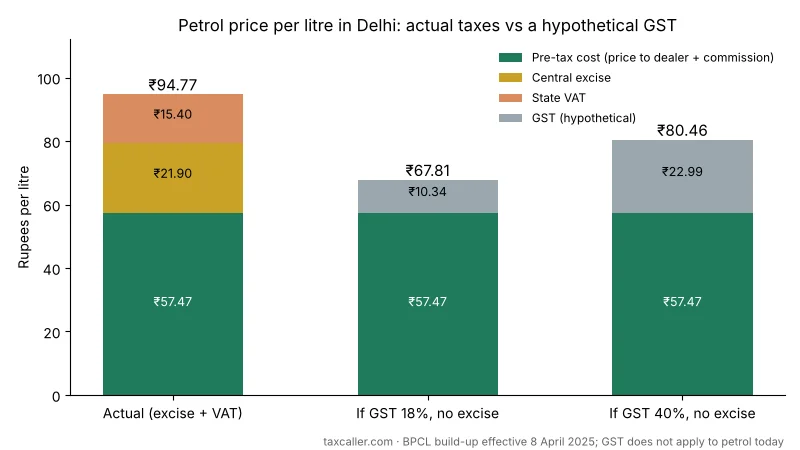
Using the BPCL Delhi numbers above, the pre-tax cost is ₹53.08 plus ₹4.39 of dealer commission, or ₹57.47 a litre. With no excise or VAT and a single GST:
| Scenario (hypothetical) | Tax per litre | Price per litre |
|---|---|---|
| Actual, 8 April 2025 (excise + VAT) | ₹37.30 | ₹94.77 |
| GST at 18%, no excise | ₹10.34 | ₹67.81 |
| GST at 40%, no excise | ₹22.99 | ₹80.46 |
Even the 40% rate, the highest in the GST structure since 22 September 2025, raises far less than the present taxes. That gap is why governments hesitate. It is also why the outcome is unlikely to look like the table. Entry 84 of the Union List still lets the Centre levy excise on these products after GST arrives, just as tobacco carries both GST and a central excise duty today. A future regime could therefore combine GST with a per-litre duty, and the pump price need not fall much at all.
The one change that would matter to businesses, whatever the rate, is input tax credit. Once fuel carries GST, a registered transporter or factory could set the tax paid on diesel against its own output GST, which is not possible with excise and VAT.
Why petrol is not under GST yet
- State revenue. VAT on fuel is one of the few large taxes states still control. Under GST they would share the tax and lose the power to set their own rate.
- Central revenue. The per-litre excise and cesses are a large and steady source of income for the Centre.
- Voting rule. Under Article 279A(9), a Council decision needs at least three-fourths of the weighted votes of members present and voting. The Centre's vote counts for one-third and all states together for two-thirds, so neither side can carry the change alone.
- Rate and compensation. No rate has been agreed, and the compensation cess that once protected state revenue has been wound down.
The Council has looked at the question and stepped back. At its 45th meeting in Lucknow on 17 September 2021, after directions from the Kerala High Court, it considered bringing specified petroleum products under GST and "was of the view that it is not appropriate to do so at this stage", according to the Council's September 2021 newsletter. In a Lok Sabha reply of 25 July 2024, the Finance Ministry said the Council had made no recommendation and had not taken the matter up as an agenda item since that meeting; after the 53rd meeting in June 2024, the Union Finance Minister was reported by Business Today and DT Next as saying the Centre was willing but states would have to agree on the rate. No later Council meeting, including the 56th in September 2025 that introduced the new slabs and the 57th in October 2026, has recommended a date.
GST on petrol and diesel for businesses: ITC and records
Can you claim input tax credit on petrol or diesel?
No. A fuel bill shows VAT, not GST, so there is no GST to take credit for. The VAT and the excise buried in the price become part of your cost, whether the fuel runs a delivery van, a generator or a boiler. This is a real cost for transport and logistics businesses, which is why trade bodies keep asking for fuel to come under GST.
GST does apply to many things around fuel, and credit on those follows the normal rules: lubricants and engine oil (18%), vehicle servicing and repairs, and freight charged by a transporter. Credit on a motor vehicle itself is restricted by Section 17(5)(a), with exceptions such as vehicles used to carry goods.
How to show fuel in your books and returns
- Record fuel purchases as an expense with VAT included. Do not show them as GST purchases.
- If you sell any of the five products, report the sales as non-GST outward supplies in Table 8 of GSTR-1 and Table 3.1(e) of GSTR-3B.
- No e-way bill is needed for moving petrol, diesel, crude, natural gas or ATF; Rule 138(14) of the CGST Rules excludes them.
When a business reimburses an employee's fuel bill or a transporter charges a fuel surcharge, the GST treatment follows the main service, not the fuel. A goods transport agency's freight, including any fuel component in it, is taxed at the GTA rate that applies to that supply.
GST registration and credit rules for petrol pumps
A petrol pump that sells only petrol and diesel makes only non-taxable supplies. Under Section 23(1)(a) of the CGST Act, a person engaged exclusively in supplying goods not liable to tax does not need to register. In practice most outlets also sell engine oil, coolant, additives or snacks, or rent space, and those are taxable, so they register once their aggregate turnover crosses the threshold. That turnover includes the fuel sales, because aggregate turnover counts exempt and non-taxable supplies.
A registered pump must split its credit. "Exempt supply" in Section 2(47) includes non-taxable supplies, so under Section 17(2) and Rules 42 and 43 the credit on common inputs and capital goods (a canopy, CCTV, accounting software, the annual maintenance contract) has to be reversed in proportion to fuel sales. Credit on purchases used only for lubricant sales is kept in full.
Pump owners who want the registration done or the credit split worked out each month can use our GST registration and GST return filing services.
Common myths about GST on petrol
- "Petrol is taxed at 28% or 40% GST." No GST rate applies to petrol. The 28% slab no longer exists and the 40% slab does not cover fuel.
- "Petrol is GST exempt." Not quite. It is outside GST until a date is notified; exemption is a different legal category. The result for buyers is the same: no GST on the bill.
- "My petrol bill has CGST and SGST." A pump bill for petrol should show VAT. If it shows GST, the GST relates to something else on the bill, such as engine oil.
- "CNG is under GST because LPG is." CNG is natural gas, one of the five excluded products. LPG is not on that list.
- "GST would halve petrol prices." Only if excise were dropped and a low rate chosen. Neither has been decided.
Related GST rates for vehicle owners: buying the vehicle is covered on GST on cars and GST on bikes, and cover for it on GST on insurance. To add or remove GST on any other purchase, use the GST calculator.
Official sources
- PPAC: state-wise VAT, sales tax and GST rates on petroleum products
- BPCL: price build-up of petrol at Delhi
- Central Excise notifications of 26 March 2026 with corrigendum (PPAC copy)
- GST Council newsletter, September 2021: 45th meeting decision on petroleum products
- Lok Sabha unstarred question 678, 25 July 2024: petroleum products and GST
- GST Council FAQs on the September 2025 rate changes
- CBIC: GST goods and services rates
- News On AIR, 1 November 2026: export duty changes on petrol, diesel and ATF
Frequently asked questions
Is there GST on petrol in India?
No. Petrol, diesel, crude oil, natural gas and aviation turbine fuel are within the constitutional definition of GST, but Section 9(2) of the CGST Act defers the levy until the government notifies a date on the GST Council's recommendation. No date has been notified, so petrol carries central excise duty and state VAT, not CGST, SGST or IGST.
Do petrol and diesel fall in the 5%, 18% or any other GST slab?
There is no GST rate for either fuel. Neither appears in any GST rate notification, and the 5%, 18% and 40% slabs introduced on 22 September 2025 do not cover them. Asking for a petrol GST rate is like asking for a GST rate on liquor: the product sits under a different tax system altogether.
Why is petrol not under GST?
Because the GST Council has not recommended a date. Fuel taxes are a large, reliable income for the Centre and the states, and states would lose control of their VAT rates. A Council decision needs three-fourths of the weighted votes, so both sides must agree. The 45th meeting in 2021 found it not appropriate at that stage.
What is the tax on 1 litre of petrol?
It varies by state and by date. In BPCL's Delhi build-up effective 8 April 2025, a ₹94.77 litre carried ₹21.90 of central excise and ₹15.40 of VAT, so taxes were ₹37.30, about 39% of the price. The excise notifications were amended in March 2026, so check the latest build-up from the oil companies or PPAC.
Is there 40% GST on petrol?
No. A 40% GST slab has existed since 22 September 2025 for a short list of luxury and harmful goods and some services, such as large cars, aerated drinks, betting and online money gaming. Petrol is not on that list because it is not under GST at all. The fuel is taxed only through excise and state VAT.
Can I claim input tax credit on petrol or diesel bills?
No. A fuel bill carries VAT and the price includes central excise, but neither is GST, so nothing can be claimed as input tax credit. The full amount is a business expense. Credit is still available on GST-taxed items around the vehicle, such as lubricants and repairs, subject to the vehicle restrictions in Section 17(5).
Which petroleum products are under GST?
All petroleum products except the five excluded ones. Domestic LPG is taxed at 5%, commercial LPG at 18%, kerosene sold through the public distribution system at 5%, and lubricating oils and greases at 18%. Only crude oil, petrol, high speed diesel, natural gas and aviation turbine fuel remain outside GST and carry excise and VAT.
Is CNG under GST?
No. Compressed natural gas is natural gas, one of the five products kept out of GST by Article 279A(5) and Section 9(2) of the CGST Act. It therefore carries central excise and state VAT, like petrol. LPG is different: it is a petroleum gas that is not on the excluded list, so it is taxed under GST.
Which tariff code covers petrol and diesel?
Petrol falls under heading 2710, with motor spirit and blends such as E20 at 2710 12 41 to 2710 12 49. High speed diesel is 2710 19 30 and automotive diesel fuel 2710 19 44. These customs tariff codes are used for excise and VAT, and carry no GST rate while the fuels stay outside GST.
Which state has the highest VAT on petrol?
Among the states in PPAC's table updated on 23 November 2026, Telangana's 35.20% is the highest flat percentage on petrol. Andhra Pradesh charges 31% plus ₹4 a litre and a road cess, and Kerala charges 30.08% plus per-litre levies and cesses. Per-litre add-ons mean the highest percentage does not always give the highest pump price.
How much VAT is charged on petrol in Delhi?
Delhi charges 19.40% VAT on petrol, according to PPAC's state tax table. Diesel in Delhi carries 16.75% VAT plus an air ambience charge of ₹250 per kilolitre. The VAT is calculated on the price after central excise and dealer commission, so part of the state's tax falls on the central duty.
Does a petrol pump need GST registration?
Only if it sells taxable goods or services as well as fuel. A person dealing exclusively in goods not liable to tax need not register under Section 23(1)(a). Most pumps also sell engine oil or other items, and their aggregate turnover, which includes fuel sales, usually crosses the threshold. A registered pump must reverse credit on common costs.
Do fuel tankers carrying petrol or diesel need an e-way bill?
No. Rule 138(14) of the CGST Rules says no e-way bill is needed when the goods being moved are petroleum crude, high speed diesel, petrol, natural gas or aviation turbine fuel, along with alcoholic liquor. State laws and the oil companies' own documents still govern these movements, and products such as lubricants need an e-way bill as usual.
Will petrol come under GST in 2026 or 2027?
No date has been announced. The 56th GST Council in September 2025 and the 57th in October 2026 did not recommend bringing petrol or diesel under GST. Any change would need a Council recommendation, a notification under Section 9(2) of the CGST Act and matching state notifications. Treat any report of a fixed date with caution.
Sources: GST portal HSN/SAC directory (updated 23 Oct 2026) · CBIC rate notifications: 9/2025-Central Tax (Rate) as amended up to 01/2026-Central Tax (Rate), 30 Apr 2026 (in force from 1 May 2026); services under 11/2017-Central Tax (Rate) as amended. Rates are the total GST (CGST + SGST, or IGST). Content updated .
Reviewed By

Expert for this topic GST classification and rates
Abhinay Rai
Advocate
Abhinay Rai is a Advocate specialising in GST classification and rates. The codes, rates and examples on this page are checked against the GST portal HSN directory and the current CBIC rate notifications, and are updated when a new notification is issued.