
GST on Tobacco 2026: 40% Rate, Biris 18%, Cess Ended, RSP Valuation
Government data: GST portal HSN directory and CBIC rate notifications. Rates as per 01/2026-Central Tax (Rate), 30 Apr 2026 (in force from 1 May 2026). Last checked 20 Nov 2026.
3 results for “Hookah tobacco”
- 24031110HSN40%
Other manufactured tobacco and manufactured tobacco substitutes, "homogenised" or "reconstituted" tobacco, tobacco extracts andessences › Water pipe tobacco specified in sub-heading note to this chapter
Hookah or gudaku tobacco
Notification 9/2025 as amended by 19/2025-CT(Rate), Schedule III, S. No. 17
- 24011080HSN5% or 40%
Unmanufactured tobacco; tobacco refuse › Tobacco, not stemmed or stripped
Tobacco for manufacture of hookah tobacco
- 5% Tobacco leave
- 40% Unmanufactured tobacco; tobacco refuse [other than tobacco leaves]
Notification 9/2025-CT(Rate), Schedule I, S. No. 162
- 24012080HSN5% or 40%
Unmanufactured tobacco; tobacco refuse › Tobacco, partly or wholly stemmed or stripped
Tobacco for manufacture of hookah tobacco
- 5% Tobacco leave
- 40% Unmanufactured tobacco; tobacco refuse [other than tobacco leaves]
Notification 9/2025-CT(Rate), Schedule I, S. No. 162
HSN codes and GST rates for tobacco
From the GST portal HSN list, with the rate from the current CBIC notification. Tap Copy to use the code on your invoice.
- 2401HSN5% or 40%
Unmanufactured tobacco; tobacco refuse
- 5% Tobacco leave
- 40% Unmanufactured tobacco; tobacco refuse [other than tobacco leaves]
Notification 9/2025-CT(Rate), Schedule I, S. No. 162
- 2402HSN40%
Cigars, cheroots, cigarillos and cigarettes, of tobacco or of tobacco substitutes
Notification 9/2025 as amended by 19/2025-CT(Rate), Schedule III, S. No. 16
- 2403HSN40%
Other manufactured tobacco and manufactured tobacco substitutes, "homogenised" or "reconstituted" tobacco, tobacco extracts andessences
Notification 9/2025 as amended by 19/2025-CT(Rate), Schedule III, S. No. 17
- 24041100HSN40%
Products containing tobacco, reconstituted tobacco, nicotine, or tobacco or nicotine substitutes, intended for inhalation without combustion, other nicotine containing products intended for the intake of nicotine into th
Containing tobacco or reconstituted tobacco
Notification 9/2025 as amended by 19/2025-CT(Rate), Schedule III, S. No. 18
- 24041900HSN40%
Products containing tobacco, reconstituted tobacco, nicotine, or tobacco or nicotine substitutes, intended for inhalation without combustion, other nicotine containing products intended for the intake of nicotine into th
Other
Notification 9/2025 as amended by 19/2025-CT(Rate), Schedule III, S. No. 19
- 21069020HSN40%
Food preparations not elsewhere specified or included › Other
Pan masala
Special cases
- 5% Namkeens, bhujia, mixture, chabena and similar edible preparations in ready for consumption form, whether or not pre- packaged and labelled
- 5% Texturised vegetable proteins (soya bari), Bari made of pulses including mungodi and batters; Roasted Gram idli/dosa batter, chutney powder; Sweetmeats
- 5% (other than 21069020) Food preparations not elsewhere specified or included [other than pan masala]
Notification 9/2025 as amended by 19/2025-CT(Rate), Schedule III, S. No. 14
Read more: HSN Code for Sweets →
Quick answer
GST on tobacco is 40% from 1 February 2026 for cigarettes, chewing tobacco, gutkha, pan masala and most raw tobacco (HSN 2401 to 2404). Biris pay 18% and tobacco leaves 5%. Compensation cess is now nil. Tax on notified goods is worked out from the printed retail sale price, and a higher central excise duty applies on top.
Tobacco has had two tax overhauls in five months. GST 2.0 on 22 September 2025 left tobacco at 28% plus compensation cess while the cess loans were being repaid. Then, from 1 February 2026, Notification 19/2025-Central Tax (Rate) moved cigarettes, cigars, chewing tobacco, gutkha, pan masala, most unmanufactured tobacco and nicotine inhalation products to 40%, put biris at 18%, and the compensation cess on all of them was cut to nil. Two new central levies arrived the same day: a higher central excise duty on tobacco and a capacity-based cess on pan masala factories.
This page sets out the GST rate for each tobacco product with its tariff code, the new retail sale price (RSP) method for working out the tax, a full timeline with notification numbers, how the excise duty and the Health Security se National Security Cess fit on top of GST, and what traders, distributors and manufacturers need to do differently in 2026. Every rate is matched to the official notification or Act; links are at the end.
On this page: Rates by product · Old and new rates · Compensation cess · RSP valuation · Calculation · Central excise · Pan masala cess · Tobacco leaves · ITC · Compliance · 40% slab
GST on tobacco products: rates from 1 February 2026
The rates below come from Notification 19/2025-Central Tax (Rate) and its IGST twin 19/2025-Integrated Tax (Rate), both dated 31 December 2025, which amended the GST 2.0 rate notification 9/2025 with effect from 1 February 2026. CGST and SGST are half of the total each; IGST is the full rate.
| Product | Tariff code | GST | Compensation cess | Valued on |
|---|---|---|---|---|
| Cigarettes, cigars, cheroots, cigarillos | 2402 | 40% (20% CGST + 20% SGST) | Nil | Retail sale price |
| Chewing tobacco, zarda, khaini, gutkha, snuff, hookah and smoking tobacco, other manufactured tobacco (except biris) | 2403 | 40% | Nil | Retail sale price |
| Biris | 2403 19 21, 2403 19 29 | 18% (9% CGST + 9% SGST) | Nil | Transaction value |
| Unmanufactured tobacco and tobacco refuse, other than tobacco leaves | 2401 | 40% | Nil | Retail sale price |
| Tobacco leaves | 2401 | 5% (reverse charge when bought from a farmer) | Nil | Transaction value |
| Heated tobacco and nicotine products for inhalation without combustion | 2404 11 00, 2404 19 00 | 40% | Nil | Retail sale price |
| Pan masala | 2106 90 20 | 40% | Nil (new capacity cess applies, see below) | Retail sale price |
| Tendu (bidi wrapper) leaves | 1404 90 10 | 5% from 22 September 2025 | Not applicable | Transaction value |
The 40% goods were added to Schedule III of the rate notification and biris to Schedule II. The same notification deleted the old 28% schedule, which by then held only these goods. Electronic cigarettes are not in the table because their production, sale and import are banned under the Prohibition of Electronic Cigarettes Act, 2019.
Tobacco pages published before February 2026 still show "28% GST plus cess". That was the law until 31 January 2026 only. An invoice for cigarettes, gutkha or pan masala dated 1 February 2026 or later must show 40% and no compensation cess.
Tobacco GST rate: old and new, with notifications
| Period | GST on most tobacco products | Biris | Other levies | Source |
|---|---|---|---|---|
| 1 July 2017 to 31 March 2023 | 28% | 28% | Compensation cess, mostly ad valorem or a percentage plus a per-thousand amount for cigarettes; small excise and NCCD on some items | 1/2017-CT(R); 1/2017-Compensation Cess (Rate) |
| 1 April 2023 to 31 January 2026 | 28% | 28% | Compensation cess on pan masala and many tobacco products changed to a per-unit amount linked to the retail sale price | Compensation cess amendments effective 1 April 2023 |
| 22 September 2025 | 28% retained | 28% retained | Cess kept on tobacco only, until the cess loans were repaid; tendu leaves cut to 5% | 9/2025-CT(R); GST Council FAQ Q1 |
| From 1 February 2026 | 40% | 18% | Compensation cess nil; RSP valuation; additional central excise; pan masala capacity cess | 19/2025-CT(R), 19/2025-CT, 20/2025-CT, 03/2025-Compensation Cess (Rate), Central Excise (Amendment) Act, 2025, Health Security se National Security Cess Act, 2025 |
The GST Council's FAQ on the September 2025 changes explains the gap. Its first answer says the existing GST and compensation cess rates "will continue to apply" to cigarettes, chewing tobacco, unmanufactured tobacco and biris until the loans and interest taken to pay compensation to states are fully discharged, after which the new rates would take effect. The government notified 1 February 2026 as that date.
Has compensation cess on tobacco ended?
Yes, in practice. Notification 03/2025-Compensation Cess (Rate), dated 31 December 2025, set the cess rate to nil on pan masala and the tobacco goods of Chapters 21 and 24 with effect from 1 February 2026. The GST Council's December 2025 newsletter describes this as fully withdrawing the levy of compensation cess on these goods. For other goods, such as cars and aerated drinks, the cess had already been merged into the GST rate on 22 September 2025.
So a tobacco invoice from 1 February 2026 carries no cess line. The revenue that the cess used to raise now comes from three places: the higher 40% GST rate, a new layer of central excise duty, and, for pan masala, the Health Security se National Security Cess.
RSP-based valuation for tobacco and pan masala
Normally GST is charged on the price the buyer actually pays. For notified tobacco goods and pan masala it is charged on the retail sale price printed on the pack, at every stage of the chain. This comes from Notification 19/2025-Central Tax, issued under Section 15(5) of the CGST Act (amending Notification 49/2023-Central Tax), and the new Rule 31D of the CGST Rules inserted by Notification 20/2025-Central Tax. Both apply from 1 February 2026.
- Goods covered: pan masala (2106 90 20) and goods of headings 2401, 2402, 2403 and 2404 that are notified. Biris and tobacco leaves are taxed on the ordinary transaction value.
- Value: the declared retail sale price, minus the tax included in it.
- Retail sale price: the maximum price at which the goods may be sold to the final consumer, inclusive of all taxes, duties, surcharges and cesses.
- More than one RSP on a pack: the highest one is used. A revised or higher RSP printed later becomes the RSP for the supply.
- Different RSPs for different areas: each area's RSP applies to supplies in that area.
The effect is that discounts in the trade chain do not reduce the tax. A distributor who sells below the printed price still pays GST worked out from the printed price.
How to calculate GST on tobacco products
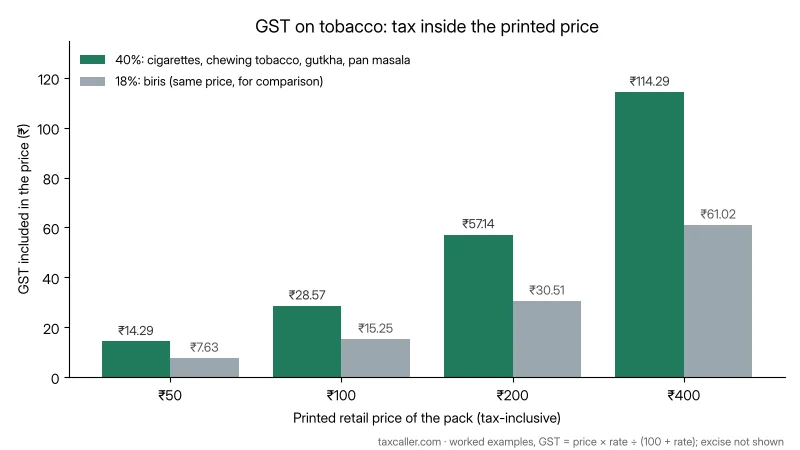
For goods valued on RSP, the tax is already inside the printed price. Take it out with this formula:
GST = RSP × rate ÷ (100 + rate), and taxable value = RSP − GST.
Example 1: a pack of cigarettes
A pack of 20 cigarettes has a printed RSP of ₹400.
| Item | Amount |
|---|---|
| GST inside the RSP: 400 × 40 ÷ 140 | ₹114.29 |
| CGST (20%) and SGST (20%) | ₹57.14 each |
| Deemed taxable value: 400 − 114.29 | ₹285.71 |
The GST is a little under 29% of what the smoker pays, even though the rate is 40%, because the rate applies to the price before tax. Excise duty is also inside that ₹285.71; GST is charged on a value that includes the excise.
Example 2: a distributor selling below the printed price
A distributor in Lucknow sells 50 packs of chewing tobacco with an RSP of ₹200 each to a retailer in the same state for ₹130 a pack.
| Item | Amount |
|---|---|
| Total RSP: 50 × ₹200 | ₹10,000 |
| GST at 40% on RSP basis: 10,000 × 40 ÷ 140 | ₹2,857.14 |
| CGST and SGST | ₹1,428.57 each |
| Price actually agreed: 50 × ₹130 | ₹6,500 |
| Invoice total (price + GST) | ₹9,357.14 |
Had the tax been charged on the ₹6,500 actually agreed, it would have been ₹2,600 at 40%. The RSP rule gives ₹2,857.14, or ₹257.14 more, because the deemed value of ₹7,142.86 is above the trade price. That gap is the point of the rule: trade discounts no longer shrink the tax base. Billing software has to show the commercial price on the invoice and the RSP-based tax separately; TallyPrime, for example, released a tobacco add-on for this.
Example 3: biris at 18%
Biris are not on RSP valuation. A wholesaler selling a carton of biris for ₹1,000 before tax adds 18%, or ₹180, as ₹90 CGST and ₹90 SGST, for a total of ₹1,180. To find the tax in a tax-inclusive ₹1,180, use 1,180 × 18 ÷ 118 = ₹180. The GST calculator does both sums.
Central excise duty on tobacco from 1 February 2026
Tobacco is one of the few goods on which the Centre can still levy excise alongside GST, under Entry 84 of the Union List. The Central Excise (Amendment) Act, 2025 raised the tariff rates of excise on tobacco and tobacco products, as one of the levies that took over from the compensation cess. The government notified 1 February 2026 as the date from which the additional excise duty applies.
| Product | Excise tariff before | Excise tariff under the 2025 Act |
|---|---|---|
| Cigarettes (per 1,000 sticks) | ₹200 to ₹735 | ₹2,700 to ₹11,000 |
| Chewing tobacco | 25% | 100% |
| Hookah (gudaku) tobacco | 25% | 40% |
| Unmanufactured tobacco | 64% | 70% |
| Smoking mixtures for pipes and cigarettes | 60% | 325% |
These tariff rates are from PRS Legislative Research's summary of the Bill, and the higher figures match reports on the enacted Act (The Tribune, CAclubindia). The duty actually collected is set by exemption notifications and can be lower; for cigarettes, ThePrint and Business Today reported the effective duty between about ₹2,050 and ₹8,500 per 1,000 sticks depending on length and filter, and around 82% for chewing and jarda scented tobacco and 91% for gutkha. Treat those effective figures as reported, and check the Central Excise notifications for the duty on a specific product. Excise is paid by the manufacturer when goods leave the factory, and no GST credit can be used to pay it.
Health Security se National Security Cess on pan masala
The Health Security se National Security Cess Act, 2025 (Act 35 of 2025) came into force on 1 February 2026 by notification S.O. 6153(E) dated 31 December 2025. Its main features:
- Goods: pan masala under tariff item 2106 90 20. The government may notify other goods later.
- Basis: not the quantity sold, but the machines installed or the process used. For machines the monthly cess depends on the maximum rated speed (pouches or tins per minute) and the weight per pack. For example, the Act's schedule sets ₹101 lakh a month for a machine running up to 500 pouches a minute with packs up to 2.5 g. A wholly manual factory pays a flat ₹11 lakh a month.
- Who pays: whoever owns, operates or controls the machine or process, even through job workers.
- Payment: monthly, by the 7th, with a monthly return. Abatement is possible if a machine is shut for at least 15 continuous days.
- Relation to GST: it is in addition to GST and any other tax. The proceeds go to the Consolidated Fund of India for health and national security spending.
The cess is a manufacturer's cost. It does not appear as a separate line on a trader's GST invoice, and it cannot be paid with GST input tax credit.
GST on tobacco leaves and raw tobacco
Heading 2401 is split in two. Tobacco leaves stay at 5%, while "unmanufactured tobacco and tobacco refuse [other than tobacco leaves]" moved to 40% on 1 February 2026. Where a registered buyer purchases tobacco leaves from an agriculturist, the buyer pays the GST under reverse charge, as listed in Notification 4/2017-Central Tax (Rate).
The line between the two is a frequent dispute. In July 2026 the West Bengal Appellate Authority for Advance Ruling upheld a ruling that sun-cured tobacco leaves, supplied after storage, grading and butting, remain "tobacco leaves" at 5%, because curing does not change their essential character; it did not cover threshing, stemming or stripping. Being an advance ruling, the order is binding on that applicant and its own tax officer alone; other dealers can use its reasoning but not claim its protection.
Processed forms such as tobacco stem powder, threshed strips and cut tobacco are generally treated as unmanufactured tobacco other than leaves, or as manufactured tobacco, and fall in the 40% bracket.
Input tax credit on tobacco
Tobacco is not a blocked credit under Section 17(5). A registered trader can take credit of the 40% GST charged by the supplier and use it against GST on the onward sale, and a manufacturer can take credit on its inputs, packaging and services. Two limits matter:
- Excise and the pan masala cess are paid in cash. They are central levies outside GST, so GST credit cannot settle them.
- Composition is not available to manufacturers. Manufacturers of pan masala and of tobacco and manufactured tobacco substitutes cannot opt for the composition scheme under Notification 14/2019-Central Tax. A trader who only resells packed products can.
Retail shops buying cigarettes or gutkha from a distributor should check that the distributor's invoice shows the RSP-based tax, since that is the amount that will show in GSTR-2B.
Compliance for tobacco and pan masala businesses
- Machine registration. Manufacturers of pan masala and notified tobacco goods have followed a special procedure since 2024: packing machines must be registered and monthly production reported in the prescribed forms.
- E-invoices and e-way bills. The GSTN advisory on RSP valuation asks businesses to report the actual sale price as the taxable value, the tax worked out on the RSP basis, and an invoice value equal to price plus that tax. Where the system computes a different tax, the amount may be edited manually in GSTR-1.
- Software. Item masters need the RSP per pack and the 40% rate with no cess; vouchers dated before 1 February 2026 keep the old structure.
- Stock and records. In a tobacco stem powder case on 19 November 2026, the GST Appellate Tribunal's Agra bench was reported (TaxGuru) to have held that excess stock found in a survey called for the demand provisions rather than confiscation; the facts of each case matter. Keep stock registers matched to invoices to avoid such disputes.
- Registration. A tobacco trader with turnover above the threshold must register like any other business; see GST registration. Brand owners should also look at trademark Class 34 for tobacco goods.
Where tobacco sits in the 40% GST slab
Since 22 September 2025 GST has one special rate above 18%, and tobacco was the last large group of goods to join it. Before February 2026 the 40% rate already applied to sugared and caffeinated drinks, the bigger passenger cars, motorcycles over 350 cc and gaming and betting. From 1 February 2026 pan masala and every tobacco product except biris and plain leaves joined that group. The full list of 40% items, with their notification entries, is kept on our GST rate finder page, and individual codes can be checked in the HSN code finder.
Two differences set tobacco apart from the other 40% goods. First, cars and drinks lost their cess on 22 September 2025, while tobacco kept 28% plus cess for another four months. Second, tobacco also carries central excise, which cars and drinks do not, so the 40% GST is only part of its total tax.
Liquor is a separate case. Alcoholic drinks for human consumption are kept out of GST by the Constitution, so state excise and VAT apply instead, and no GST slab, 40% or otherwise, is charged on them. For the vehicles in the slab, see GST on cars and GST on bikes.
Official sources
- GST Council newsletter, December 2025: notifications 19/2025-CT(R), 19/2025-CT, 20/2025-CT and 03/2025-Compensation Cess (Rate)
- GST Council FAQs on the September 2025 rates (Q1 on tobacco)
- India Code: Health Security se National Security Cess Act, 2025
- PIB factsheet on the Health Security se National Security Cess
- PRS: Central Excise (Amendment) Bill, 2025 summary
- News On AIR: 1 February 2026 notified for additional excise and new rates
- West Bengal AAAR order 03/WBAAAR/Appeal/2026 on tobacco leaves
- GSTN e-invoice advisory on RSP-based valuation
Frequently asked questions
How much GST is charged on tobacco in 2026?
Most tobacco products pay 40% GST from 1 February 2026: cigarettes, cigars, chewing tobacco, zarda, khaini, gutkha, hookah tobacco, unmanufactured tobacco other than leaves and nicotine inhalation products. Biris pay 18% and tobacco leaves 5%. The rates come from Notification 19/2025-Central Tax (Rate), and no compensation cess is added any more.
What was the GST on tobacco before 1 February 2026?
From July 2017 to 31 January 2026, tobacco products and biris were taxed at 28% GST. Most products, though not biris, also carried compensation cess, which for cigarettes combined a percentage with an amount per thousand sticks. GST 2.0 on 22 September 2025 left this structure in place for tobacco until the cess loans were repaid.
How much GST is charged on gutkha?
Gutkha is manufactured tobacco under heading 2403, so it pays 40% GST from 1 February 2026, calculated on the retail sale price printed on the pouch. It also carries central excise duty under the Central Excise (Amendment) Act, 2025. The compensation cess that gutkha paid until January 2026 has been reduced to nil.
At what rate are cigarettes taxed under GST now?
Cigarettes under heading 2402 pay 40% GST, split as 20% CGST and 20% SGST within a state. The tax is worked out from the printed retail sale price, so a ₹400 pack contains ₹114.29 of GST. A separate central excise duty based on stick length applies as well, but the old compensation cess no longer does.
What is the GST rate on bidi?
Biris, under tariff items 2403 19 21 and 2403 19 29, are taxed at 18% from 1 February 2026, down from 28%. They are not on retail sale price valuation, so the tax is charged on the actual sale price. Tendu leaves used to wrap biris were cut from 18% to 5% on 22 September 2025.
What is the GST on tobacco leaves?
Tobacco leaves are taxed at 5% GST. When a registered buyer purchases them from an agriculturist, the buyer pays that tax under reverse charge. Other unmanufactured tobacco and tobacco refuse under heading 2401 moved to 40% from 1 February 2026, so the dividing line between plain leaves and processed raw tobacco now carries a large difference in tax.
Is compensation cess still charged on tobacco?
No. The cess on pan masala and tobacco products became nil from 1 February 2026 under a Compensation Cess (Rate) notification issued on the last day of 2025, numbered 03/2025. Its revenue is now raised through the 40% GST rate, a higher central excise duty on tobacco and the new capacity-based cess on pan masala manufacturing.
What is RSP-based valuation for tobacco?
It means GST on notified tobacco goods and pan masala is calculated on the retail sale price printed on the pack, not on the price the buyer pays. The value is the RSP minus the tax included in it. It comes from Notification 19/2025-Central Tax under Section 15(5) and Rule 31D, both effective 1 February 2026.
How do you calculate GST on tobacco products?
For goods valued on RSP, multiply the printed price by the rate and divide by 100 plus the rate. A ₹200 pouch at 40% holds 200 × 40 ÷ 140, or ₹57.14 of GST, on a value of ₹142.86. For biris, which use the sale price, simply add 18% to the price before tax.
What is the Health Security se National Security Cess?
It is a new central cess on pan masala manufacturing under Act 35 of 2025, in force from 1 February 2026. It is charged monthly on each packing machine according to its rated speed and pack size, or as a flat amount for manual factories, and is paid by the manufacturer in addition to GST and other taxes.
What changed in excise duty on tobacco in 2026?
The Central Excise (Amendment) Act, 2025 raised the tariff rates on tobacco, for example from ₹200 to ₹735 per thousand cigarettes to ₹2,700 to ₹11,000, and chewing tobacco from 25% to 100%. The additional duty applies from 1 February 2026. Effective rates set by notification can be lower than these tariff rates.
Can a trader claim ITC on tobacco purchases?
Yes. Tobacco is not on the blocked list in Section 17(5), so a registered trader can claim the 40% GST charged by the supplier and set it off against GST on resale. Credit cannot be used to pay central excise duty or the pan masala cess. Manufacturers of tobacco products cannot use the composition scheme.
Is there 40% GST on alcohol?
No. Liquor for drinking is kept out of GST by Article 366(12A) of the Constitution, so states tax it through their own excise and VAT. The 40% slab covers tobacco and pan masala, aerated and certain other non-alcoholic drinks, larger cars, motorcycles above 350 cc, betting, gaming and admission to events like the IPL.
Is GST on pan masala also 40%?
Yes. Pan masala under tariff item 2106 90 20 moved to 40% GST from 1 February 2026, valued on the printed retail sale price, with compensation cess cut to nil. Manufacturers also pay the Health Security se National Security Cess on their packing machines. Pan masala that contains tobacco, sold as gutkha, falls under heading 2403.
Sources: GST portal HSN/SAC directory (updated 23 Oct 2026) · CBIC rate notifications: 9/2025-Central Tax (Rate) as amended up to 01/2026-Central Tax (Rate), 30 Apr 2026 (in force from 1 May 2026); services under 11/2017-Central Tax (Rate) as amended. Rates are the total GST (CGST + SGST, or IGST). Content updated .
Reviewed By

Expert for this topic GST classification and rates
Abhinay Rai
Advocate
Abhinay Rai is a Advocate specialising in GST classification and rates. The codes, rates and examples on this page are checked against the GST portal HSN directory and the current CBIC rate notifications, and are updated when a new notification is issued.