ITR due date, transfer pricing cases: 30 Nov 2026 7 days left

TDS / TCS deposit for last month: 7 Dec 2026 14 days left

GSTR-1 (monthly filers): 11 Dec 2026 18 days left

Advance tax, 3rd instalment (75%): 15 Dec 2026 22 days left

+91 87500 70081wecare@taxcaller.comAsk TaxCaller

Md Salim, TaxCaller expert, in the TaxCaller office

Trademark Registration Online Simple & Reliable with TaxCaller

Trademark registration online for your brand name, logo or slogan, from search and TM-A filing to the registration certificate.

Content updated 21 Nov 2026 · Verified by expert 24 Oct 2026

★ Special offer🎁 Free expert consultation

Register your Trademark

55 online
Pay on Proof · ₹1,399 Trademark Filing plan
PAY NOW · 49%₹686
AFTER GOVT PROOF (TM NO.)₹713 balance
Brand not protected?Your rights count from the filing date, so file early
IN +91
🔒 No spam · Privacy
Since 2018Trusted Experience
980+Experts Connected
220+Cities Served
1164+Agents Available
12,650+Founders Trusted
S

Srishti Magoo

★★★★★

Excellent experience with TaxCaller for filing my & my family members ITR returns. The entire process was smooth, quick and hassle-free. They are professional, knowledgeable and guided me through every step with patience.

O

obeid sait

★★★★★

The team has handled my taxes for the past three years, and it's been a wonderful, hassle-free experience. Thank you for your consistently quick and efficient service.

P

Pushkar

★★★★★

They are among the best in their field. Their work culture is highly professional, and their client service is smooth and reliable. They can confidently be relied on to get the job done.

P

Prasad Sheth

★★★★★

Excellent experience with TaxCaller! The ITR filing process was smooth, quick, and completely hassle-free. The CA was knowledgeable, responsive, and explained everything clearly.

A

Apoorv Bansal

★★★★★

Excellent service for ITR filing. The team was highly professional, responsive, and guided me through the entire process smoothly. My return was filed accurately and on time.

A

Abhishek Kumar

★★★★★

I was searching for a good CA firm in Ghaziabad and found TaxCaller. The experience was excellent from start to finish. The team is responsive, transparent, and genuinely helpful.

U

uma pandey

★★★★★

Great service! TaxCaller India made the entire ITR filing process quick, smooth, and hassle-free. They answered all my queries patiently and ensured maximum accuracy.

T

tanu mittal

★★★★★

Excellent job! We've been connected for many years, and your success truly makes me happy. You are an incredibly intelligent person. Keep shining, keep growing.

B

Bhanu Pratap Maurya

★★★★★

I am filing my ITR since past 3 years with Abhinav and Firm is known as TaxCaller and they are professional interms of ITR rules. They will explain and tell you all the information.

A

ashish Sharma

★★★★★

I am providing my honest reviews: No.1 service ...

A

AARYAN GROUP

★★★★★

Honestly, finding a good CA firm in Ghaziabad was confusing, but TaxCaller India made it simple. I contacted them for GST work and the experience was smooth.

N

News Speaks

★★★★★

If you're looking for a reliable CA firm in Ghaziabad, TaxCaller India is a great choice. They provide complete taxation and compliance solutions including GST.

A

Anshul Chaprana

★★★★★

Got my GST registration done through TaxCaller CA firm. Process was quite smooth, they guided properly on documents and didn't waste time. Overall good experience.

How we work

Online · Call · WhatsApp

Quick answer

Trademark registration in India is done online by filing Form TM-A with the Trade Marks Registry under the Trade Marks Act, 1999. The government fee is ₹4,500 per class for individuals, startups and small enterprises, and ₹9,000 for others. You can use ™ after filing and ® after registration, which lasts ten years and is renewable.

Reviewed by Abhinay Rai · Updated 21 Nov 2026

Pick a plan that fits

Filing

Trademark search + application in 1 class

₹2,999 53% off

₹1,399 + GST

+ Govt. fee

Pay now (49%)₹686+ GST After the TM application number₹713+ GST
Zubair, TaxCaller expertHandled by a TaxCaller Expert Trademark Expert
Book Now

Fee confirmed in writing before you pay

What you'll get

  • Trademark search
  • Application (TM-A) in 1 class
  • Use ™ from the day of filing

Most Popular

Filing + Objection

Filing + reply to the examination report

₹4,999 52% off

₹2,399 + GST

+ Govt. fee

Pay now (49%)₹1,176+ GST After the TM application number₹1,223+ GST
Abhinay Rai, TaxCaller expertHandled by a TaxCaller Expert Trademark Expert
Book Now

Fee confirmed in writing before you pay

What you'll get

  • Everything in Filing
  • Reply to the examination report (objection)
  • Application status tracking

Filing + Objection + Hearing

Full support till the decision

₹7,999 56% off

₹3,499 + GST

+ Govt. fee

Pay now (49%)₹1,715+ GST After the TM application number₹1,784+ GST
Shadab, TaxCaller expertHandled by a TaxCaller Expert Trademark Expert
Book Now

Fee confirmed in writing before you pay

What you'll get

  • Everything in Filing + Objection
  • Hearing support before the Registrar
  • Tracking till registration certificate

Government fees and taxes are extra where applicable. Our expert confirms the final amount on the first call. No hidden charges.

About Trademark Registration in India

Trademark registration gives you the legal right to use your brand name, logo or slogan for the goods or services you sell. In India, it is done under the Trade Marks Act, 1999 and the Trade Marks Rules, 2017. You file Form TM-A with the Trade Marks Registry, which works under the Controller General of Patents, Designs and Trade Marks (IP India).

The whole process is online. You search for clashing marks, pick the right class, file the application and pay the government fee. The Registry then examines the mark, publishes it in the Trade Marks Journal and, if nobody objects, issues a registration certificate. The registration lasts ten years and can be renewed again and again.

TaxCaller handles this work online for clients across India from our New Delhi head office. This page explains every stage in plain words: what you can register, what it costs, how long it takes and what to do after you get the ® symbol.

Complete guide

Choose a topic to open it. Every answer gives the rule or section it comes from.

02 Topic 2 of 24

Types of Marks and What the Law Will Not Register

Indian law allows many kinds of marks. You choose the type in Form TM-A when you file. The type decides how the mark is shown in the application and how the examiner reads it.

Type of markExampleFiling note
Word markA brand name in plain lettersProtects the word in any font, style or colour
Device or logo markA symbol, label or stylised nameImage up to 8 cm x 8 cm under Rule 26(1)
Combined markName and logo togetherProtects the full combination as filed
Slogan or taglineA short catchy line used with the brandMust be distinctive, not a plain claim of quality
Shape (3D) markA unique bottle or product shapeThree views needed under Rule 26(3)
Colour markA distinctive colour combinationColour claim and colour image under Rule 26(2)
Sound markA jingle or audio signatureMP3 file up to 30 seconds plus notation, Rule 26(5)
Collective markMark of an association used by its membersGoverned by Sections 61 to 68
Certification markMark that certifies quality or originGoverned by Sections 69 to 78

Brand name, logo or both?

Most small businesses ask which one to file first. The answer depends on what customers remember and on your budget.

What you fileWhat it protectsWeak point
Word mark onlyThe name itself, in any font, colour or styleThe design of your logo stays unprotected
Logo onlyThe image exactly as filedA rival may copy the name in a plain style
Name and logo as one composite markThe full combinationRights are read as a whole, so a copy of the name alone is harder to stop
Word mark and logo as two applicationsThe name and the logo, each on its ownTwo government fees for each class

If money allows only one filing, the word mark usually gives wider cover. Add the logo once the design is final.

Not every sign can be registered. Section 9 lists the absolute grounds for refusal. The Registry will refuse a mark that:

  • has no distinctive character, so buyers cannot link it to one business;
  • only describes the kind, quality, quantity, purpose, value or origin of the goods;
  • has become customary in everyday language or trade practice;
  • is likely to deceive the public or cause confusion;
  • may hurt religious feelings, or is scandalous or obscene;
  • is barred by the Emblems and Names (Prevention of Improper Use) Act, 1950;
  • is a shape that comes from the nature of the goods, gives a technical result or adds substantial value.

Section 11 lists relative grounds. These compare your mark with earlier marks. A mark that is identical or deceptively similar to an earlier mark for the same or similar goods can be refused if it may confuse buyers. Well-known marks get wider protection, even across unrelated goods.

Think of marks on a scale of strength. Invented words are the strongest. Ordinary words used in an unrelated field come next. Suggestive words that hint at a quality are weaker. Plain descriptive words are the hardest to register. Generic names of products cannot be registered at all. A distinctive mark moves through examination faster.

Zubair

Zubair Trademark Expert

Have a question on this topic? Ask Zubair on a free call.

Ask an expert

← Previous Next: Who Can Apply and When You Should File →

03 Topic 3 of 24

Who Can Apply and When You Should File

Section 18 lets any person who claims to be the owner of a mark apply for it. The mark can already be in use or only proposed for use. Rule 25(1) asks for a statement of use only when the mark is already in use. So you can file before you launch.

These applicants can file a trademark application in India:

  • Individuals: any person, including a freelancer or creator.
  • Sole proprietors: the mark is filed in the owner's own name, with the trade name mentioned.
  • Partnership firms: the mark is filed in the names of the partners trading as the firm.
  • LLPs and companies: the mark is filed in the name of the entity itself.
  • Trusts, societies and NGOs: filed through an authorised trustee or office bearer.
  • Startups and small enterprises: they pay the lower government fee if they meet the Rule 2 definitions.
  • Joint owners and foreign businesses: foreign applicants must give an Indian address for service under Rule 17.

Whose name should the mark be in?

Business formMark is filed in the name ofGovernment fee per class
Individual or sole proprietorshipThe owner, with the trading name shown₹4,500
Partnership firmAll partners, trading as the firm₹4,500 if Udyam shows micro or small, else ₹9,000
LLP or companyThe LLP or company itself₹4,500 if micro or small on Udyam, or DPIIT recognised, else ₹9,000
Trust or societyThe trust or society, through its authorised person₹9,000 unless it qualifies for the lower fee
Foreign businessThe foreign entity, with an Indian address for service₹9,000 unless it qualifies for the lower fee

A brand used by a company should be filed in the company's name, not a director's. If a founder already holds it, an assignment can move it to the company later.

Trademark registration is not compulsory in India. You can run a business without it. But an unregistered brand is weak in a dispute. Section 27 says no one can sue for infringement of an unregistered mark. You are left with a passing off action, where you must prove reputation, confusion and loss.

The right time to file is before you spend on the brand. File before you print packaging, build a website or run ads. File before you list on a marketplace, take on investors or sign a franchise deal. Investors and buyers often check whether the brand is filed in the company's name.

Section 34 protects a person who used a similar mark before you. Registration does not stop that earlier user. This is one more reason to search well and file early. The date of filing becomes your date of priority against later applicants.

← Previous Next: Benefits of Registering Your Brand in India and Abroad →

04 Topic 4 of 24

Benefits of Registering Your Brand in India and Abroad

Registration gives you rights that an unregistered brand does not have. Here are the main benefits in practical terms.

  • Exclusive right to use: Section 28 gives the registered owner the exclusive right to use the mark for the registered goods or services across India.
  • Easier court action: Section 29 lets you sue for infringement. You do not need to prove reputation as you would in a passing off case.
  • The ® symbol: only a registered owner can use ®. It tells competitors the brand is protected.
  • Early priority date: rights date back to the filing date under Section 23(1), not the date of the certificate.
  • A business asset: a registered mark can be sold, assigned, licensed or franchised. It can add value when a business is valued or sold.
  • Marketplace access: brand protection programmes on large online marketplaces usually ask for a trademark application or registration.
  • A deterrent: your mark shows up in the Registry's search. Later applicants with similar marks get an objection citing your mark.
  • A base for global filing: your Indian application can support a Madrid Protocol filing for other countries.

Protection abroad. An Indian trademark protects your brand in India only, because trademark rights are territorial. India joined the Madrid Protocol in 2013, and Chapter IVA of the Act (Sections 36A to 36G) deals with it. Your Indian application or registration can be the base for one international application covering many member countries. Each country then examines the mark under its own law. Under the Paris Convention, you can also claim your Indian filing date in other member countries if you file there within six months. Section 154 gives the same benefit in India to applicants from convention countries.

Online marketplaces. Large e-commerce platforms run brand protection programmes. They usually ask for a registered trademark or a pending application number. Once enrolled, you get tools to report fake listings and control your brand page. To use them, file the mark exactly as it appears on your packaging, in the class of the goods you sell, and in the same name as the seller account. If you sell goods, you may also need GST; our GST registration page explains when it applies.

Registration also builds trust. Customers, distributors and banks see a registered brand as a serious business. For a small business, the cost is low compared with the cost of a forced rebrand later.

← Previous Next: Choosing the Right Trademark Class →

05 Topic 5 of 24

Choosing the Right Trademark Class

Every trademark is registered for specific goods or services. India follows the Nice Classification of WIPO, as stated in Section 7 and Rule 20 of the Trade Marks Rules, 2017. There are 45 classes. Classes 1 to 34 cover goods. Classes 35 to 45 cover services.

Protection applies only to the classes and items you claim. If you register a clothing brand in Class 25, it does not automatically stop someone using the same name for a cafe in Class 43. So class selection is one of the most important decisions in the application.

All 45 trademark classes at a glance

ClassMain goods or services covered (short form)
1Industrial and farm chemicals, fertilisers, adhesives
2Paints, varnishes, colourants, rust preventives
3Cosmetics, soaps, perfumes, cleaning products
4Industrial oils, fuels, lubricants, candles
5Medicines, supplements, disinfectants, baby food
6Common metals, metal fittings, hardware, safes
7Machines, machine tools, motors, engines (not for land vehicles)
8Hand tools, cutlery, razors
9Software, apps, computers, phones, electronic and scientific devices
10Medical, surgical and dental instruments, spectacles and sunglasses
11Lighting, heating, cooking, cooling and water supply apparatus
12Vehicles and their parts
13Firearms, ammunition, fireworks
14Jewellery, precious metals, watches
15Musical instruments
16Paper, printed matter, books, stationery
17Rubber, plastics in semi-processed form, insulating material
18Leather goods, luggage, bags, umbrellas
19Non-metal building materials such as cement, tiles and building glass
20Furniture, mirrors, picture frames
21Kitchen and household utensils, glassware, brushes
22Ropes, tents, tarpaulins, sacks, raw fibres
23Yarns and threads for textile use
24Textiles, household linen, curtains
25Clothing, footwear, headgear
26Lace, buttons, hair decorations, artificial flowers
27Carpets, rugs, mats, floor coverings, wall hangings
28Games, toys, sports goods
29Meat, fish, dairy, edible oils, processed fruits and vegetables
30Tea, coffee, rice, flour, bakery items, spices, sweets, ice cream
31Fresh fruits and vegetables, grains, seeds, plants, animal feed
32Mineral water, soft drinks, fruit juices, beer
33Alcoholic drinks other than beer
34Tobacco, smokers' articles
35Advertising, business management, retail and online store services
36Insurance, banking, finance, real estate services
37Construction, repair, installation services
38Telecom services
39Transport, travel booking, storage, delivery
40Treatment of materials, recycling, printing, food preservation
41Education, coaching, training, entertainment, events
42IT and scientific services, software development, SaaS
43Restaurants, cafes, catering, hotels
44Medical, beauty, salon, farming services
45Legal, security and personal services

This list is a short guide. The official heading of each class has more items, and the class of a product can turn on small details. A clothing seller that also runs an online store may need Class 25 and Class 35 together. A cloud kitchen often needs Class 43, and Class 30 if it sells packed food.

Rule 23(4) allows one application to cover one mark in as many classes as you need. The government fee is charged for each class. Some owners prefer separate applications for each class. That way, an objection in one class does not hold up the others.

The wording of goods and services also matters. Too narrow a list leaves gaps. Too broad a list can draw objections or later non-use attacks. Rule 37 does not let you add new goods after filing. We draft the specification around what you sell now and what you plan to sell soon.

Abhinay Rai

Abhinay Rai Trademark Expert

Have a question on this topic? Ask Abhinay on a free call.

Ask an expert

← Previous Next: Trademark Search Before You File →

06 Topic 6 of 24

Trademark Search Before You File

A search is the first and most useful step. It tells you whether an identical or similar mark is already filed in your class. Skipping it is the main reason applications run into objections.

IP India runs a free public search of the trademark register. It allows three main checks:

  • Word search: finds marks that start with, contain or match your word.
  • Phonetic search: finds marks that sound like yours, even with a different spelling.
  • Vienna code search: finds logos with similar figurative elements, such as stars, animals or crowns.

A good search goes beyond the register. We also look at company and LLP names, domain names and active brands on marketplaces and social media. Section 34 protects earlier users even if they never filed, so their use matters too.

During examination, the Registrar runs its own search under Rule 33(1). If it finds a similar earlier mark, it cites that mark in the examination report. A careful search before filing lowers this risk. It does not remove it, because the examiner may read similarity differently.

If you want an official view, you can ask the Registry for a search certificate in Form TM-C. The e-filing fee is ₹9,000, as per the First Schedule shown on the IP India Form and Fees page. Most small businesses rely on a professional search instead, which is part of our filing plan.

Our search report gives you a clear view: go ahead, go ahead with changes, or pick a new name. If the risk is high, we suggest small changes that can make the mark distinctive.

Quick checklist before you file

  • The name does not simply describe the product or its quality.
  • Word, sound-alike and logo searches are done in every class you need.
  • The class list and the wording of goods or services are final.
  • The applicant is the real owner of the brand: you, your firm or your company.
  • For a firm, LLP or company, Udyam (micro or small) or DPIIT proof is ready if you want the ₹4,500 fee.
  • You know the first date of use, and you have dated proof for it.
  • The logo is final, in a clear JPG within 8 cm x 8 cm.
  • The domain name and social media handles are free or already yours.

← Previous Next: Documents Required for Trademark Registration →

07 Topic 7 of 24

Documents Required for Trademark Registration

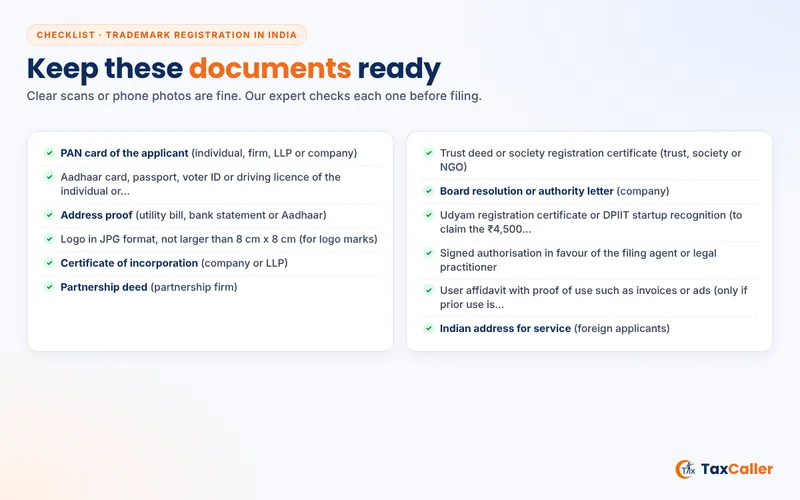
Documents for Trademark registration: PAN card of the applicant (individual…, Aadhaar card, passport, voter ID or…, Address proof (utility bill, bank…, Logo in JPG format, not larger than 8…, Certificate of incorporation (company……
Trademark Registration in India: documents to keep ready

The paperwork is light, but it must match the applicant type. A mismatch between the applicant name and the documents is a common reason for formality objections.

ApplicantDocuments
Individual or sole proprietorPAN, Aadhaar or other ID, address proof, logo file (if any), signed authorisation
Partnership firmPartnership deed, firm PAN, ID and address proof of partners, logo, authorisation signed by a partner
LLPCertificate of incorporation, LLP agreement, LLP PAN, ID of the designated partner, logo, authorisation
CompanyCertificate of incorporation, company PAN, board resolution or authority letter, ID of the signatory, logo, authorisation
Trust, society or NGOTrust deed or registration certificate, PAN, ID of the authorised trustee, logo, authorisation
Foreign applicantIncorporation proof, Indian address for service, logo, authorisation

Some documents depend on your claims:

  • Startup or small enterprise proof: a DPIIT startup recognition or Udyam registration certificate to claim the ₹4,500 fee. Get it through our MSME registration service before filing if you do not have one.
  • User affidavit: if you claim use before the filing date, Rule 25(2) asks for an affidavit with supporting proof such as invoices, ads or labels.
  • Logo file: a clear JPG image, not larger than 8 cm x 8 cm, in black and white or the exact colours you claim.
  • Authorisation: Section 145 allows a legal practitioner or a registered trade marks agent to act for you. Rule 19 asks for the authorisation in Form TM-M.

Keep proof of use from the day you start. Dated invoices, packaging, website screenshots and ad bills help in replies, oppositions and court cases later.

← Previous Next: How TaxCaller Files Your Trademark Online, Step by Step →

08 Topic 8 of 24

How TaxCaller Files Your Trademark Online, Step by Step

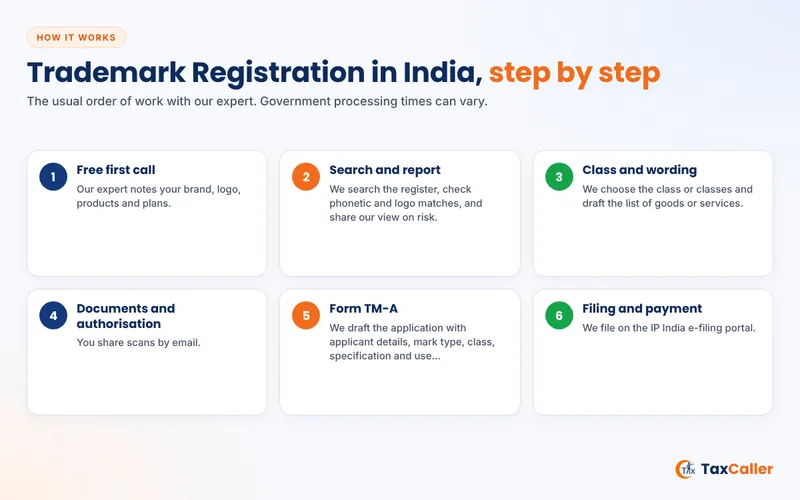
Trademark registration process step by step: Free first call, Search and report, Class and wording, Documents and authorisation, Form TM-A, Filing and payment
Trademark Registration in India: how the work moves, step by step

We run the full process online. You do not need to visit the Registry. Here is how a typical file moves with us.

  1. Free first call: our expert notes your brand, logo, products and plans. We tell you the fee upfront.
  2. Search and report: we search the register, check phonetic and logo matches, and share our view on risk.
  3. Class and wording: we choose the class or classes and draft the list of goods or services.
  4. Documents and authorisation: you share scans by email. We prepare the authorisation and any user affidavit.
  5. Form TM-A: we draft the application with applicant details, mark type, class, specification and use date.
  6. Filing and payment: we file on the IP India e-filing portal. The government fee is paid online. You get an application number the same day.
  7. Use the ™ symbol: you can start using ™ with your brand once the application is filed.
  8. Tracking: we watch the status on the IP India e-status page and tell you when the examination report comes.
  9. Reply and hearing: under the higher plans, we draft the reply and support you at the hearing.
  10. Journal and certificate: we track publication, the opposition window and the issue of the certificate.
  11. Renewal reminders: we keep your renewal date on record and remind you in time.

For logo marks, the Registry adds Vienna codes to the image after filing. These codes describe the figurative parts of the logo. They help the examiner find similar logos.

The Registry has five offices. Rule 4 sends your application to the office that covers your principal place of business in India. As per the IP India office locations page, the New Delhi office covers Delhi, Uttar Pradesh, Haryana, Punjab, Uttarakhand, Himachal Pradesh, Jammu and Kashmir and Chandigarh. Mumbai, Kolkata, Chennai and Ahmedabad cover the other states. So a business in Ghaziabad or Noida falls under New Delhi. Since filing and hearings are online, the office matters less than it once did. The broad flow matches the official IP India trademark filing process guide.

Shadab

Shadab Trademark Expert

Have a question on this topic? Ask Shadab on a free call.

Ask an expert

← Previous Next: Trademark Registration Stages After Filing and Realistic Timelines →

09 Topic 9 of 24

Trademark Registration Stages After Filing and Realistic Timelines

Once your application is filed, it moves through three official stages: examination, Journal publication and registration. Here is what happens at each one.

1. Examination. An examiner checks formalities, the absolute grounds in Section 9 and the relative grounds in Section 11. The Registrar also runs a search for similar marks under Rule 33(1). The result is an examination report, issued online. The report may accept the mark, or it may raise objections that need a reply. Status meanings and objection deadlines are covered below.

2. Journal publication. An accepted mark is advertised in the Trade Marks Journal under Section 20 and Rule 39. The Journal is published online. For four months after publication, anyone can oppose the mark. Rule 38 also lets the Registrar withdraw acceptance before registration if a fresh issue arises, with thirty days for you to respond.

3. Registration certificate. If nobody opposes, or an opposition fails, the mark is registered under Section 23. The Registry issues the certificate in Form RG-2 under Rule 56(1), with the Registry's seal. The date of registration is the date of filing, as Section 23(1) says. Your ten-year term counts from that date. The certificate section below explains what it shows and where you use it.

Under Section 23(1), the Registry aims to register a mark within eighteen months of filing. Actual time depends on the Registry's workload and on objections or oppositions.

StageTime limit or usual timeBasis
Filing and application numberSame day on e-filingIP India e-filing system
Examination reportDepends on Registry queueRule 33
Reply to examination reportWithin one month of receiptRule 33(4)
Show cause hearingDate fixed by the RegistryRule 115
Opposition window after publicationFour monthsRule 42(1)
Certificate if not opposedAfter the opposition window endsSection 23, Rule 56
Expedited examinationOrdinarily within three months of the requestRule 34(1)

The four-month opposition window cannot be shortened. If speed matters, you can ask for expedited examination in Form TM-M under Rule 34, after you get the application number. The e-filing fee is ₹20,000 for individuals, startups and small enterprises, and ₹40,000 for others. Rule 34 says later steps, up to final disposal, are also handled faster.

We share honest timelines on the first call. We do not promise a fixed date, because the Registry controls the pace. What we control is our side: same-day filing once documents are ready, and replies well before the deadline.

← Previous Next: Trademark Status Meanings and What to Do Next →

10 Topic 10 of 24

Trademark Status Meanings and What to Do Next

Your application number lets you follow the file on the IP India e-status page. The status words are short, and the exact labels on the screen can change over time. The table names each stage in plain words, so match the status you see to the nearest stage.

StageWhat it meansWhat you should do
Application receivedThe filing is received and waiting to be processedNothing yet. You may use ™
Vienna codification (logo marks)The Registry is coding the figurative parts of your logoWait. This is a routine step for logo marks
Formality check passedThe basic filing details are in orderWait for examination
Formality check failedA document, signature or detail is missing or wrongFix the defect quickly, usually through Form TM-M
Sent for examinationThe file has gone to an examinerWait for the examination report
Objection raisedThe examination report raises one or more objectionsFile a reply within one month under Rule 33(4)
Show cause hearing dueThe reply did not clear all objections and a hearing is duePrepare arguments and evidence, then attend the online hearing
Accepted and advertisedThe mark is accepted and published in the Trade Marks JournalWatch the four-month opposition window
Advertised before acceptanceThe Registrar has published the mark before acceptance, as the proviso to Section 20(1) allows in some casesWatch for oppositions and any conditions noted in the Journal
OpposedA third party has filed a notice of oppositionFile the counter-statement within two months under Rule 44(1)
RegisteredThe mark is on the register and the certificate is issuedDownload the certificate, start using ® and note the renewal date
RefusedThe Registrar has refused the applicationAsk for written grounds within thirty days under Rule 36, then consider an appeal
AbandonedThe file was closed, often for a missed reply or counter-statementCheck at once whether it can be revived; otherwise file again
WithdrawnThe applicant withdrew the applicationFile a fresh application if you still want the mark
RemovedThe mark was taken off the register, often for non-renewalApply for restoration within one year from expiry under Rule 60

Status screens can lag behind the Registry's actual work by a few days. Check the documents tab for the latest notice, not just the status line. We check our clients' files regularly and send each new notice with a note on what it means.

← Previous Next: Replying to an Examination Report Objection →

11 Topic 11 of 24

Replying to an Examination Report Objection

An objection is the examiner's question, not a final refusal. After examining your application under Rule 33 of the Trade Marks Rules, 2017, the Registry issues an examination report. It lists each point that stops the mark from being accepted, and the status then shows the mark as objected. You must answer within one month of receiving the report, under Rule 33(4). The reply has no government fee. It is filed online on the e-filing portal as a reply to the examination report.

Ground in the reportWhat it usually meansHow it is usually answered
Section 9(1)(a): no distinctive characterA common word, a plain shape, a single letter or a laudatory phraseShow how the mark points to your business alone, with evidence of use
Section 9(1)(b): describes the goodsThe mark states the kind, quality, purpose or origin, such as "Pure Ghee" for gheeExplain why the mark only suggests and does not describe; offer a disclaimer if that helps
Section 9(1)(c): customary in the tradeThe word is already used by many sellers in that lineShow the term is not common for your goods, or prove acquired distinctiveness
Section 9(2): deceptive or barredThe mark may mislead, hurt religious feelings or use a protected emblemClarify the meaning, or amend the goods so the mark is not misleading
Section 11: similar earlier markThe examiner has cited one or more earlier marksCompare look, sound, meaning and goods; check whether cited marks are still alive; rely on prior use (Section 34), honest concurrent use (Section 12) or the earlier owner's consent (Section 11(4))
Formal requirementsWrong class, vague goods, missing authorisation or an unsupported use dateCorrect by Form TM-M within Rule 37 limits, file a user affidavit under Rule 25(2), or file the authorisation under Rule 19

The proviso to Section 9(1) is often the strongest point. A mark is not refused if, before the filing date, it had become distinctive through use. That is why dated invoices, packaging, ads and sales figures matter so much. Use after the filing date does not count for this purpose.

How a strong reply is built.

  1. Read the report fully. We note each objection and open the record of every cited mark. A cited mark that is abandoned, removed or refused can be pointed out at once.
  2. Pick the route. Argue, narrow the goods, add evidence, or file afresh with a stronger mark. We explain each option in plain words before drafting.
  3. Draft point by point. The reply carries the application details, a short summary, a separate answer for every objection, a comparison table for cited marks and numbered exhibits.
  4. Close with a prayer. It asks the Registrar to accept and advertise the mark, and asks for a hearing before any adverse order, as Section 128 allows.
  5. File and follow up. We file the reply, then watch for acceptance, a Journal date or a hearing notice.

The hearing. If the reply does not settle every point, the Registry fixes a show cause hearing under Rule 115. Video hearings are permitted under that rule, so you rarely need to travel. We prepare a short note of arguments and attend with you or for you.

More time. If the one-month deadline is close, a request for more time can be filed in Form TM-M before it ends, at ₹900 on e-filing. Under Section 131 and Rule 109, the Registrar may allow up to one more month if there is sufficient cause. It is not automatic, so we aim to file within the first month.

If things go wrong. No reply can lead to the file being treated as abandoned under Rule 33(4) and Section 132. A review of a Registrar's decision can be sought in Form TM-M within one month under Rule 119, at ₹2,700 on e-filing. If the mark is refused after the hearing, Rule 36 lets you ask for written grounds in Form TM-M within thirty days, at ₹900. An appeal then lies to the High Court within three months under Section 91. Otherwise a new Form TM-A is needed, with a new filing date.

Mistakes that sink replies:

  • Pasting a template that does not deal with your mark or the cited marks.
  • Leaving one objection unanswered.
  • Claiming years of use without invoices or a sworn affidavit to back it up.
  • Trying to change the logo or add goods through the reply, which Rule 37 does not allow.
  • Missing the hearing date or the one-month deadline.

TaxCaller's objection reply service starts at ₹1,999 + GST. For new filings, our Filing + Objection plan at ₹2,399 + GST already includes the reply. Any government fee, such as ₹900 for a Form TM-M request, is paid separately at actual.

Shreya

Shreya Trademark Expert

Have a question on this topic? Ask Shreya on a free call.

Ask an expert

← Previous Next: Opposition Proceedings: Filing or Defending Form TM-O →

12 Topic 12 of 24

Opposition Proceedings: Filing or Defending Form TM-O

Opposition is a contest between two parties before the Registrar. It begins after the Registry accepts a mark and advertises it in the Trade Marks Journal. Section 21(1) lets any person oppose within four months of that advertisement. The opponent does not need a registration of its own. An earlier user of an unregistered mark can rely on prior use and passing off under Section 11(3)(a). Whether you are the brand owner who spotted a copycat or the applicant who received a notice, the steps and deadlines are the same.

Grounds an opponent can raise.

  • Section 9: the mark is descriptive, generic, customary in the trade, deceptive, or barred by the Emblems and Names (Prevention of Improper Use) Act, 1950.
  • Section 11: it is identical or similar to an earlier mark for similar goods, takes unfair advantage of a well-known mark, or would be stopped by passing off or copyright law.
  • Section 18(1): the applicant is not the true owner, for example a former distributor or a squatter who filed in bad faith.
StageWho filesTime limitBasis
Notice of opposition in Form TM-OOpponentFour months from the Journal advertisementSection 21(1), Rule 42(1)
Copy of notice sent to applicantRegistryOrdinarily within three months of receiptRule 42(5)
Counter-statement in Form TM-OApplicantTwo months from receipt of the noticeSection 21(2), Rule 44(1)
Evidence by affidavit, or a letter relying on the noticeOpponentTwo months from service of the counter-statementRule 45
Evidence by affidavit, or a letter relying on the counter-statementApplicantTwo months from receipt of the opponent's evidenceRule 46
Evidence in replyOpponentOne month from receipt of the applicant's evidenceRule 47
HearingBoth sidesNotice at least one month before the first dateRule 50
Appeal against the orderLosing sideThree months from the date the order is communicatedSection 91, to the High Court

Deadlines have teeth. If the applicant does not file the counter-statement in two months, Section 21(2) treats the application as abandoned. If the opponent files neither evidence nor a reliance letter, Rule 45(2) treats the opposition as abandoned. Rule 46(2) applies the same result to an applicant who stays silent at its evidence stage. The four months and the two months are fixed by Section 21 itself. Section 131 lets the Registrar extend only time limits that the Act does not fix, so these two cannot be stretched. Further evidence after Rule 47 needs the Registrar's leave under Rule 48.

Fees. The notice and the counter-statement each cost ₹2,700 per class on e-filing, or ₹3,000 on paper, as per the First Schedule. The schedule has no separate fee for evidence affidavits, but each affidavit must be stamped under Rule 120(6). A party can ask to adjourn the hearing in Form TM-M at least three days before the date. Rule 50 allows each side no more than two adjournments of up to thirty days each. The Registrar may also award costs under Rule 118, up to the limits in the Fourth Schedule.

Papers to keep ready. An opponent needs the Journal entry, its own registration certificates or proof of earlier use, and evidence of reputation such as invoices, ads and sales figures. An applicant needs the notice copy, the story of how it chose the mark, dated proof of use and any coexistence history. Rule 49 asks for an attested translation of any document that is not in Hindi or English. If we act for you, you sign an authorisation in Form TM-M under Rule 19.

How we handle an opposition. We work out the exact deadline from the Journal date or the date you received the notice. We compare the two marks, the goods and the filing dates, and tell you honestly how strong the case is. We then draft and file the notice or counter-statement, build the evidence affidavits, and prepare written arguments for the hearing. Many disputes end in a settlement. Common terms are a narrower list of goods, a change in the logo or a coexistence agreement, followed by withdrawal. A fully contested case often runs for a year or more, because the Registry's hearing list and adjournments control the pace.

Common mistakes in opposition matters:

  • Counting four months from the wrong date, or noticing the Journal entry too late.
  • A notice that lists every section of the Act but explains none of them.
  • Evidence with no dated documents, or claims that the invoices do not support.
  • Letting a Rule 45 or Rule 46 deadline pass, which can end the case for that side.
  • Skipping the hearing, so the Registrar decides on the papers alone.
  • Refusing to talk settlement when a small change to the goods would close the matter.

TaxCaller's opposition service starts at ₹5,999 + GST. The Form TM-O fee of ₹2,700 per class, and stamp duty on affidavits, are paid separately at actual.

← Previous Next: Trademark Renewal: Form TM-R, Grace Period and Restoration →

13 Topic 13 of 24

Trademark Renewal: Form TM-R, Grace Period and Restoration

A registration does not last forever on its own. Section 25 of the Trade Marks Act, 1999 gives it a life of ten years. The owner can extend it for ten more years, again and again, with no upper limit. Each extension is filed in Form TM-R. The Registry does not examine the mark afresh at renewal, and no proof of use has to be filed.

Count from the filing date. Section 23(1) treats the date of application as the date of registration. So the ten years run from the day you filed, not from the day the certificate arrived. A mark filed in March 2017 and registered in 2019 still falls due in March 2027. Owners who count from the certificate often lose two or three years of planning time.

When you file Form TM-RGovernment fee per class (e-filing)Basis
Any time in the last year before expiry₹9,000Section 25(2), Rule 57(1)
Within six months after expiry₹9,000 plus ₹4,500 surcharge, so ₹13,500Proviso to Section 25(3), Rule 59
After six months but within one year of expiry (restoration)₹9,000 plus ₹9,000 restoration fee, so ₹18,000Section 25(4), Rule 60
More than one year after expiryRestoration window closed; a fresh Form TM-A is neededSection 25(4)

Physical filing costs ₹10,000, ₹15,000 and ₹20,000 per class for the three cases. The amounts come from the First Schedule on the IP India Form and Fees page. Unlike Form TM-A, there is no lower renewal fee for individuals, startups or small enterprises. Every owner pays the same rate. Three classes renewed on time by e-filing cost 3 × ₹9,000, which is ₹27,000 in government fees.

The Registry's reminder. Rule 58(1) requires the Registrar to send a notice in Form RG-3 not more than six months before the expiry date. It goes to the address on the register. Section 25(3) also says the owner must be told of the expiry before the mark can be removed, and courts have set aside removals where that notice was never sent. Even so, treat RG-3 as a backup. If your address or email on record is old, the reminder may never reach you.

Marks registered close to or after the due date. Some files stay pending for so long that registration comes after the ten years have already passed. Rule 58(2) and (3) cover this case. The owner can renew within six months from the date the mark is actually entered on the register.

How we renew a mark for you.

  1. We open the record on the IP India e-register and confirm the expiry date, every class and the owner shown.
  2. If the owner's name or address has changed, we first record the change in Form TM-P under Section 58. The renewal then goes in the right name.
  3. You sign an authorisation in Form TM-M, as Rule 19 requires when an agent or advocate files for you.
  4. We file Form TM-R online for each class you want to keep and pay the official fee through the e-filing portal.
  5. For restoration, we add a short statement of why the renewal was missed. The Registrar restores the mark only if satisfied that it is just to do so.
  6. We track the file till the register shows the new term. Under Rule 61, the renewal is notified to the owner and any registered user and advertised in the Trade Marks Journal.

What removal does. If nothing is filed by the end of the grace period, the Registrar may remove the mark under Rule 59. For one year after removal, Section 26 still treats your mark as being on the register when others apply for a similar mark. That cover has exceptions, for example where you made no genuine trade use in the two years before removal. Once the one-year restoration window closes, the only option is a new application with a new filing date. Stop using ® from the date of removal, because Section 107 penalises anyone who claims a mark is registered when it is not.

Mistakes we see at renewal time:

  • Counting ten years from the certificate date instead of the filing date.
  • Dropping a class by accident. The fee is per class, so list every class you still trade in.
  • Renewing in a name that no longer matches the register after a sale, merger or name change.
  • Keeping an old address or email on record and missing the RG-3 notice.
  • Assuming renewal protects an unused mark. Section 47 still allows removal after five years of continuous non-use.
  • Letting the one-year limit in Rule 60 pass while waiting for a reminder.

A mark protected abroad through the Madrid Protocol has its own ten-year cycle, renewed directly with WIPO. TaxCaller's renewal service starts at ₹1,499 + GST. Government fees for Form TM-R, and any surcharge or restoration fee, are paid separately at actual.

← Previous Next: Assignment and Licensing: Selling or Sharing Your Brand →

14 Topic 14 of 24

Assignment and Licensing: Selling or Sharing Your Brand

A trademark is business property. You can sell it, pass it on, or let another business use it while you keep ownership. Selling or transferring ownership is called assignment. Giving permission to use is a licence. The Trade Marks Act, 1999 deals with them in separate chapters, and the Registry uses separate forms for each.

PointAssignmentLicence
What changesThe owner on the registerNothing; you stay the owner
Main sectionsSections 37 to 45Sections 48 to 54, and "permitted use" in Section 2(1)(r)
Registry formForm TM-P, Rule 75Form TM-U for a registered user, Rule 86
Government fee (e-filing)₹9,000 per mark₹4,500 per mark
Time limit to watchSection 42 directions within six months if goodwill is not transferredForm TM-U within six months of the licence agreement, Rule 86(3)
Suing infringersThe new ownerA registered user can sue in its own name under Section 52; a permitted user cannot, under Section 53

Kinds of assignment. Section 38 lets a registered mark move with or without the goodwill of the business, and for all or only some of its goods or services. Section 39 allows the same for an unregistered mark. So a deal can be complete or partial. A transfer that happens by law rather than by sale is called transmission. Death of the owner or a court-approved merger are common examples. Heirs or the successor company record it through the same route, with a will, succession papers or the approved scheme as proof.

Limits set by the Act. Section 40 blocks a transfer that would leave two people with exclusive rights in similar marks for the same kind of goods, where buyers could be confused. The owner can ask the Registrar for a certificate on the proposed deal under Section 40(2). Section 41 needs the Registrar's approval to split rights between different parts of India. A certification mark needs the Registrar's consent under Section 43. Associated marks can only move together, under Section 44.

Transfer without goodwill. If a mark already used in a business is sold without that business's goodwill, Section 42 applies. The buyer must apply for the Registrar's directions on advertising the transfer within six months of the assignment. The Registrar can extend this by up to three months in total. The request costs ₹2,700 and an extension ₹1,800 on e-filing. The buyer then publishes the advertisement as directed and files proof of it under Rule 81. If the six-month window is missed, the assignment does not take effect.

Recording the new owner. Signing the deed binds the two parties. Recording it tells everyone else. Section 45(1) asks the new owner to apply to register its title. The application is made in Form TM-P under Rule 75, with a certified copy of the deed and a statement of case under Rule 76(1). Rule 76(2) says the Registrar will ordinarily dispose of it within three months. Rule 77 allows a request for more proof only where there is reasonable doubt. Until the application is filed, Section 45(4) makes the transfer ineffective against someone who later gains a conflicting interest without knowing of it. A mark that is only applied for can also be assigned, since Section 39 covers unregistered marks.

The deed. A sound deed names both parties, the trade mark numbers, classes and the goods covered. It says whether goodwill passes, states the price and the effective date, and confirms there are no disputes or other licences. It also binds the seller to sign any Registry papers later. Stamp duty depends on your state's stamp law. Under Rule 78, a deed that is not properly stamped is impounded under the Indian Stamp Act, 1899. Where money is paid to someone outside India, Rule 79 needs any permission required under foreign exchange law first.

Licensing. A written licence with quality rules lets franchisees, contract makers or group companies use your brand. Under Section 48(2), their use counts as your use, which helps against a non-use claim. Registering the licensee as a registered user is optional but gives a public record and a right to sue under Section 52. A registered user cannot pass the right on to anyone else, as Section 54 makes clear.

Common mistakes:

  • A founder's personal mark is never moved into the company that actually runs the business.
  • The deed is unsigned by one side, unstamped or missing the trade mark numbers.
  • Goodwill is kept back, but no Section 42 request is made within six months.
  • One of a set of associated marks is sold alone, against Section 44.
  • The renewal goes in the seller's name because Form TM-P was never filed.
  • A licence has no quality control or end date, so disputes follow.

A brand sale may also have income tax and GST effects for both sides. Our tax consultant team can check this before you sign. TaxCaller's assignment service starts at ₹1,999 + GST. The TM-P fee, any Section 42 fee and stamp duty are paid separately at actual.

Zubair

Zubair Trademark Expert

Have a question on this topic? Ask Zubair on a free call.

Ask an expert

← Previous Next: ™ vs ®: Which Symbol You Can Use and When →

15 Topic 15 of 24

™ vs ®: Which Symbol You Can Use and When

The two symbols look similar, but they have very different legal meaning. Using the wrong one can attract a penalty.

SymbolMeaningWhen you can use it
™You claim the sign as your brandAny time, but most owners start after filing
®The mark is registered in IndiaOnly after registration, only for registered goods or services
SMInformal service mark claimNot defined in Indian law; ™ is used for services too

The ™ symbol has no statutory status. It only tells people that you treat the sign as your trademark. It is good practice to use it once your application is filed.

The ® symbol is different. Section 107 makes it an offence to falsely represent a mark as registered. Section 107(3) says that using the word "registered", or any symbol that suggests registration, counts as such a claim in India.

The Jan Vishwas (Amendment of Provisions) Act, 2023 changed the penalty under Section 107(2) from 1 August 2024. It is now a monetary penalty of half a per cent of total sales or turnover, or ₹5 lakh, whichever is less. Imprisonment no longer applies for this offence.

Three practical rules help you stay safe:

  • Do not use ® while the application is pending, even after acceptance.
  • Use ® only on the goods or services covered by your registration. Use ™ on others.
  • If your registration lapses and is removed, stop using ® until it is restored.

← Previous Next: Trademark Registration Fees: Government Fee vs TaxCaller's Fee →

16 Topic 16 of 24

Trademark Registration Fees: Government Fee vs TaxCaller's Fee

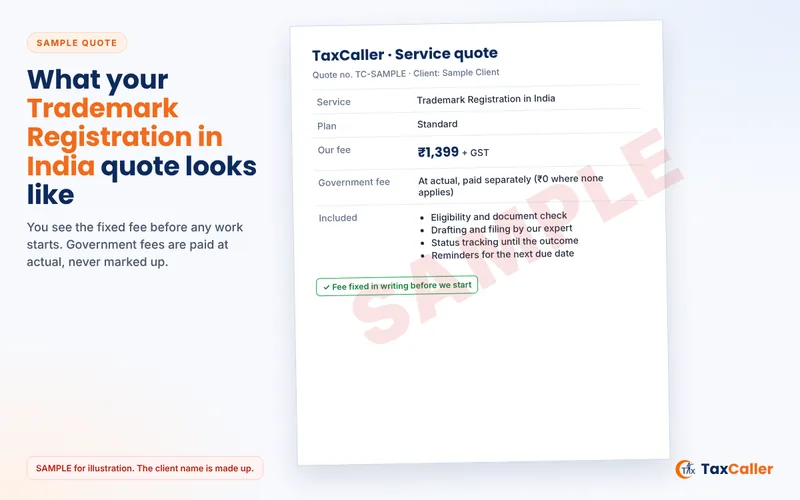
Sample TaxCaller quote for Trademark registration: fixed fee plus GST, government fee paid at actual
Trademark Registration in India: SAMPLE quote, for illustration only

There are two separate costs. The first is the government fee paid to the Trade Marks Registry. The second is TaxCaller's professional fee. We show them apart so you know exactly where your money goes.

Government fees. These come from the First Schedule to the Trade Marks Rules, 2017, as shown on the IP India Form and Fees page. They are per class and per mark.

Form and purposeE-filingPhysical filing
TM-A application: individual, startup or small enterprise₹4,500₹5,000
TM-A application: all other applicants₹9,000₹10,000
TM-O opposition or counter-statement₹2,700₹3,000
TM-M expedited examination: individual, startup or small enterprise₹20,000Not allowed
TM-M expedited examination: others₹40,000Not allowed
TM-R renewal₹9,000₹10,000
Renewal surcharge (late renewal)₹4,500 extra₹5,000 extra
Restoration with renewal₹9,000 plus renewal fee₹10,000 plus renewal fee
TM-M minor requests, such as extension or amendment₹900₹1,000

Worked examples of the government fee

Number of classesIndividual, startup or small enterpriseOther applicants
1 class₹4,500₹9,000
2 classes₹9,000₹18,000
3 classes₹13,500₹27,000
5 classes₹22,500₹45,000

The lower fee depends on who applies, not on the type of mark. A word mark and a logo filed as two applications pay two fees.

TaxCaller's fee. Our registration plans cover one mark in one class:

PlanWhat it includesTaxCaller fee
FilingTrademark search, TM-A filing in 1 class, ™ use from the filing date₹1,399 + GST
Filing + ObjectionEverything in Filing, reply to the examination report, status tracking₹2,399 + GST
Filing + Objection + HearingEverything above, hearing support before the Registrar, tracking till the certificate₹3,499 + GST

Starting professional fee (+ GST), government fee extra

ServiceStarting TaxCaller feeMain government fee, paid separately
Trademark registration₹1,399 + GST₹4,500 or ₹9,000 per class (TM-A)
Trademark objection reply₹1,999 + GSTNo fee for the reply
Trademark opposition₹5,999 + GST₹2,700 per class (TM-O)
Trademark renewal₹1,499 + GST₹9,000 per class (TM-R)
Trademark assignment₹1,999 + GST₹9,000 per mark (TM-P)

TaxCaller's fee starts at ₹1,399 + GST for the Filing plan. Government fees, such as the TM-A fee per class and any later Registry fees, are paid separately at actual. Extra classes, a second application for the logo and complex contested matters are quoted in writing before work starts.

← Previous Next: The Registration Certificate: What It Shows and How to Use It →

17 Topic 17 of 24

The Registration Certificate: What It Shows and How to Use It

Once the mark is registered, the Registry issues a certificate in Form RG-2 under Rule 56(1), with its seal. This is your proof that the brand is on the register.

What the certificate contains

  • The trade mark number
  • The mark, as a word or as the logo image you filed
  • The class and the list of goods or services covered
  • The name and address of the registered proprietor
  • The date of registration, which is the filing date under Section 23(1)
  • Any condition or limitation, such as a disclaimer on a common word

Check every detail when the certificate arrives. A spelling error in your name or address can be corrected under Section 58, on a request with the fee set in the First Schedule.

Where you will use it

  • Online marketplaces: brand protection programmes ask for your trade mark number.
  • Investors and buyers: due diligence checks that the brand sits in the company's name.
  • Licensing and franchising: the agreement should quote the registration number and classes.
  • Customs recordal: you can record a registered mark with Indian Customs under the Intellectual Property Rights (Imported Goods) Enforcement Rules, 2007, so fake imports can be held at the port.
  • Legal notices: a cease and desist letter carries more weight when it quotes your registration.

Note one limit. Rule 56(2) says the RG-2 certificate cannot be used in legal proceedings or to get registration abroad. For those, ask the Registry for a certified copy under Section 137, often called a legal certificate. Keep a soft copy of both with your company records.

Abhinay Rai

Abhinay Rai Trademark Expert

Have a question on this topic? Ask Abhinay on a free call.

Ask an expert

← Previous Next: Infringement, Offences and Penalties Under the Trade Marks Act →

18 Topic 18 of 24

Infringement, Offences and Penalties Under the Trade Marks Act

Registration gives you strong tools against copycats. The Act also punishes people who fake marks. Here is a short guide to the main provisions.

ProvisionWhat it coversConsequence
Section 29Use of an identical or deceptively similar mark on registered goods or servicesCivil suit for infringement
Section 27Unregistered marksNo infringement suit; passing off action only
Section 103Falsifying a trade mark or applying a false trade descriptionJail of 6 months to 3 years and fine of ₹50,000 to ₹2 lakh
Section 104Selling goods or giving services with a false markSame range as Section 103
Section 105Second or later conviction under Section 103 or 104Jail of 1 to 3 years and fine of ₹1 lakh to ₹2 lakh
Section 107Falsely showing a mark as registeredPenalty of 0.5% of turnover or ₹5 lakh, whichever is less

Under Section 134, a suit for infringement or passing off goes to a District Court or higher. You can file where you live or carry on business. This saves you from fighting a case in the copier's city.

Section 135 lists the reliefs. The court can grant an injunction to stop the use. It can also award damages or an account of profits, and order delivery of infringing labels and goods for destruction.

Infringement or passing off?

PointInfringementPassing off
Needs a registered markYes, Section 29No, it protects unregistered marks too
What you must proveThe other mark is identical or deceptively similar for covered goods or servicesYour goodwill, a misrepresentation and damage to you
Effort and proofLower, because the register proves your titleHigher, because reputation must be shown with evidence
ReliefsInjunction, damages or account of profits, delivery upSimilar reliefs, if you prove your case

Court cases and police complaints need a separate engagement. If you find a copycat, call us first. We help you collect evidence and explain the options, from a cease and desist notice to a suit.

← Previous Next: Rectification, Removal and Cancellation of a Registered Mark →

19 Topic 19 of 24

Rectification, Removal and Cancellation of a Registered Mark

A registration is strong, but it is not beyond challenge. The Act lets an aggrieved person ask for a mark to be taken off the register or corrected. Owners should know these routes, both to defend their own mark and to clear a blocking mark.

RouteSectionWhen it applies
Removal for non-useSection 47The mark was not used for a continuous period of five years after registration
Rectification of the registerSection 57An entry was made without sufficient cause, wrongly remains, or has an error or defect
Correction at the owner's requestSection 58Change of name, address or description, or cancellation of the entry by the owner
Removal for non-renewalSection 25The renewal fee was not paid even within the grace period

A non-use or rectification petition is filed before the Registrar, or before the High Court in some cases. The owner gets a chance to reply with evidence. Under Section 47, genuine use in the period, or special trade circumstances that stopped use, can defeat the claim.

This is why proof of use matters so much. Keep dated invoices, labels and ad bills for every class you hold. If an earlier registered mark blocks your application and its owner has stopped using it, a non-use petition may clear the way.

A mark that is cancelled loses all its statutory rights. You may still have passing off rights if you continue to trade under it, but they are harder to enforce.

← Previous Next: Common Mistakes That Lead to Objections or Refusal →

20 Topic 20 of 24

Common Mistakes That Lead to Objections or Refusal

Most problems in trademark files are avoidable. These are the mistakes we see most often:

  • Choosing a descriptive name: words like "Fresh Juice" or "Quality Tailors" describe the product. They draw a Section 9 objection.
  • No search before filing: a clash with an earlier mark leads to a Section 11 objection or an opposition.
  • Wrong class: filing a software service in Class 9 instead of Class 42 leaves the real business unprotected.
  • Vague goods list: phrases like "all goods" or "general services" get objected.
  • Wrong applicant: filing in a director's name when the company owns the brand creates trouble in funding and due diligence.
  • False use date: claiming an early use date without proof weakens the file and may fail in opposition.
  • Claiming the lower fee without eligibility: a company without Udyam or startup recognition must pay ₹9,000 per class.
  • Missing the one-month reply deadline: Rule 33(4) allows the Registrar to treat the file as abandoned.
  • Ignoring opposition notices: no counter-statement in two months means abandonment under Section 21(2).
  • Using ® too early: this can attract the Section 107 penalty.
  • Changing the logo after filing: Rule 37 does not allow amendments that change the mark in substance. A new logo needs a new application.
  • Forgetting renewal: the mark can be removed if the renewal fee is not paid in time.

A short call before filing catches most of these issues. It costs far less than a rejected application and a new brand.

Shadab

Shadab Trademark Expert

Have a question on this topic? Ask Shadab on a free call.

Ask an expert

← Previous Next: After Registration: Use, Records and Brand Watch →

21 Topic 21 of 24

After Registration: Use, Records and Brand Watch

A registered trademark needs light but regular care. These are the main points after you get the certificate.

Keep using the mark. Section 47 allows removal if a mark is not used for a continuous five years. Use the mark as registered, on the goods or services you claimed. Keep dated proof of use each year, such as invoices, packaging and ad bills.

Use ® correctly. Use ® only on registered goods or services. Use ™ on new products until they are covered too.

Record changes. If you change your address, name or business structure, update the register through Form TM-P under Section 58. An outdated address means you may miss Registry notices.

Licensing. You can license the brand to franchisees or manufacturers through a written agreement. Royalty payments may attract TDS, which our TDS return filing team can handle. The brand is also an intangible asset in your books; our accounting and bookkeeping service can record it properly.

Watch the Journal. New applications are published every week. If a similar mark appears in your class, you have four months to oppose it. A regular watch helps you act in time.

Plan new filings. When you add a new product line or a new logo, check whether your registration covers it. A new class or a changed logo needs a fresh application.

← Previous Next: Design Registration Under the Designs Act, 2000: Protecting a Product's Look →

22 Topic 22 of 24

Design Registration Under the Designs Act, 2000: Protecting a Product's Look

Design registration protects the new shape, pattern or surface look of a product, not its brand name. It is granted under the Designs Act, 2000 and the Designs Rules, 2001, as amended in 2021. Like trademarks, it is run by the Controller General of Patents, Designs and Trade Marks (IP India). Under Section 2(d) of the Designs Act, 2000, a design means only the features of shape, configuration, pattern, ornament or composition of lines or colours applied to an article. A mechanical device, a trademark and an artistic work are left out.

What a design must have

  • Novelty: Section 4 bars a design that is not new or original.
  • No earlier disclosure: the design must not be published or used in public anywhere in the world before the filing date or priority date. So file first and launch later.
  • Clearly different and clean: the design must be significantly different from known designs and must not contain scandalous or obscene matter.

Form 1, Locarno class and the official fee

You apply on Form 1. You attach representation sheets that show the article from several views, with a short statement of novelty. Rule 10, as amended in 2021, classifies articles under the current edition of the Locarno Classification of WIPO. It has 32 classes. Under Section 5, one design is registered in one class only.

FilingNatural person, startup or small entityOthers
Form 1: application for registration₹1,000₹4,000
Form 3: extension for 5 more years₹2,000₹8,000
Form 4: restoration of a lapsed design₹1,000 + ₹1,000 restoration fee₹4,000 + ₹4,000 restoration fee

These are the First Schedule fees to the Designs Rules, 2001, as revised by the Designs (Amendment) Rules, 2021. A startup or small entity files Form 24 with proof of status, such as a DPIIT or MSME certificate. If the lower fee is claimed wrongly, the filing has no effect until the full fee is paid.

Ten years plus five, then it ends

Section 11 gives the owner copyright in the design for ten years. The date of registration is the date of application, under Section 5(6). Before the ten years end, you can file Form 3 and get five more years. The maximum is fifteen years, with no further renewal. Copying a registered design is piracy under Section 22. The owner can claim up to ₹25,000 for each contravention, capped at ₹50,000 for one design, or sue for damages. Anyone interested can ask for cancellation under Section 19, for example for prior publication or lack of novelty.

PointDesignTrademarkCopyright
ProtectsThe look of a productThe brand name, logo or slogan used in tradeOriginal art, text, music or code
Main testNew and not published before filingDistinctive and not confusingly similarOriginal work
ClassesLocarno, 32 classesNice, 45 classesNo classes
Term10 + 5 years, then free for all10 years, renewable without limitUsually the author's life plus 60 years

A trademark is advertised in the Trade Marks Journal before it is registered, so rivals can oppose it. Our trademark journal guide explains that stage. A design has no such advertisement stage before grant. Under Section 15 of the Copyright Act, 1957, a registered design has no copyright as an artistic work. See our copyright registration page for that limit. If the new part is how the product works, a design will not help. That needs a patent registration.

Many products need two filings: a design for the shape of a bottle and a trademark for the brand on its label. Book a call and our expert will tell you which right fits.

← Previous Next: Trademark Registration Changes in 2026 →

23 Topic 23 of 24

Trademark Registration Changes in 2026

The core law is still the Trade Marks Act, 1999 and the Trade Marks Rules, 2017. Several official notices in 2026 changed how the Registry works. Here is what applicants should know, based on the IP India news and updates page and its archive.

  • Official fees unchanged: as of November 2026, the TM-A fee is still ₹4,500 or ₹9,000 per class on e-filing, per the First Schedule shown on the IP India Form and Fees page.
  • Revised draft Trade Marks Manual: on 21 August 2026, IP India posted a revised draft Manual of the Trade Marks Office (Practice and Procedure). It is still a draft and cannot override the Act or the Rules. It proposes that show cause hearing notices be sent by email about thirty days before the hearing.
  • Mandatory e-KYC: IP India made e-KYC compulsory for stakeholders who use its online services. A public notice dated 7 August 2026 extended the deadline from 9 August 2026 to 31 August 2026. A notice dated 31 August 2026 gave a final extension to 30 September 2026. We complete these checks before filing.
  • AI and squatting guidelines: after a Delhi High Court order of 13 October 2026, a public notice dated 16 October 2026 invited suggestions, within three weeks, for guidelines on the use and misuse of artificial intelligence and on trademark squatting. No final guidelines have been issued yet.
  • Refund of duplicate payments: a procedure posted on 22 October 2026 explains how to claim a refund if the same trademark fee is paid twice by mistake on the e-filing portal. Claims should ideally be made within one year of the duplicate payment.
  • Special drive on old oppositions: a public notice dated 2 November 2026 announced a special drive to hear and dispose of long-pending opposition cases from 1996 to 2010.

Also note a change that took effect earlier and still surprises many owners. Since 1 August 2024, misuse of ® attracts a money penalty under Section 107(2), as amended by the Jan Vishwas Act, 2023.

We update this section when IP India notifies a final rule. Drafts do not change your filing today.

Shreya

Shreya Trademark Expert

Have a question on this topic? Ask Shreya on a free call.

Ask an expert

← Previous Next: Why Choose TaxCaller for This Work →

24 Topic 24 of 24

Why Choose TaxCaller for This Work

We keep our promises simple and checkable.

  • Serving clients since 2018: TaxCaller India LLP (LLPIN AAQ-7388) has worked with small businesses since 2018.
  • Expert-reviewed content and process: this page and our trademark process are reviewed by Abhinay Rai, Advocate and founder of TaxCaller.
  • Fee told upfront: you see our fee and the government fee before we start.
  • Clear plans: three fixed plans, from filing only to filing with objection reply and hearing support.
  • Fully online: share documents by email and follow updates by phone. No visits needed.
  • Deadline tracking: we track the one-month reply window, the Journal and the renewal date for you.
  • Real people: our tax experts explain each step and answer your calls in office hours.

Our head office is in New Delhi. We serve clients across India online. Office hours are Monday to Friday, 9:00 AM to 6:00 PM, and Saturday, 10:00 AM to 4:00 PM.

TaxCaller is a private professional services firm. We are not linked with IP India or any government department. Government fees go directly to the Trade Marks Registry.

A trademark is often one part of setting up a business. These TaxCaller services cover the other parts:

Not sure where to start? Contact us and our expert will map out the steps for your business on one call.

← Previous

Why TaxCaller

Real experts, not a call centre

Your work is handled by experienced professionals who explain every step, check your documents and keep you updated.

Registered company

TaxCaller is run by TaxCaller India LLP (LLPIN AAQ-7388), serving clients since 2018.

Fee told upfront

You know the complete fee, our professional fee and the government fee, before any work starts. No hidden charges.

Support after the work

Notices, renewals, returns and compliance reminders: we stay with your business after the registration is done.

Reviewed By

Abhinay Rai

Reviewed & Verified Trademark Registration

Abhinay Rai

Advocate

Abhinay Rai is a Advocate specialising in Trademark Registration. The process, documents, timelines and fees on this page are checked against the current rules and government portals, and updated whenever the law, forms or fees change.

Reviewed byAbhinay Rai
Content updated
Verified on
View LinkedIn Profile

Trademark Registration: your questions answered

Is trademark registration mandatory in India?

No, registration is not compulsory. You can use a brand without it. But Section 27 of the Trade Marks Act bars an infringement suit for an unregistered mark. You would have to prove reputation and confusion in a passing off case instead. Registration makes enforcement far easier, so most growing businesses file early, ideally before launch.

How long does trademark registration take in India?

There is no fixed time. Section 23(1) targets registration within eighteen months of filing. Examination depends on the Registry's queue, and the mark must then pass a four-month opposition window after Journal publication. A file without objections finishes sooner. Objections, hearings or oppositions can stretch it much longer. You can use ™ from the filing date.

Can I register a trademark myself without an agent?

Yes. Any owner can file Form TM-A directly on the IP India e-filing portal. Many people still use a professional because class selection, goods wording and objection replies need care. Section 145 allows a registered trade marks agent or legal practitioner to act for you. A weak first filing can lead to objections, delays or a refused mark.

What is the government fee for trademark registration?

The Form TM-A e-filing fee is ₹4,500 per class for individuals, startups and small enterprises. All other applicants, such as companies without Udyam or startup recognition, pay ₹9,000 per class. Physical filing costs ₹500 or ₹1,000 more. These amounts come from the First Schedule to the Trade Marks Rules, 2017, shown on ipindia.gov.in.

Can I use the ™ symbol before registration?

Yes. The ™ symbol has no legal status and only shows that you claim the sign as your brand. Most owners start using it after filing. The ® symbol is different. Use it only after registration and only for registered goods or services. Wrong use of ® attracts a penalty under Section 107 of the Act.

Can I file one trademark in more than one class?

Yes. Rule 23(4) of the Trade Marks Rules, 2017 lets one application cover one mark in several classes. The government fee is charged for each class. Some owners still file separate applications, so that an objection in one class does not delay the others. We suggest the approach after checking your products, services and budget.

Do I need a logo to register a trademark?

No. You can file a word mark for just the brand name. A word mark protects the name in any font or style, so many owners start there. If your logo is distinctive, file it as a device mark too. The logo image must be clear and not larger than 8 cm by 8 cm under Rule 26(1).

What is the opposition period for a trademark in India?

Anyone can oppose within four months from the date the mark is advertised in the Trade Marks Journal, under Section 21(1). This period cannot be extended. If an opposition is filed, the applicant must file a counter-statement within two months of receiving it, or the application is treated as abandoned. Both filings use Form TM-O at ₹2,700 per class.

How long is a trademark valid and what does renewal cost?

A registration lasts ten years from the filing date under Section 25, and you can renew it for ten years at a time without limit. Form TM-R costs ₹9,000 per class on e-filing. Filing within six months after expiry adds a ₹4,500 surcharge per class. Between six months and one year, restoration costs ₹9,000 plus the renewal fee per class.

Can two businesses have the same trademark?

Sometimes. Protection is limited to the classes and goods registered. The same word may coexist for unrelated goods if buyers are not likely to be confused. Section 11 still blocks marks similar to well-known marks, even for different goods. Section 34 also protects an honest earlier user. A search shows whether coexistence is possible.

Is an Indian trademark valid in other countries?

No. Trademark rights are territorial, so an Indian registration protects you only in India. To protect your brand abroad, you can use the Madrid Protocol under Sections 36A to 36G. Your Indian application can serve as the base. Under the Paris Convention, filing abroad within six months lets you claim your Indian filing date.

Can I sell my trademark or license it instead?

Yes, both are allowed. A sale, called assignment, moves ownership. The buyer records it in Form TM-P under Section 45, at ₹9,000 per mark on e-filing. A licence keeps you as the owner and lets another business use the brand under a written agreement. A licensee can also be recorded as a registered user in Form TM-U.

What is the time limit to reply to a trademark objection?

You have one month from the date you receive the examination report, under Rule 33(4). You can ask for more time in Form TM-M, at ₹900 on e-filing, before the deadline ends. The Registrar may then allow up to one more month. With no reply, the application may be treated as abandoned and you could lose your filing date.

Can I register a trademark in Hindi or another regional language?

Yes. A mark in Hindi, Tamil, Bengali or any other language can be registered if it is distinctive. Rule 28 asks for a transliteration and translation, in English or Hindi, of words in other scripts. The examiner checks the meaning, so a descriptive word in a regional language still draws an objection, just as in English.

Should the trademark be filed in my name or my company's name?

File it in the name of whoever owns the business that uses the brand. For a company or LLP, that is the entity, not a director. Investors and buyers check this during due diligence. A mark already filed in a founder's name can be assigned to the company later, and the transfer recorded in Form TM-P.

Trademark Registration in your city

Local experts, the same fixed process and fee. Choose your city.

See all cities we serve

Protect your brand name before someone else files it

Book a free call. Our expert checks your brand, suggests the right class and tells you the full cost, our fee + GST and the government fee, before we file.

Mon–Fri 9:00 AM – 6:00 PM, Sat 10:00 AM – 4:00 PM · Your trust is our biggest fee.

Request a callback

+91

No spam calls. Your details stay 100% private. Privacy Policy