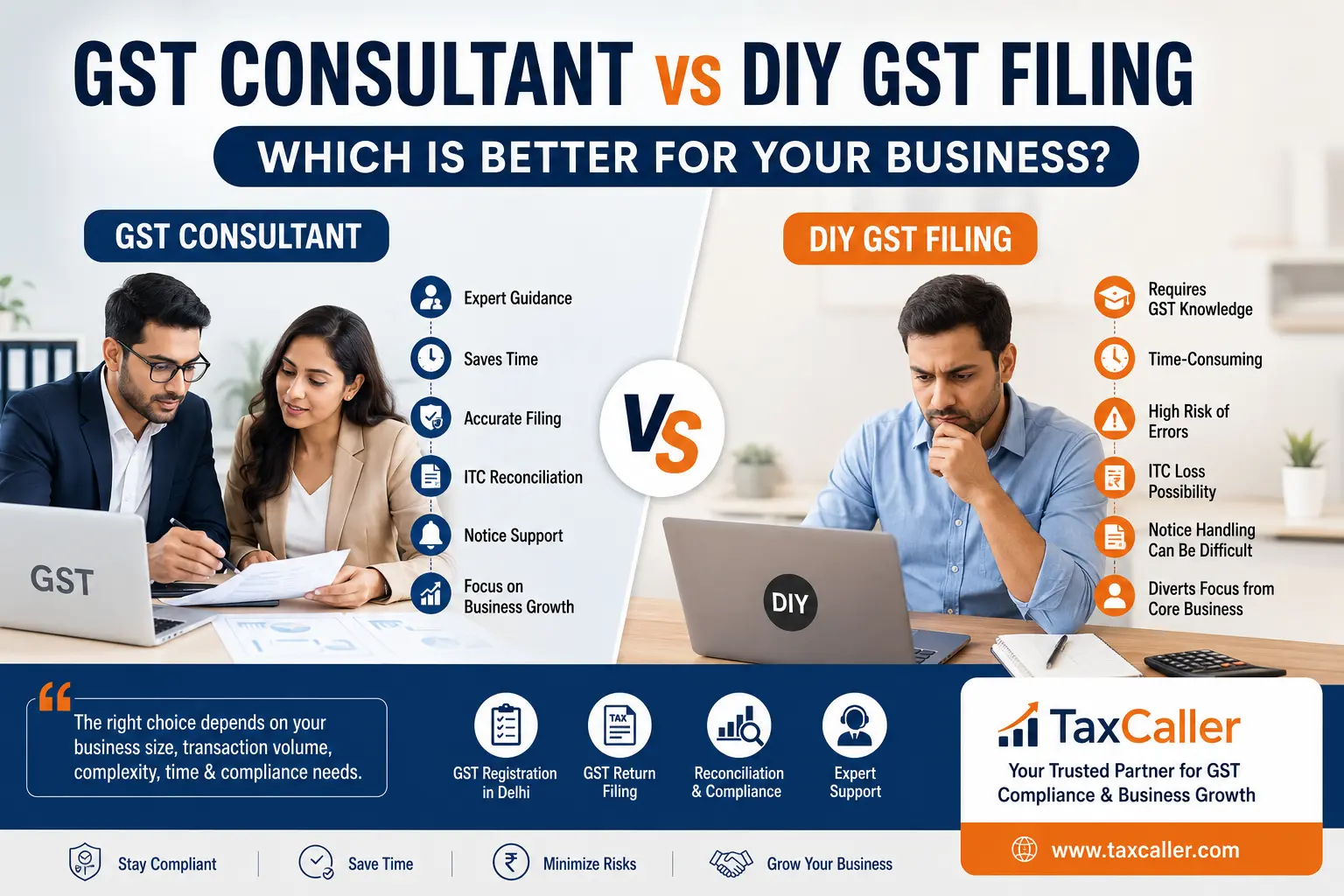
Quick Answer: GST Consultant or DIY Filing?
DIY GST filing can be done by businesses with simple transactions, organized accounts, and someone who knows the relevant GST requirements. Complicated transactions can take time to reconcile, and if you have a business that requires constant compliance, tax advice, or notice assistance, a GST Consultant in Delhi may be the better option. The best fit is determined by your business risk, complexity and time available.
Key Takeaways
- GST filing can be completed online through the official GST system.
- DIY filing may suit businesses with straightforward transactions and good accounting records.
- A GST Consultant in Delhi can provide professional assistance with GST returns, reconciliation, registration, notices, and ongoing compliance.
- GST Registration in Delhi is only the beginning; registered businesses may have continuing filing and payment obligations.
- GST returns can involve outward supplies, input tax credit, tax liability, and payment information.
- Incorrect reporting can create reconciliation and compliance problems.
- A professional can save business owners time when GST requirements become complicated.
- The cheapest option is not necessarily the most cost-effective option.
- Businesses should compare professional expertise, service scope, communication, and fees before choosing a consultant.
- Some businesses may use a hybrid model where internal staff maintain records and a GST professional reviews or files the returns.
GST Consultant vs DIY GST Filing: Comparison
| Factor |
DIY GST Filing |
GST Consultant |
| GST Registration |
Self-managed |
Professional assistance |
| Return Filing |
Self-managed |
Professional assistance |
| Basic GST Compliance |
Requires taxpayer knowledge |
Managed with professional guidance |
| GST Reconciliation |
Self-managed |
Professional assistance |
| ITC Review |
Self-managed |
Professional review available |
| Tax Planning |
Self-managed |
Professional guidance |
| Notice Assistance |
Self-managed |
May be available |
| Time Required |
Higher for inexperienced users |
Lower for business owner |
| Cost |
Lower professional cost |
Professional fee applies |
| Best For |
Simple, organized businesses |
Complex or growing businesses |
| Ongoing Compliance |
Internal responsibility |
Can be outsourced |
| Accounting Review |
Self-managed |
Can be included depending on engagement |
| Error Risk |
Depends on taxpayer knowledge |
Can be reduced through professional review |
Important: A GST consultant can provide a variety of services depending on the professional and the engagement. Professional assistance does not relieve the taxpayer of his or her basic legal responsibilities.
What Does DIY GST Filing Involve?
DIY GST filing means the taxpayer or an internal employee handles GST compliance without outsourcing the task to a GST consultant.
The business may need to:
- Maintain sales records.
- Maintain purchase records.
- Review invoices.
- Reconcile GST data.
- Check eligible input tax credit.
- Prepare applicable GST returns.
- Calculate tax liability.
- Make applicable tax payments.
- File returns through the GST Portal.
- Maintain filing acknowledgements and supporting records.
The GST Act requires registered persons to furnish applicable returns electronically, and the GST framework includes reporting of supplies, input tax credit, tax payable and tax paid.
Who Is a Good Candidate for DIY GST Filing?
DIY GST filing can be practical when the business has:
- Relatively few transactions
- Straightforward sales
- Simple purchase records
- Well-maintained books
- Limited GST registrations
- An accounting system that produces accurate reports
- Someone internally who understands GST
- Enough time to monitor filing requirements
For example, a small business with a few monthly invoices and well-organized accounting records may be able to manage routine filings internally.
However, "possible" doesn't always mean "efficient."
As transaction volume increases, the time required for reconciliation and compliance can also increase.
What Does a GST Consultant Do?
A professional GST Consultant in Delhi can help businesses manage different aspects of GST compliance depending on the scope of the engagement.
Services may include:
GST Registration
Assistance with:
- GST application preparation
- Documentation
- Principal place of business information
- Registration clarifications
- Registration amendments
GST Return Filing
A consultant may assist with applicable returns such as:
- GSTR-1
- GSTR-3B
- GSTR-9, where applicable
- Other applicable GST statements/returns
The GST Portal's official taxpayer guidance provides information about GST returns, including GSTR-1 and GSTR-3B.
GST Reconciliation
A consultant may compare:
Books ↔ Sales Data ↔ GST Returns ↔ ITC Records
to identify discrepancies before filing.
Input Tax Credit Review
A professional can help review relevant ITC information and identify potential reconciliation issues.
GST Notice Assistance
Depending on the engagement, a consultant may help analyze GST notices and organize the required response.
GST Registration in Delhi: What Happens After Registration?
Many businesses focus on obtaining GST Registration in Delhi but overlook what happens afterward.
GST registration can create continuing compliance responsibilities.
Depending on the taxpayer and applicable provisions, businesses may need to:
- File applicable GST returns
- Report outward supplies
- Report relevant input tax credit
- Pay GST where applicable
- Maintain records
- Reconcile transactions
- Respond to notices
- Complete annual compliance where applicable
The CGST Act requires applicable registered persons to furnish returns for tax periods, including in cases where there are no supplies, subject to applicable provisions.
GST Registration → GST Compliance → Return Filing → Reconciliation → Ongoing Monitoring
GST registration is not the end of the process.
DIY GST Filing: Advantages
1. Lower Professional Cost
The business doesn't pay a separate professional fee for routine filing.
2. Direct Control
You or your internal team controls the entire filing process.
3. Better Understanding of Your Data
Handling GST yourself can help you understand your business's:
- Sales
- Purchases
- GST liability
- ITC
- Filing status
4. Suitable for Simple Businesses
Businesses with straightforward transactions may find DIY filing manageable.
DIY GST Filing: Disadvantages
1. Time-Consuming
Understanding GST rules, reconciling records, checking invoices and filing returns can consume significant time.
2. Learning Curve
GST compliance has multiple forms, processes and rules.
3. Reconciliation Risk
Differences between accounting records and GST data can be difficult to identify without experience.
4. Notice Handling Can Be Difficult
If the business receives a notice, someone internally needs to understand the issue and respond appropriately.
5. Business Owner's Time
The biggest hidden cost can be the time spent on compliance instead of:
- Sales
- Marketing
- Customer service
- Product development
- Business growth
GST Consultant: Advantages
1. Saves Time
A professional can take responsibility for routine GST-related tasks under the agreed engagement.
2. Professional Expertise
An experienced GST Consultant in Delhi understands common filing, reconciliation and compliance requirements.
3. Better Reconciliation
Professional review can help identify discrepancies before filing.
4. Ongoing Compliance Support
A consultant can help businesses track recurring GST obligations.
5. Notice Assistance
Depending on the engagement, professional assistance may be available if the business receives a GST communication.
6. Scalable Support
As transaction volume increases, outsourcing GST compliance can become more practical than relying solely on the business owner.
GST Consultant: Potential Disadvantages
1. Professional Fees
You need to pay a professional fee.
2. Quality Varies
Not every service provider provides the same level of expertise.
3. Communication Matters
A consultant who doesn't respond promptly can create compliance challenges.
4. You Still Need Accurate Records
A GST consultant cannot produce accurate returns from incomplete or incorrect business data.
Therefore, choosing the right professional is important.
When Should You File GST Yourself?
DIY filing can make sense when:
- Your business has limited transactions.
- Your books are accurate.
- You understand GST basics.
- Your invoices are properly maintained.
- You can reconcile your records.
- You have enough time.
- You don't have complicated GST matters.
Before choosing DIY filing, ask:
"Can I confidently reconcile and explain every number submitted in my GST return?"
If the answer is yes, DIY may be practical.
When Should You Hire a GST Consultant?
Consider hiring a GST Consultant in Delhi when:
1. Your Transactions Are Increasing
More transactions mean more invoices and greater reconciliation work.
2. You Have Multiple GST Registrations
Managing multiple registrations can significantly increase compliance complexity.
3. Your Business Has Multiple Locations
Different registrations and reporting requirements can make compliance more demanding.
4. You Have Significant ITC
Businesses with substantial input tax credit may benefit from regular reconciliation.
5. You Receive a GST Notice
Professional assistance can help interpret the notice and organize supporting records.
6. You Don't Have Internal GST Expertise
If nobody in the business understands GST compliance, outsourcing can reduce operational risk.
7. GST Is Taking Too Much Time
If GST compliance prevents you from focusing on business operations, professional support may provide better value.
Step-by-Step: How to Decide Between DIY and a GST Consultant
Step 1: Calculate Your Transaction Volume
Count approximately how many:
- Sales invoices
- Purchase invoices
- Credit notes
- Debit notes
you handle each period.
Step 2: Review Your Accounting System
Determine whether your accounting system produces reliable GST reports.
Step 3: Evaluate Your GST Knowledge
Ask whether the person filing your returns understands:
- GST returns
- ITC
- Reconciliation
- Tax payment
- Filing procedures
Step 4: Calculate the Time Cost
Estimate how many hours your business spends each month on GST.
Step 5: Consider the Risk
Ask:
"What happens if we make an error?"
Consider possible:
- Reconciliation problems
- Tax payment issues
- Interest
- Late fees
- Notices
- Business disruption
The CGST Act provides for late fees when certain required returns or details are not furnished by the prescribed due dates.
Step 6: Compare the True Cost
DIY cost isn't simply ₹0.
You should consider:
Employee/Owner Time + Software + Training + Error Risk + Compliance Cost
Compare that with:
Professional GST Fee + Internal Record-Keeping Cost
Step 7: Choose the Appropriate Model
You might choose:
DIY
or
Fully Outsourced GST Compliance
or
Hybrid Model
Hybrid GST Model: An Alternative to DIY vs Consultant
You don't always have to choose between completely doing it yourself and completely outsourcing the process.
A hybrid approach can work well.
Internal Team Handles:
- Invoicing
- Accounting
- Data entry
- Purchase records
- Sales records
GST Consultant Handles:
- GST reconciliation
- Return review
- Filing
- Compliance calendar
- Technical GST questions
- Notice assistance where agreed
This approach can provide greater control while reducing compliance workload.
Common GST Filing Mistakes
Mistake 1: Treating GST Filing as Simple Data Entry
GST returns are connected to accounting, invoices, ITC and tax payments.
Mistake 2: Filing Without Reconciliation
Figures should be reviewed before submission.
Mistake 3: Ignoring ITC Differences
Input tax credit information should be reviewed carefully under the applicable provisions.
Mistake 4: Missing Filing Dates
The GST framework contains specified filing deadlines, although applicable dates and extensions can vary by taxpayer and notification.
Mistake 5: Assuming No Sales Means No Filing
Registered taxpayers should check the applicable return obligations rather than automatically assuming there is nothing to file.
Mistake 6: Ignoring GST Notices
Notices should be reviewed and handled within the applicable time.
Mistake 7: Choosing a Consultant Only on Price
Professional expertise and service scope matter.
What Should You Ask a GST Consultant Before Hiring?
Before choosing a GST Consultant in Delhi, ask:
- How many businesses do you currently handle?
- Do you have experience with my industry?
- Will you reconcile GST data before filing?
- Do you review ITC?
- Who will prepare my returns?
- Who will communicate with me?
- What is included in the professional fee?
- Are notices included?
- Are amendments included?
- How will documents be shared and stored?
- Will you provide filing confirmations?
- Can you support my business as it grows?
These questions can help you compare providers more objectively.
How to Choose the Right GST Consultant in Delhi
Professional Experience
Choose someone who understands your business type.
Transparent Pricing
Know the monthly, quarterly, or annual charges and additional fees.
Strong Communication
You should be able to reach the responsible person easily.
Reconciliation Capability
Ask about their process for checking GST records before filing.
Technology
Digital accounting and document-sharing systems can improve efficiency.
Post-Filing Support
Clarify how notices, corrections and other issues will be handled.
Expert Advice from TaxCaller
Mohd. Salim — TaxCaller
Mohd. Salim has 15 years of experience in CA and related taxation, accounting and compliance services.
"DIY GST filing is feasible for a small business with simple transactions, accurate books and someone who knows GST requirements. But when the volume of transactions, the ITC, the registrations or the complexity of compliance grows, the professional review can be worth much more. Businesses need to weigh up the cost of professional support against the time and risk of managing GST themselves."
TaxCaller's Recommended Decision Formula
Business Complexity + Transaction Volume + Internal GST Knowledge + Time Available + Compliance Risk = Right GST Filing Model
For businesses that want professional support, a GST Consultant in Delhi can help with GST registration, return filing, reconciliation and ongoing compliance, depending on the agreed scope.
Why Choose TaxCaller?
TaxCaller provides GST, taxation, accounting and compliance-related services for businesses and professionals.
Depending on your requirements, services include:
- GST Registration
- GST Return Filing
- GSTR-1 Filing
- GSTR-3B Filing
- GST Reconciliation
- GST Consultation
- GST Compliance
- Tax Consultation
- Accounting & Bookkeeping
- Business Compliance
The businesses planning GST Registration in Delhi can also avail professional help with documentation, registration process and post registration compliance.
Suggested Internal Links
- GST Registration in Delhi → Your GST Registration Delhi service page
- GST Consultant in Delhi → Your GST Consultant Delhi service page
- GST Return Filing in Delhi → Your GST Return Filing service page
- Tax Consultant in Delhi → Your Tax Consultant Delhi page
- Accounting Services in Delhi → Your Accounting service page
- CA Firm in Delhi → Your CA service page
GST Filing Decision Checklist
Choose DIY GST Filing when most of these statements are true:
- Transactions are simple.
- Books are accurate and updated.
- Someone understands GST compliance.
- GST reconciliation can be performed internally.
- Filing deadlines can be monitored.
- There are no complicated GST issues.
Consider a GST Consultant when several of these apply:
- Transaction volume is high.
- Multiple GST registrations exist.
- ITC reconciliation is complex.
- GST takes significant management time.
- Internal GST knowledge is limited.
- GST notices have been received.
- The business is expanding.
- You want professional compliance review.
Frequently Asked Questions
1. Is DIY GST filing possible?
Yes. Eligible taxpayers can do the relevant GST compliance activities electronically using the GST Portal. Whether DIY filing is appropriate depends on the complexity of the business and the taxpayer’s knowledge.
2. Is a GST Consultant better than filing GST yourself?
Not automatically. DIY filing can work for straightforward businesses. A GST consultant can be more useful when transactions, reconciliation, ITC or compliance requirements become complex.
3. When should I hire a GST Consultant in Delhi?
If GST compliance is taking up a lot of your time, if you have complex transactions, if you need to reconcile ITC, if you have multiple GST registrations, or if you get GST notices, you should think about getting professional help.
4. Is GST Registration in Delhi difficult?
GST registration is done through an online application and supporting documents. Complexity will depend on the business structure, location, documents, and circumstances. Professional help can support the correct preparation of the application.
5. Does GST registration require regular return filing?
Registered taxpayers have return obligations that apply based on the registration type and scheme. The relevant provisions of the CGST Act provide for periodic returns for registered persons.
6. Do businesses have to file GST returns when there are no sales?
In case no supplies are made, a registered person is generally required to furnish the applicable return for the tax period, subject to the relevant provisions, if he is required to file a return.
7. Can a GST Consultant help with GSTR-1 and GSTR-3B?
Yes. Yeah. GST consultants usually help with relevant GST returns such as GSTR-1 and GSTR-3B based on the services and engagement.
8. How much does a GST Consultant in Delhi charge?
Fees depend on transaction volume, number of GST registrations, services required, accounting complexity and level of support. Get a clear quote before you hire.
9. Can I use a hybrid GST filing model?
Yes. A business can do its own accounting but have a professional do the GST reconciliation, review, filing and compliance support.
10. What is the biggest advantage of a GST consultant?
One major advantage is reducing the business owner's compliance workload. A consultant can also provide professional review and help identify potential discrepancies before filing.
11. Can TaxCaller help with GST Registration in Delhi?
TaxCaller provides GST registration and GST compliance related services to businesses and professionals. The exact service scope needs to be confirmed on the basis of your business requirements.
12. Why choose TaxCaller for GST services?
TaxCaller provides GST registration, GST return filing, reconciliation, taxation, accounting and compliance related services to help businesses manage their applicable GST responsibilities with professional support.
Conclusion
So, GST Consultant vs DIY GST Filing—which is better?
There isn't one answer for every business.
Choose DIY GST Filing when:
Your business has simple transactions, accurate accounting records, someone who understands GST, and enough time to manage filing and reconciliation.
Consider a GST Consultant when:
If you have a growing transaction volume, complex GST reconciliation, large ITC, multiple registrations or limited internal GST expertise or need ongoing professional support.
GST Registration in Delhi – Registration is not end of business decision Also, a proper post-registration GST compliance process is equally important.
Before you decide on DIY filing vs a GST Consultant in Delhi, work out the total cost, including your time, internal resources, software, reconciliation effort, and potential compliance risks.
Many growing businesses can also work with a hybrid model – keeping accounting and records in-house and engaging a GST professional for reconciliation, review, filing and technical assistance.
The best way to file GST is the way that keeps your business accurate, on time, compliant and focused on growth.
Official Government References
For current GST procedures, filing requirements and taxpayer services, use authoritative sources:
The CGST Act contains provisions relating to GST returns such as filing of returns electronically, frequency of returns, late fees and consequences of non filing. The types of returns and frequency of returns is also mentioned in the guidance for taxpayers on GST Portal.
 4.9 Google Rating
 4.4 Rated Excellent Trustpilot