
GST on Medicine 2026: 5% Rate, Nil-Rated Drugs and MRP Examples
Government data: GST portal HSN directory and CBIC rate notifications. Rates as per 01/2026-Central Tax (Rate), 30 Apr 2026 (in force from 1 May 2026). Last checked 20 Nov 2026.
No code found for “Glucometer”
Try a simpler word (for example "shirt" instead of "cotton formal shirt"), the first 4 digits of the code, or switch between goods and services.
HSN codes and GST rates for medicine
From the GST portal HSN list, with the rate from the current CBIC notification. Tap Copy to use the code on your invoice.
- 3822HSN5%
Diagnostic or laboratory reagents on a backing, prepared diagnostic or laboratory reagents whether or not on a backing, whether or not put up in the form of kits, other than those of heading 3006; certified reference materials
Special cases
- 5% Micronutrients, which are covered under serial number 1(g) of Schedule 1, Part (A) of the Fertilizer Control Order, 1985 and are manufactured by the manufacturers which are registered under the Fertil
Notification 9/2025-CT(Rate), Schedule I, S. No. 263
- 9018HSN5%
Instruments and appliances used in medical, surgical, dental or veterinary sciences, including scientigraphic apparatus, other electromedical apparatus and sight-testing instruments
Special cases
- 5% Coronary stents and coronary stent systems for use with cardiac catheters
- 5% Artificial kidney
- 5% Blood glucose monitoring system (Glucometer) and test strips
Notification 9/2025-CT(Rate), Schedule I, S. No. 483
- 9025HSN5% or 18%
Hydrometers and similar floating instruments, thermometers, pyrometers, barometers, hygrometers and psychrometers, recording or not, and any combination of these instruments
- 5% Thermometers for medical, surgical, dental or veterinary usage
- 18% Hydrometers and similar floating instruments, thermometers, pyrometers, barometers, hygrometers and psychrometers, recording or not, and any combination of these instruments [other than thermometers for medical, surgical, dental or veterinary usage]
Special cases
- 5% Coronary stents and coronary stent systems for use with cardiac catheters
- 5% Artificial kidney
- 5% Blood glucose monitoring system (Glucometer) and test strips
Notification 9/2025-CT(Rate), Schedule I, S. No. 488
- 9027HSN5% or 18%
Instruments and apparatus for physical or chemical analysis (for example, polarimeters, refractometers, spectrometers, gas or smoke analysis apparatus); instruments and apparatus for measuring or checking viscosity, porosity, expansion, surface tension or the like; instruments and apparatus for measuring or checking quantities of heat, sound or light (including exposure meters); microtomes
- 5% Instruments and apparatus for medical, surgical, dental or veterinary uses, for physical or chemical analysis
- 18% Instruments and apparatus for physical or chemical analysis (for example, polarimeters, refractometers, spectrometers, gas or smoke analysis apparatus); instruments and apparatus for measuring or checking viscosity, porosity, expansion, surface tension or the
Special cases
- 5% Coronary stents and coronary stent systems for use with cardiac catheters
- 5% Artificial kidney
- 5% Blood glucose monitoring system (Glucometer) and test strips
Notification 9/2025-CT(Rate), Schedule I, S. No. 489
Quick answer
GST on medicine is 5% for tablets, syrups, injections and other medicines under HSN 3004, including Ayurvedic and homoeopathic ones, from 22 September 2025. The 37 drugs in Annexure I of Notification 10/2025, mostly for cancer and rare diseases, carry nil GST. Since GST is inside the MRP, a 5% medicine's tax is MRP × 5 ÷ 105.
GST on medicine is 5% for almost every tablet, capsule, syrup, injection and ointment sold in India, whether allopathic, Ayurvedic or homoeopathic. A short list of life-saving drugs for cancer and rare diseases carries no GST at all, and a few pharmacy items, such as nicotine gum, cosmetics and hospital beds, stay at 18%. These rates have applied since 22 September 2025, when GST 2.0 removed the old 12% slab that most medicines used to fall in.
This guide is about the tax itself: how much of the price on the strip is GST, how a chemist or hospital charges it, what changed in September 2025, how input tax credit works for a medical store, and when a hospital bill carries GST. For the full list of Chapter 30 codes and the 8-digit lines, see our HSN code for medicines page.
On this page: Rates · 22 Sep 2025 changes · Nil GST drugs · Calculation · MRP examples · Ayurvedic and homeopathic · Devices and test kits · Hospitals · Pharmacies · Input tax credit · Who pays and RCM · Old stock and MRP · Common mistakes
GST on medicine rates in 2026
The rate depends on what the product is, not on where it is sold. A face cream in a chemist's shop is still a cosmetic, and an Ayurvedic tablet bought online is still a medicine. The current position, by type of product:
| Product | GST rate | Legal entry |
|---|---|---|
| Tablets, capsules, syrups, injections, creams and other medicines (allopathic) | 5% | Notification 9/2025, Schedule I, S. Nos. 226, 233, 234 |
| Ayurvedic, Unani, Siddha, Homoeopathic and Bio-chemic medicines | 5% | Schedule I, S. Nos. 228, 229, 233, 234 |
| Insulin, cyclosporin, deferiprone and desferrioxamine, oral rehydration salts | 5% | Schedule I, S. No. 225 |
| Vaccines, antisera, bandages, dressings, sutures, ostomy items | 5% | Schedule I, S. Nos. 231, 232, 235, 236 |
| Drugs listed in Annexure I (cancer, rare and serious chronic diseases) | Nil | Notification 10/2025, S. No. 113 |
| Human blood and its components; all contraceptives | Nil | Notification 10/2025, S. Nos. 114, 115 |
| Medicines imported for personal use | 5% | Notification 9/2025, Schedule I, S. No. 514 (heading 9804) |
| Nicotine gum and nicotine patches (oral or transdermal nicotine products) | 18% | Schedule II, S. No. 6 (2404 91 to 2404 99) |
| Hospital beds, operating and examination tables | 18% | Schedule II (heading 9402) |
| Hand sanitisers and disinfectants; skin creams sold as cosmetics | 18% | Schedule II (headings 3808, 3304) |
Inside a state, the 5% is split into 2.5% CGST and 2.5% SGST (or UTGST). On a sale to another state, the seller charges 5% IGST instead. The total is the same either way, so the patient pays the same price.
The government chose 5% rather than a full exemption for most medicines on purpose. The GST Council's own FAQ on the reform explains that if medicines were fully exempt, makers and dealers would lose input tax credit on what they buy, and that cost could reach patients as higher prices. A nil rate is kept for the short list of costly drugs where the saving to the patient matters most.
What changed on 22 September 2025
The 56th GST Council meeting on 3 September 2025 recommended the cuts, and CBIC notified them on 17 September 2025 with effect from 22 September 2025. The main notifications are 9/2025-Central Tax (Rate) for rates on goods, 10/2025-Central Tax (Rate) for exempt goods, 15/2025-Central Tax (Rate) for services, and 16/2025-Central Tax (Rate) for the health insurance exemption. Matching Integrated Tax and Union Territory Tax notifications carry the same numbers.
| Item | Till 21 Sept 2025 | From 22 Sept 2025 |
|---|---|---|
| Most medicines (3003, 3004), including Ayurvedic and homoeopathic | 12% | 5% |
| 33 life-saving drugs and medicines | 12% | Nil |
| Agalsidase beta, imiglucerase, eptacog alfa (factor VIIa) | 5% | Nil |
| Insulin, ORS, cyclosporin, deferiprone | 5% | 5% (no change) |
| Medicines imported for personal use (9804) | 12% for most | 5% |
| Bandages, gauze, dressings, diagnostic kits and reagents, glucometers and strips | 12% | 5% |
| Medical-grade oxygen, anaesthetics, medicinal hydrogen peroxide | 12% | 5% |
| Medical thermometers; analysis instruments for medical use (9027) | 18% | 5% |
| Job work on Chapter 30 goods (contract manufacturing of medicines) | 12% | 5% |
| Individual health insurance premiums | 18% | Nil |
Before 22 September 2025, the old rate schedule was Notification 1/2017-Central Tax (Rate), and the old exemption list was Notification 2/2017-Central Tax (Rate). Both have been replaced, so a bill, a price list or a software rate master that still points to them is out of date. Later amendments we have checked did not touch medicine rates: Notification 1/2026-Central Tax (Rate) of 30 April 2026 changed beverage codes, Notification 2/2026 of 27 October 2026 covered fertilisers and tyres, and Notification 3/2026 of the same date exempted psyllium seeds.
Medicines with nil GST: the life-saving drug list
S. No. 113 of Notification 10/2025 exempts the drugs and medicines listed in its Annexure I, in whatever chapter they fall. Many websites and news reports speak of "33 drugs" or "36 drugs". Both numbers come from the Council's press release: 33 drugs moved from 12% to nil and 3 moved from 5% to nil. The annexure itself has 37 entries, because it also carries gene therapy, which had already been exempted in January 2025 after the 55th Council meeting.
The list is mainly made up of:
- Cancer medicines: for example daratumumab (and its subcutaneous form), atezolizumab, alectinib, obinutuzumab, amivantamab, teclistamab, avelumab and pegylated liposomal irinotecan.
- Rare genetic and storage diseases: for example onasemnogene abeparvovec and risdiplam for spinal muscular atrophy, imiglucerase and velaglucerase alfa for Gaucher disease, agalsidase alfa and beta for Fabry disease, laronidase and idursulphatase.
- Bleeding disorders and other serious conditions: for example emicizumab, eptacog alfa, rurioctocog alfa pegol, C1-inhibitor injection, and the cholesterol drugs alirocumab, evolocumab and inclisiran.
The full list of 37 names is on our HSN code for medicines page. Three practical points matter more than the count:
- The exemption follows the generic name. Check the salt on the pack against the annexure. A cancer drug that is not named is taxed at 5%, however serious the illness.
- No tax invoice for exempt drugs. A pharmacy or distributor issues a bill of supply (or shows the line at nil on a combined invoice) and collects no GST on it.
- No input tax credit. GST paid on purchases used for these drugs cannot be claimed. This is covered under input tax credit below.
Strictly, the drugs in Annexure I are "exempt" (they are in the exemption notification), not "nil-rated". The patient sees no difference, but the seller reports them in the exempt column of GSTR-1 and GSTR-3B and handles credit under Rule 42.
How to calculate GST on medicine
Two formulas cover every case. Use the first when you know the price before tax, and the second when you only know the MRP, which already includes GST.
- Adding GST: GST = taxable value × rate ÷ 100. Total = taxable value + GST.
- Taking GST out of the MRP: GST = MRP × rate ÷ (100 + rate). For a 5% medicine this is MRP × 5 ÷ 105, which is about 4.76% of the MRP.
Then split the tax. For a sale within the state, half is CGST and half is SGST. For a sale to another state, all of it is IGST. Our GST calculator does both directions, adding GST to a price or removing it from an MRP, and shows the CGST and SGST split.
GST on medicine price examples with MRP
Chemists sell at or below the printed MRP, and the MRP already includes GST. So the tax is worked backwards out of the price the customer pays. These examples use 5% and a sale within the state:
| Medicine (example) | MRP | Taxable value | CGST 2.5% | SGST 2.5% |
|---|---|---|---|---|
| Paracetamol strip of 15 tablets | ₹31.50 | ₹30.00 | ₹0.75 | ₹0.75 |
| Antibiotic course | ₹210.00 | ₹200.00 | ₹5.00 | ₹5.00 |
| Ayurvedic syrup, 450 ml | ₹262.50 | ₹250.00 | ₹6.25 | ₹6.25 |
| Insulin pens, pack of five | ₹1,575.00 | ₹1,500.00 | ₹37.50 | ₹37.50 |
| Annexure I cancer drug, one vial | ₹45,000.00 | ₹45,000.00 | Nil | Nil |
The prices are round figures chosen to make the arithmetic easy to follow, not the price of any brand.
Before and after the rate cut
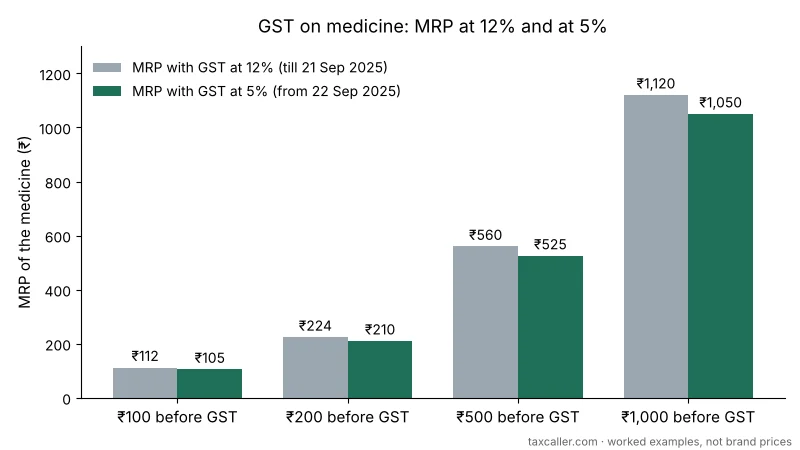
Take a medicine with a price of ₹200 before tax. At the old 12% rate, the MRP worked out to ₹224, of which ₹24 was GST. At 5%, the same medicine should sell at ₹210, of which ₹10 is GST. The patient saves ₹14, which is 6.25% of the old price. For an Annexure I drug that was at 12%, the saving is the full 12% of the base price: a ₹1,00,000 course that cost ₹1,12,000 with tax now costs ₹1,00,000.
Sale to a hospital in another state
A distributor in Gujarat supplies medicines worth ₹50,000 to a hospital in Maharashtra. The invoice shows IGST of 5%, that is ₹2,500, and a total of ₹52,500. If the same hospital were in Gujarat, the ₹2,500 would be shown as ₹1,250 CGST and ₹1,250 SGST. Using CGST and SGST on an inter-state sale is a common error; the tax then has to be paid again as IGST and the wrong tax claimed back as a refund.
Reading the GST on a pharmacy bill
A proper GST bill from a registered chemist shows, for each line, the product, the HSN code (where required), the batch and expiry, the MRP, any discount, the taxable value, the GST rate and the tax. At the foot it shows the CGST and SGST totals. If a bill shows 12% on a medicine sold after 21 September 2025, it is wrong: ask the chemist to correct it. If the chemist is under the composition scheme, the bill will say "bill of supply" and show no GST, because composition dealers cannot collect tax from customers.
GST on Ayurvedic and homeopathic medicines
Ayurvedic, Unani, Siddha, Homoeopathic and Bio-chemic medicines are taxed at 5%, the same as allopathic medicines. They are not exempt. Before 22 September 2025 most of them were at 12%, and only a narrow 5% entry, for bio-chemic medicaments not sold under a brand name, applied.
- Classical formulations made strictly to the books listed in the First Schedule to the Drugs and Cosmetics Act, 1940, or to the homoeopathic pharmacopoeias, and sold under the book name, fall under S. No. 229 at 5%.
- Proprietary Ayurvedic and herbal medicines sold under a brand name for treating or preventing a disease are medicaments of heading 3003 or 3004 and are also at 5%.
- Homoeopathic dilutions, mother tinctures and bio-chemic tablets are 5% under the same entries.
- Herbal cosmetics and food products (a herbal face wash, hair oil, or a "wellness" drink licensed as food) are not medicines. They are taxed at the rate for that product, which can be 5% or 18%. The drug or cosmetic licence and the label claim usually settle which side a product falls on.
For a customer, the practical point is simple: an Ayurvedic tablet and an allopathic tablet with the same MRP carry the same ₹4.76 of GST in every ₹100.
GST on medical devices and test kits
The 2025 reform moved almost all medical devices to 5%. Notification 9/2025 has separate Schedule I entries for each heading, and the GST Council's FAQ states that 5% now applies to all medical devices, instruments and apparatus used in medical, surgical, dental or veterinary work.
| Device or kit | Earlier rate | Rate now | Schedule I entry |
|---|---|---|---|
| Diagnostic kits and reagents, including pregnancy and rapid test kits | 12% | 5% | S. No. 263 (3822) |
| Glucometers and test strips | 12% | 5% | S. No. 475 |
| Syringes, needles, catheters, BP instruments and other medical instruments | 12% | 5% | S. No. 483 (9018) |
| Nebulisers and massage or physiotherapy apparatus; breathing appliances | 12% | 5% | S. Nos. 484, 485 (9019, 9020) |
| X-ray and other radiation apparatus for medical use | 12% | 5% | S. No. 487 (9022) |
| Medical thermometers | 18% | 5% | S. No. 488 (9025) |
| Medical analysis instruments (for physical or chemical analysis) | 18% | 5% | S. No. 489 (9027) |
| Orthopaedic appliances, splints, artificial joints and limbs | 12% (5% for appliances for persons with disabilities) | 5% | S. No. 486 (9021) |
| Surgical and examination gloves | 12% | 5% | S. No. 275 (4015) |
| Corrective spectacles, spectacle and contact lenses | 12% | 5% | S. Nos. 480, 482 (9001, 9004) |
| Hearing aids | Nil | Nil | Notification 10/2025, S. No. 160 (parts for making them: S. No. 170) |
Some items near this list are not at 5%. Hospital furniture under 9402 stays at 18%. Thermometers and analysis instruments for laboratories or industry (not for medical use) are at 18%. Sunglasses and goggles that do not correct vision are also 18%. When a device could fit two headings, the code decides the rate, so confirm it in the GST rate finder before you bill.
Is GST charged on hospital bills and health services?
Most health care services are exempt. S. No. 74 of Notification 12/2017-Central Tax (Rate) exempts health care services by a clinical establishment, an authorised medical practitioner or para-medics, and transport of patients in an ambulance. Doctors' consultation fees, surgery, diagnostic tests by a pathology lab or imaging centre, nursing, and ICU charges carry no GST. Food given to in-patients as advised by the doctor is part of the exempt health care supply, as CBIC Circular 32/06/2018-GST explains.
Five parts of a hospital's billing are taxed:
- Room rent above ₹5,000 a day: a room (other than ICU, CCU, ICCU or NICU) charged at more than ₹5,000 per day attracts 5% GST, without input tax credit, under S. No. 31A of Notification 11/2017 as inserted by Notification 3/2022-Central Tax (Rate), in force since 18 July 2022. The 2025 reform did not change this.
- Pharmacy sales to out-patients and visitors: medicines bought at the hospital pharmacy to take home are an ordinary sale of goods at 5%.
- Cosmetic and plastic surgery: procedures done for appearance fall outside the definition of health care and are taxed at 18%. Reconstructive surgery after an injury, a birth defect or a disease stays exempt.
- Food and services to attendants and visitors: canteen sales and similar services are taxable at their own rates.
- Hospital purchases: the hospital pays GST on the medicines, devices and equipment it buys, and because its main service is exempt, it usually cannot claim that tax back.
What about medicines given to in-patients during treatment? The Kerala Authority for Advance Ruling held in 2018 (Ernakulam Medical Centre) that medicines, implants and consumables used in treating an admitted patient are part of a composite supply of health care, which is exempt, so they are not billed with separate GST. An advance ruling binds only the applicant, but hospitals widely follow this view. The same medicine sold over the counter to an out-patient is taxable at 5%.
Worked example: a patient stays three days in a private room at ₹6,000 a day, with surgery fees of ₹60,000 and medicines used during the stay of ₹8,000. GST applies only to the room: 5% of ₹18,000 is ₹900. If the discharge medicines for home (₹1,050 MRP) are bought from the hospital pharmacy, they carry ₹50 of GST inside the price. Since September 2025, individual and family health insurance premiums are also exempt under Notification 16/2025-Central Tax (Rate), so if the stay is paid by such a policy, its premium carries no GST either. Group policies, such as an employer's cover, are still taxed.
GST for pharmacies and medical stores
A chemist or medical store follows the normal GST rules for a trader of goods, with a few points that come up only in this trade.
- Registration: required once turnover crosses ₹40 lakh a year (lower limits of ₹20 lakh or ₹10 lakh apply in some states), or earlier for inter-state sales and, in most cases, for selling through an e-commerce platform. A drug licence is a separate requirement. Our GST registration service takes care of the application.
- Composition scheme: a store with turnover up to ₹1.5 crore can pay 1% of turnover instead of 5% on each sale, but then it cannot claim credit, cannot collect GST from customers and cannot sell to other states. With medicines now at 5%, the gap between the two options is small.
- Invoices: a tax invoice for taxable sales and a bill of supply for exempt drugs. A store with turnover above ₹5 crore must issue e-invoices for sales to registered buyers such as clinics and hospitals.
- Returns: GSTR-1 and GSTR-3B monthly or quarterly, with an HSN summary in Table 12 of GSTR-1. Our GST return filing team handles this for chemists and distributors.
- Online sales: medicines sold through an e-commerce platform carry the same rates; the platform collects tax at source of 0.5% on net sales, which the seller can use against its own tax.
Input tax credit for chemists and medical stores
A chemist registered under the regular scheme pays GST on purchases and collects GST on sales. The tax paid on purchases is input tax credit, and only the difference is paid in cash.
Example: a chemist buys an antibiotic from a distributor at ₹150 plus ₹7.50 GST (5%). It sells the strip at its MRP of ₹210, which is ₹200 plus ₹10 GST. The chemist owes ₹10, uses the ₹7.50 credit, and pays ₹2.50 in cash (₹1.25 CGST and ₹1.25 SGST). The GST on the margin of ₹50 is exactly that ₹2.50.
Credit is allowed only when the conditions of Section 16 of the CGST Act are met:
- the chemist holds a tax invoice showing its own GSTIN;
- the goods have been received;
- the invoice appears in the chemist's GSTR-2B, which means the supplier has reported it;
- the supplier has paid the tax, and the chemist has filed its own return;
- the claim is made by 30 November after the end of the financial year (or the annual return date, if earlier).
Credit is also available on business costs such as shop fittings, billing software, refrigerators for vaccines and insulin, and professional fees, provided they are used for taxable sales.
Where a chemist cannot take credit
- Exempt drugs: credit on Annexure I drugs bought for sale is not allowed. Credit on common costs, such as rent or software, is split under Rule 42 of the CGST Rules in the ratio of exempt to total turnover.
- Expired, damaged or destroyed stock: Section 17(5)(h) blocks credit on goods lost, destroyed or written off. If expired stock is destroyed at the store, reverse the credit taken on it. If it is returned to the supplier, the supplier issues a credit note under Section 34 and the chemist reverses the matching credit.
- Free samples and gifts: goods given away free also fall under Section 17(5)(h).
- Composition dealers: no credit at all while in the scheme.
Manufacturers and inverted duty
Medicine makers sell at 5% but pay 18% on many inputs, such as active ingredients classed as organic chemicals, packing and machinery. Credit then builds up. Section 54(3) of the CGST Act allows a refund of this unused credit on account of the inverted duty structure, using the formula in Rule 89(5). The GST Council's FAQ on the 2025 reform confirms that this refund is available to medical device makers, and the same section applies to medicine makers. The refund does not cover credit on input services or capital goods.
Who pays GST on medicine, and is there reverse charge?
The patient bears the GST as part of the price, and the registered seller (manufacturer, distributor or chemist) collects it and deposits it with the government. At each stage the seller pays only the tax on its own margin, after credit. Medicines are not on the reverse charge list, so a buyer never pays GST on medicines directly to the government in place of the seller.
Reverse charge does reach a medical store through its costs. Two common cases:
- Shop rent from an unregistered landlord: since 10 October 2024, a registered business renting commercial property from an unregistered person pays the GST on the rent itself under reverse charge (Notification 9/2024-Central Tax (Rate)). From 16 January 2025, composition dealers are excluded (Notification 7/2025-Central Tax (Rate)).
- Goods transport agency: freight paid to a goods transport agency is usually under reverse charge when the agency has not opted to pay tax itself.
Tax paid under reverse charge can be claimed as credit in the same month, provided it relates to taxable sales.
Old stock, MRP and price lists after the rate cut
GST is charged at the rate in force on the date of supply, not the date of purchase. Stock bought at 12% before 22 September 2025 was sold at 5% from that day, and the credit already taken on it at 12% did not have to be reversed. That is one reason why the 5% rate (instead of an exemption) helped chemists.
The National Pharmaceutical Pricing Authority directed manufacturers and marketers to revise the MRP of medicines and medical devices with effect from 22 September 2025, and to send revised or supplementary price lists in Form V or VI to dealers, retailers, State Drug Controllers and the government. Re-labelling or re-stickering of stock already in the market was not made compulsory, provided the revised prices were made public. In practice, that means a pack printed with an old MRP may still be on the shelf, but the chemist must charge the lower, revised price. If you were charged the old MRP after the cut, ask for the revised price list. The State Drug Controller also receives these lists and can be approached if the chemist refuses.
Common mistakes with GST on medicine
- Billing at 12%. Any medicine invoice at 12% after 21 September 2025 is wrong. Tax collected in excess must still be paid to the government under Section 76, even though it was not due.
- Treating every chemist item as a medicine. Cosmetics, sanitisers, some supplements and hospital furniture have their own rates.
- Exempting a drug because it treats cancer. Only the drugs named in Annexure I are exempt.
- Claiming credit on exempt drugs or on destroyed stock. Both must be reversed.
- Adding GST on top of the MRP. MRP is the ceiling and already includes tax.
If you run a pharmacy, a distributorship or a hospital and want the rates, codes and credit checked across your billing master, our tax consultants can review it. To look up another product, use the HSN code finder.
Related GST rates: individual health and life insurance is nil from 22 September 2025, while group cover is 18%. Plain milk is nil, ready-made clothes are 5% up to ₹2,500 a piece and 18% above, and food at a restaurant is 5% without credit.
Official sources: CBIC GST portal (Notifications 9/2025, 10/2025, 15/2025 and 16/2025-Central Tax (Rate) dated 17 September 2025) · GST Council (press release and FAQs on the 56th meeting) · Circular 32/06/2018-GST · GST portal: Search HSN code.
Frequently asked questions
What is the GST on medicine in India?
Most medicines are taxed at 5% GST from 22 September 2025, split as 2.5% CGST and 2.5% SGST within a state, or 5% IGST between states. This covers allopathic, Ayurvedic and homoeopathic medicines. The 37 drugs in Annexure I of Notification 10/2025 carry no GST, and a few items such as nicotine gum stay at 18%.
How much GST is charged on tablets?
Medicine tablets, whether a paracetamol strip or a prescription drug, carry 5% GST under heading 3004, unless the drug is in the nil list of Notification 10/2025. On a strip with an MRP of ₹105, ₹5 is GST. Note that a tablet computer is an electronic device, not a medicine, and is taxed at 18%.
Is GST on medicine 12% or 5% now?
It is 5%. The 12% rate on medicines ended on 21 September 2025. From 22 September 2025, Notification 9/2025-Central Tax (Rate) put all drugs and medicines at 5%, except the drugs listed for nil GST. A chemist's bill showing 12% on a medicine after that date is wrong and should be corrected.
Which medicines have 0% GST?
Thirty-seven drugs listed in Annexure I of Notification 10/2025 are exempt, mainly for cancer, rare genetic diseases and serious chronic conditions, such as daratumumab, risdiplam and emicizumab. Thirty-three of them moved from 12% and three from 5% in September 2025, and gene therapy was already exempt. Human blood and all contraceptives also carry no GST.
How do I calculate GST on a medicine bill?
If the price is before tax, multiply it by 5 and divide by 100 to get the GST, then add it to the price. If you only know the MRP, multiply the MRP by 5 and divide by 105. Split the result equally into CGST and SGST for a sale within the state, or show it as IGST.
How much GST is included in the MRP of a medicine?
For a 5% medicine, GST is 5/105 of the MRP, which is about 4.76%. A medicine with an MRP of ₹210 has a taxable value of ₹200 and GST of ₹10, shown as ₹5 CGST and ₹5 SGST. The chemist cannot add GST on top of the MRP, because the MRP already includes all taxes.
What is the GST rate on Ayurvedic medicine?
Ayurvedic medicines are taxed at 5% from 22 September 2025, down from 12% for most of them. Both classical formulations made to the authoritative books and branded proprietary Ayurvedic medicines fall under the 5% entries. Herbal products sold as cosmetics or food, such as hair oil or wellness drinks, are taxed at their own rates.
What is the GST on homeopathic medicines?
Homoeopathic medicines, including dilutions, mother tinctures and bio-chemic tablets, carry 5% GST from 22 September 2025. Most were at 12% before. They fall under the same Chapter 30 entries as other medicines in Schedule I of Notification 9/2025. As with any medicine, the GST is already included in the printed MRP of the bottle or pack.
What is the GST on medical devices and test kits?
Diagnostic and rapid test kits, glucometers and test strips, thermometers, syringes, surgical instruments, gloves, X-ray apparatus and corrective spectacles are all at 5% from 22 September 2025. Earlier they were at 12% or 18%. Hearing aids remain exempt, while hospital beds and furniture under heading 9402 are taxed at 18%.
Is GST charged on hospital bills?
Treatment by a hospital, clinic or doctor is exempt under S. No. 74 of Notification 12/2017. GST applies to a non-ICU room charged above ₹5,000 a day (5%, without credit), cosmetic surgery (18%), and medicines bought from the hospital pharmacy to take home (5%). Medicines used on admitted patients are part of the exempt treatment.
Is GST charged on doctor consultation fees?
No. Consultation by an authorised medical practitioner, whether in a clinic, a hospital or online, is a health care service exempt from GST. The same applies to diagnostic tests by a pathology lab or imaging centre and to ambulance services. Cosmetic procedures done only to improve appearance are not covered and attract 18% GST.
Can a chemist claim input tax credit on medicines?
Yes, if registered under the regular scheme. The chemist claims the GST paid to the distributor against the GST collected from customers, provided the invoice is in its GSTR-2B and the goods were received. Credit is not allowed on exempt drugs, destroyed or expired stock written off, or while the chemist is in the composition scheme.
What changed in GST on medicines in 2026?
The big change took effect on 22 September 2025 and still applies in 2026: most medicines moved from 12% to 5%, and 36 life-saving drugs moved to nil. The October 2026 amendment to the rate notification covered fertilisers and tyres, not medicines. Always check the latest CBIC notifications before changing rates in your billing software.
Which medical items are taxed at 5% GST?
At 5% are almost all medicines, Ayurvedic and homoeopathic medicines, insulin, ORS, vaccines, bandages and dressings, diagnostic kits, glucometers and strips, thermometers, medical instruments and appliances, surgical gloves, medical-grade oxygen and corrective spectacles. The main exceptions are the exempt drugs, blood and contraceptives at nil, and nicotine gum, sanitisers and hospital furniture at 18%.
Is GST charged on medicines bought online?
Yes, at the same rates as in a shop: 5% on most medicines and nil on the exempt drugs. The rate does not change because the seller is an online pharmacy. The platform collects 0.5% tax at source on net sales, but the seller adjusts it against its own GST, and it is not added to your bill.
Sources: GST portal HSN/SAC directory (updated 23 Oct 2026) · CBIC rate notifications: 9/2025-Central Tax (Rate) as amended up to 01/2026-Central Tax (Rate), 30 Apr 2026 (in force from 1 May 2026); services under 11/2017-Central Tax (Rate) as amended. Rates are the total GST (CGST + SGST, or IGST). Content updated .
Reviewed By

Expert for this topic GST classification and rates
Abhinay Rai
Advocate
Abhinay Rai is a Advocate specialising in GST classification and rates. The codes, rates and examples on this page are checked against the GST portal HSN directory and the current CBIC rate notifications, and are updated when a new notification is issued.