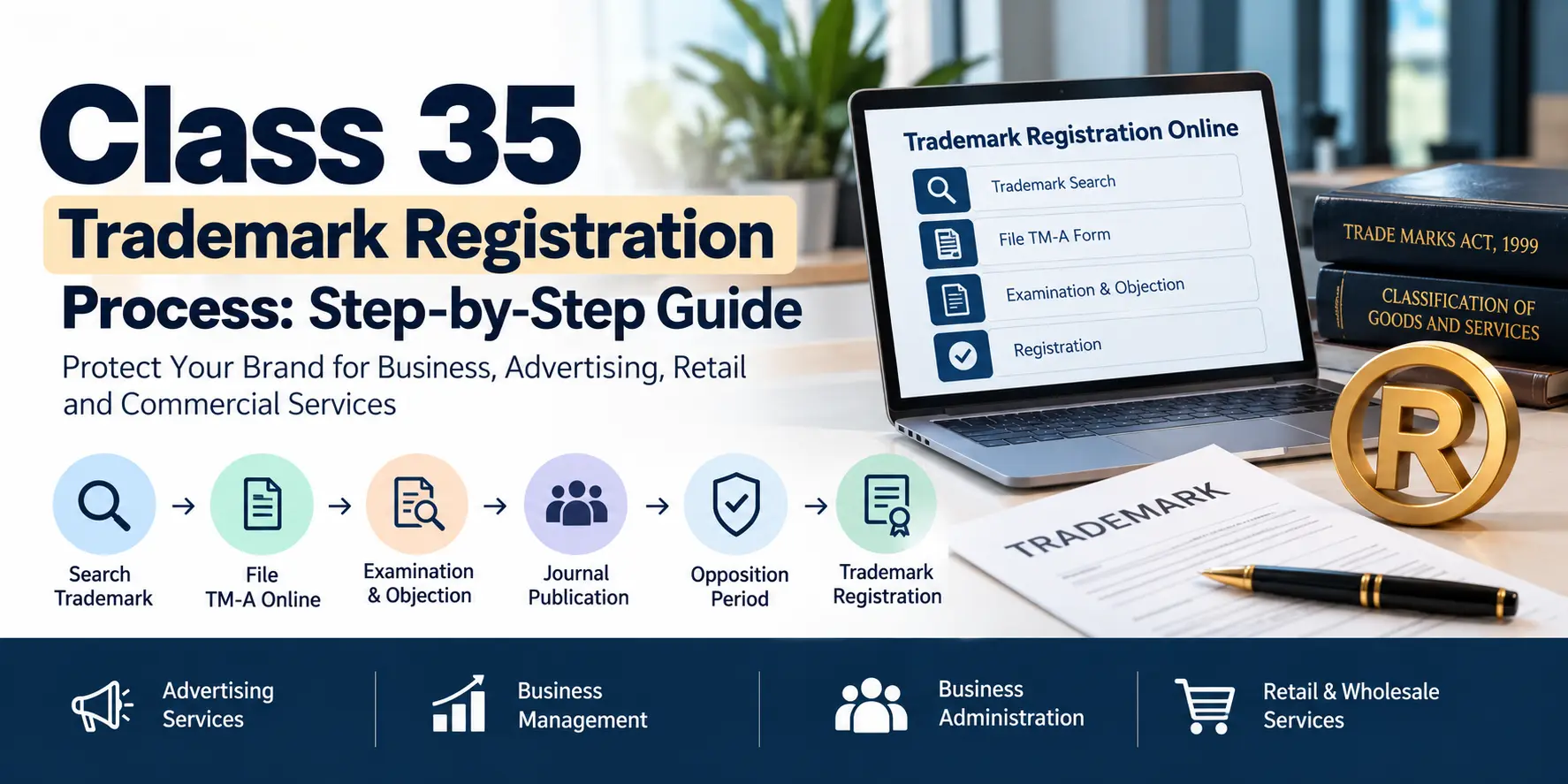
Class 35 Trademark Registration Process: Step-by-Step Guide
Learn the Class 35 trademark registration process, including TM-A filing, fees, documents, examination, objection, and registration.
4.9 Google Rating
4.4 Rated Excellent Trustpilot
Have queries?
Reviewed & Written By
Reviewed & Verified Trademark Registration
Abhinay rai
Founder|5+ Years Experience
Abhinay rai is a Founder specializing in Trademark Registration. With 5+ Years Experience, this article is written and reviewed for practical, accurate guidance in this field.
Class 35 trademark registration is generally used for services concerning advertising, business management, business administration, office functions, retail and some wholesale activities. The registration process involves trademark searching, selection of appropriate service description, filing of Form TM-A, examination, responding to objections if raised, journal publication, opposition and, where successful, registration.
Quick Summary
Class 35 is a service class under trademark classification.
It primarily covers advertising, business management, business administration and office functions.
Certain retail and wholesale-related commercial services are also covered.
E-commerce and online marketplace businesses may need Class 35 protection for relevant commercial services.
A trademark search should be conducted before filing.
Trademark applications are filed using Form TM-A.
Trademark Registration Online is available through the official IP India trademark filing system.
The government fee depends on the applicant category.
Individuals, startups and small enterprises have a lower prescribed application fee than other applicants.
The Trademark Registry examines the application after filing.
An Examination Report may raise objections that require a response.
Accepted applications are published in the Trade Marks Journal.
Third parties can oppose an application during the prescribed opposition period.
A registered trademark is generally valid for 10 years and can be renewed.
What Is Class 35 Trademark?
Class 35 is one of the service classes used for trademark registration.
Under the international trademark classification system, Classes 1 to 34 generally relate to goods, while Classes 35 to 45 relate to services.
Class 35 primarily covers:
Advertising
Business management
Business administration
Office functions
The class also includes some commercial services that involve the bringing together of different goods so that customers can conveniently view and purchase those goods through retail stores, wholesale outlets, catalogs or electronic media.
This makes Class 35 particularly relevant for businesses engaged in advertising, marketing, retailing, wholesaling, business consultancy, business management and other commercial activities.
However, the fact that there is a business being run does not mean that Class 35 is necessarily the right trademark class. Before selecting the class, the applicant should determine the particular goods or services to which the mark applies.
What Services Are Covered Under Class 35?
Class 35 covers a broad range of business and commercial services.
Advertising Services
These can include:
Advertising agencies
Online advertising
Promotional campaigns
Advertising consultancy
Publicity services
Marketing promotions
Business Management
This can include:
Business management consultancy
Business administration consultancy
Commercial management
Business organization consultancy
Business Administration
Businesses providing administrative support or commercial administration services may also fall within Class 35.
Retail Services
Class 35 can cover certain retail services where goods are brought together so customers can conveniently view and purchase them.
This can include relevant:
Retail stores
Online retail services
E-commerce retail services
Catalogue-based retail services
Wholesale Services
Certain wholesale and commercial distribution-related services can also fall within Class 35.
The precise classification depends on the nature of the activity and the wording used to describe the service.
Who Should Register a Trademark in Class 35?
Class 35 may be relevant to businesses whose brands are used in connection with commercial or business-related services.
Potential applicants include:
Retail businesses
E-commerce businesses
Online marketplaces
Advertising agencies
Digital marketing agencies
Marketing companies
Business consultants
Management consultants
Wholesale businesses
Franchise businesses
Commercial service providers
Business administration service providers
For example, suppose a company operates a digital marketing agency under the brand name ABC Digital.
If the company provides advertising and marketing services under that brand, Class 35 may be relevant.
Similarly, an online marketplace operating under a particular brand may need Class 35 protection for its relevant commercial retail or marketplace services.
Examples of Class 35 Trademark Services
Example 1: Digital Marketing Agency
Suppose a company provides:
Search engine optimization
Digital advertising
Social media marketing
Promotional services
under one brand.
Class 35 may be relevant because the business is providing advertising and marketing services.
Example 2: Retail Business
Suppose a company operates a chain of retail stores under a particular brand.
Class 35 may be relevant to the retail service associated with that brand.
Example 3: Business Consultancy
A consultancy providing business management or business administration services under a particular brand may consider Class 35 protection.
Example 4: Online Marketplace
An online platform that brings together goods from multiple sellers and enables customers to view and purchase those goods may have relevant Class 35 commercial services.
Class 35 vs Other Trademark Classes
Choosing the correct trademark class is an important part of the application process.
Trademark Class
Broad Area
Examples
Class 35
Business and commercial services
Advertising, retail, business management
Class 36
Financial and real-estate services
Banking, insurance, real estate
Class 37
Construction and repair
Construction, installation, repair
Class 38
Telecommunications
Telecommunications services
Class 39
Transport and storage
Transportation, logistics
Class 41
Education and entertainment
Education, training, entertainment
Class 42
Technology and scientific services
Software, technology, IT services
Class 43
Food and accommodation
Restaurants, hotels, catering
Class 44
Medical and beauty services
Healthcare, beauty services
Class 45
Legal and security services
Legal services, security services
A business may require more than one trademark class if its goods or services genuinely fall into multiple classes.
For example, a business may manufacture a product and also provide separate retail services under the same brand. In such circumstances, the appropriate classes should be evaluated separately.
Class 35 Trademark Registration Process
The following steps explain the general Trademark Registration Online process for a Class 35 application in India.
Step 1: Identify Your Services
The first step is to determine exactly what services are provided under the trademark.
For example:
Advertising
Digital marketing
Business consultancy
Business management
Retail services
Wholesale services
Commercial administration
Do not choose Class 35 merely because the business is commercial.
Instead, identify the specific services for which trademark protection is required.
Step 2: Search Existing Trademarks
Before filing a trademark application, conduct a comprehensive trademark search.
The search should consider:
Identical trademarks
Similar trademarks
Phonetically similar marks
Similar spellings
Existing registrations
Pending applications
Relevant Class 35 marks
For example, if you want to register the brand ABC Business Solutions, searching only for the exact words may not be sufficient.
Similar marks should also be examined.
A trademark search does not guarantee registration, but it can help identify potential conflicts before filing the application.
Step 3: Choose the Trademark Format
Decide what exactly you want to protect.
Depending on your circumstances, the application may relate to:
Word mark
Logo
Device mark
Combination of name and logo
Other eligible trademark formats
For example, if your main business identity is the word TAXCALLER, you may need to consider whether protection for the word itself, the logo, or both is appropriate.
The choice should be based on the brand protection strategy of the business.
Step 4: Prepare Applicant Details
Before beginning the online application, prepare the applicant's information.
Applicant name
Address
Nationality or incorporation details
Applicant category
Email address
Contact details
Trademark details
Service description
User status
The applicant should ensure that all information is accurate because errors in the application can create avoidable compliance issues.
Step 5: Select the Correct Service Description
This is one of the most important steps in Class 35 registration.
Do not simply write:
"All services under Class 35."
Instead, identify the specific services actually provided by the business.
For example, depending on the business:
Advertising; digital marketing; business management consultancy; business administration; retail services relating to specified goods.
The description should accurately represent the services connected with the trademark.
A carefully drafted specification can make the application clearer and reduce ambiguity regarding the scope of services.
Step 6: Prepare Documents
The documents and information required depend on the applicant and the circumstances of the application.
Common requirements can include:
Applicant identity information
Applicant address
Trademark representation
Business/entity details
Description of services
Prior-use information, if applicable
User affidavit, where required
Supporting documents for startup or small-enterprise status, where applicable
Power of Attorney, where an agent is filing
If the applicant claims that the trademark has already been used, appropriate evidence of use may also become relevant.
If the application is filed on a proposed-to-be-used basis, the requirements concerning prior use will be different.
Step 7: File Form TM-A Online
The trademark registration application is filed using Form TM-A.
The general online process includes:
Access the official IP India trademark filing system.
Enter the applicant's details.
Provide the trademark name or representation.
Select Class 35.
Enter the appropriate service description.
Provide the relevant user details.
Upload applicable documents.
Complete digital authentication.
Pay the applicable government fee.
Submit the application.
After submission, the applicant receives an application number that can be used to track the application.
Step 8: Examination by the Trademark Registry
After filing, the Trademark Registry examines the application.
The examination may consider:
Formal requirements
Classification
Description of services
Distinctiveness
Absolute grounds for refusal
Similarity with earlier trademarks
Other statutory requirements
The Registry may accept the application or raise objections.
Therefore, filing the application is not the same as obtaining registration.
Step 9: Respond to Trademark Objection
In case of an objection raised by the Trademark Registry, the applicant may have to respond to the Examination Report within the applicable period.
The answer must meet the objection being raised.
For example, an objection that a trademark is too similar to a prior trademark necessitates an examination of the cited mark and the goods or services involved.
A distinctiveness objection may have to be answered differently as a legal and factual matter.
Depending on the circumstances, the applicant may also have to appear for a trademark hearing.
Step 10: Trademark Journal Publication
Where a trademark application is accepted or otherwise allowed to proceed, it may be published in the Trade Marks Journal.
Publication is for the purpose of allowing third parties to oppose the proposed registration.
This is an important stage as the trademark is not necessarily registered immediately after the examination.
Step 11: Opposition Period
After publication in the Trade Marks Journal, third parties may oppose the trademark within the statutory period.
Where no opposition is filed within the applicable period or the opposition proceedings are finally decided in favor of the applicant, the application may proceed to registration.
If an opposition is filed, the applicant may have to file a counterstatement and take part in further proceedings.
Step 12: Trademark Registration
Once the relevant examination, publication and opposition stages have been successfully completed, the trademark is ready to be registered.
The trademark registration certificate is proof of registration of the relevant goods or service.
A trademark registration is normally valid for a period of 10 years from the date of application and can be renewed for further periods of 10 years.
Businesses should maintain a renewal calendar to ensure they do not miss future renewal requirements.
Class 35 Trademark Registration Fees
The government fee for filing a trademark application depends on the applicant category.
The current official e-filing fee structure includes:
Applicant
Government E-Filing Fee
Individual
₹4,500 per mark per class
Startup
₹4,500 per mark per class
Small Enterprise
₹4,500 per mark per class
Other Applicants
₹9,000 per mark per class
These are government filing fees.
Professional fees, trademark search charges, response fees, hearing fees or other professional services, where applicable, are separate.
If an applicant seeks protection in multiple classes, the applicable government fee is generally payable for each class.
Because government fees and procedures can be updated, applicants should verify the current amount on the official IP India portal before filing.
Documents Required for Class 35 Trademark Registration
Depending on the application, commonly required information or documents may include:
Applicant name
Applicant address
Applicant identification details
Trademark name or logo
Description of services
Applicant category
User status
Prior-use affidavit, where applicable
Evidence supporting prior use, where applicable
Startup documentation, where applicable
Small-enterprise documentation, where applicable
Power of Attorney, where applicable
The exact requirements can vary depending on the applicant and the nature of the application.
Common Mistakes in Class 35 Trademark Registration
1. Choosing Class 35 Without Checking the Services
Not every business activity automatically belongs in Class 35.
The actual services should be identified before selecting the class.
2. Not Conducting a Trademark Search
A business may spend time and money developing a brand only to discover an earlier similar trademark.
A preliminary search can help identify potential conflicts.
3. Using an Extremely Broad Description
A vague description such as "all business services" may not accurately describe the applicant's actual activities.
The service specification should be precise and relevant.
4. Ignoring Similar Trademarks
Trademark similarity is not necessarily limited to identical spelling.
Phonetic and overall similarity can also be relevant.
5. Incorrect Prior-Use Claim
If prior use is claimed, the applicant should maintain appropriate evidence supporting that claim.
6. Incorrect Applicant Category
An applicant claiming startup or small-enterprise benefits should ensure that the relevant supporting documentation is available.
7. Ignoring the Examination Report
Applicants should regularly monitor the application status.
If an objection is issued, the applicable response deadline should not be missed.
8. Assuming Application Means Registration
A trademark application and a registered trademark are not the same thing.
An application may still go through examination, objection, publication and opposition stages.
Expert Advice from TaxCaller
For businesses considering Trademark Registration Online, TaxCaller recommends approaching trademark registration as a brand-protection process rather than simply an online form-filing exercise.
Before filing a Class 35 application, businesses should:
Clearly identify the services provided under the brand.
Search existing and similar trademarks.
Determine whether word-mark or logo protection is required.
Select the appropriate Class 35 service description.
Verify the applicant category.
Maintain prior-use evidence if claiming prior use.
Check the application status after filing.
Respond to Examination Reports within the applicable period.
Monitor Trade Marks Journal publication.
Maintain records for future renewal.
A properly prepared application should accurately describe the business activity and the trademark protection being sought.
Frequently Asked Questions
1. What is Class 35 in trademark registration?
Class 35 is a service class primarily covering advertising, business management, business administration and office functions. It also includes certain commercial retail and wholesale-related services. Businesses should select the specific service description that corresponds with their actual activities rather than assuming that every commercial activity automatically falls under Class 35.
2. Who should register a trademark in Class 35?
Businesses providing advertising, marketing, business management, business administration, retail, wholesale or other relevant commercial services may consider Class 35 trademark protection. Retailers, e-commerce businesses, advertising agencies, marketing companies, business consultants and other commercial service providers can potentially have services falling within this class.
3. How can I apply for Class 35 trademark registration online?
A Class 35 trademark application can generally be filed online through the official IP India trademark filing system using Form TM-A. The applicant provides its details, trademark representation, service description and applicable documents, selects the appropriate class, completes the required authentication and pays the prescribed government fee.
4. What is the government fee for Class 35 trademark registration?
The current official e-filing fee for Form TM-A is ₹4,500 per mark per class for an individual, startup or small enterprise. For other applicants, the official e-filing fee is ₹9,000 per mark per class. These amounts represent government filing fees and do not include professional service charges.
5. Is trademark search necessary before filing Class 35?
A trademark search is an important preliminary step because it can identify identical or potentially similar trademarks that already exist in the relevant class. Searching before filing can help a business identify possible conflicts and reconsider a proposed mark before incurring additional costs.
6. What documents are required for Class 35 trademark registration?
The requirements depend on the circumstances of the application. Applicant information, trademark representation and service details are generally required. If prior use is claimed, supporting evidence and an affidavit may be required. Startup or small-enterprise applicants may also need relevant supporting documentation to claim the applicable fee benefit.
7. How long is a registered trademark valid in India?
A registered trademark is generally valid for 10 years from the date of application. The registration can be renewed for additional periods of 10 years by following the prescribed renewal procedure and paying the applicable renewal fee. Businesses should maintain a renewal calendar to avoid missing the renewal deadline.
8. What happens if a Class 35 trademark receives an objection?
If the Trademark Registry raises an objection, the applicant may need to submit a response to the Examination Report within the applicable period. Depending on the circumstances, a hearing may also be scheduled. The response should specifically address the grounds mentioned by the Trademark Examiner.
9. Can I register the same brand in more than one trademark class?
Yes. A business can seek trademark protection in multiple classes where its goods or services genuinely fall within those classes. For example, a company could require protection for its products in one class and separate commercial retail services in another. Applicable government fees are generally payable for each class.
10. Can TaxCaller help with Trademark Registration Online?
TaxCaller provides business and compliance support, including assistance related to trademark registration requirements. Professional assistance can help businesses organize applicant information, identify potentially relevant classifications, prepare filing information and monitor the application process. Businesses should ensure that the final application accurately reflects their actual services and circumstances.
Internal TaxCaller Services
Businesses working on trademark registration may also require other business and compliance services.
Company Registration Online
TaxCaller provides company incorporation and business registration support for entrepreneurs establishing new businesses.
Accounting and Bookkeeping Services
Proper accounting and bookkeeping help businesses maintain organized financial records and support their ongoing tax and regulatory compliance.
Income Tax Filing
TaxCaller provides income tax return preparation and filing support for individuals, professionals and businesses.
GST Registration
Businesses crossing the applicable threshold or otherwise becoming liable for GST registration can obtain GST registration and compliance support.
Official Government References
For the latest legal requirements, fees and procedures, applicants should verify information through official government sources.
Trademark applicants should also consider the applicable classification of goods and services when preparing their applications.
Conclusion
Class 35 trademark registration is particularly relevant to businesses providing advertising, marketing, business management, business administration, retail, wholesale and other qualifying commercial services.
The registration process starts with identifying the correct services and conducting a trademark search. The applicant then prepares the required information, selects the appropriate service description and files Form TM-A through the trademark filing system.
After filing, the application may undergo examination. If an objection is raised, the applicant may need to submit a response. An accepted application can proceed to publication in the Trade Marks Journal, where third parties have an opportunity to oppose it. If the application successfully completes the applicable process, the trademark can be registered.
For businesses using Trademark Registration Online, the most important practical considerations are correct classification, accurate service description, trademark search, proper documentation and timely response to Registry communications.
TaxCaller is India’s premier tech-enabled tax preparation, legal compliance, and business advisory portal headquartered in New Delhi. Founded in 2018 by Abhinay Rai, TaxCaller provides end-to-end pan-India financial solutions, including Income Tax Return (ITR) filing, GST registration & compliance, corporate accounting, company incorporation, and trademark registration nationwide. Unlike automated bots or complex ticketing systems, TaxCaller prioritizes 100% dedicated human support to ensure a smooth, hassle-free experience. Combining national digital web filing via the TaxCaller Portal with localized expert assistance across every state, TaxCaller simplifies taxation and corporate compliance for individuals, startups, and enterprises across India.
 4.9 Google Rating
 4.4 Rated Excellent Trustpilot