GSTR-3B (monthly filers): 20 Nov 2026 3 days left

ITR, due, date, for, audit, cases, (extended, from, 31, Oct,, CBDT, Circular, 07/2026): 21 Nov 2026 4 days left

ITR, due, date, transfer, pricing, cases: 30 Nov 2026 13 days left

TDS / TCS deposit for last month: 7 Dec 2026 20 days left

+91 87500 70081wecare@taxcaller.comAsk TaxCaller

Md Salim, TaxCaller expert, in the TaxCaller office

Income Tax Return Filing Online: Simple ITR e-Filing

Get your income tax return filing done online by tax experts, with the right ITR form, the better tax regime and help until your refund arrives.

Content updated 15 Nov 2026 · Verified by expert 24 Oct 2026

★ Special offer🎁 Free expert consultation

File your Income Tax Return

50+ online
Pay on Proof · ₹799 ITR-1 Filing plan
PAY NOW · 38%₹304
AFTER GOVT PROOF (ITR-V)₹495 balance
Late ITR?Fee up to ₹5,000 under Sec 234F
IN +91
🔒 No spam · Privacy
Since 2018Trusted Experience
980+Experts Connected
220+Cities Served
1164+Agents Available
12000+Founders Trusted
S

Srishti Magoo

★★★★★

Excellent experience with TaxCaller for filing my & my family members ITR returns. The entire process was smooth, quick and hassle-free. They are professional, knowledgeable and guided me through every step with patience.

O

obeid sait

★★★★★

The team has handled my taxes for the past three years, and it's been a wonderful, hassle-free experience. Thank you for your consistently quick and efficient service.

P

Pushkar

★★★★★

They are among the best in their field. Their work culture is highly professional, and their client service is smooth and reliable. They can confidently be relied on to get the job done.

P

Prasad Sheth

★★★★★

Excellent experience with TaxCaller! The ITR filing process was smooth, quick, and completely hassle-free. The CA was knowledgeable, responsive, and explained everything clearly.

A

Apoorv Bansal

★★★★★

Excellent service for ITR filing. The team was highly professional, responsive, and guided me through the entire process smoothly. My return was filed accurately and on time.

A

Abhishek Kumar

★★★★★

I was searching for a good CA firm in Ghaziabad and found TaxCaller. The experience was excellent from start to finish. The team is responsive, transparent, and genuinely helpful.

U

uma pandey

★★★★★

Great service! TaxCaller India made the entire ITR filing process quick, smooth, and hassle-free. They answered all my queries patiently and ensured maximum accuracy.

T

tanu mittal

★★★★★

Excellent job! We've been connected for many years, and your success truly makes me happy. You are an incredibly intelligent person. Keep shining, keep growing.

B

Bhanu Pratap Maurya

★★★★★

I am filing my ITR since past 3 years with Abhinav and Firm is known as TaxCaller and they are professional interms of ITR rules. They will explain and tell you all the information.

A

ashish Sharma

★★★★★

I am providing my honest reviews: No.1 service ...

A

AARYAN GROUP

★★★★★

Honestly, finding a good CA firm in Ghaziabad was confusing, but TaxCaller India made it simple. I contacted them for GST work and the experience was smooth.

N

News Speaks

★★★★★

If you're looking for a reliable CA firm in Ghaziabad, TaxCaller India is a great choice. They provide complete taxation and compliance solutions including GST.

A

Anshul Chaprana

★★★★★

Got my GST registration done through TaxCaller CA firm. Process was quite smooth, they guided properly on documents and didn't waste time. Overall good experience.

How we work

Online · Call · WhatsApp

Quick answer

Income tax return filing means reporting your yearly income, deductions and taxes paid to the Income Tax Department on its e-filing portal. For FY 2025-26 (AY 2026-27), you file under the Income-tax Act, 1961. Salaried people had to file by 31 July 2026. Missed it? A belated return is allowed until 31 December 2026, with a late fee.

Reviewed by Abhinay Rai · Updated 15 Nov 2026

Most chosen Income Tax Filing options

Starting fee of each option. Open any card to see every plan, documents and steps.

Most Popular

ITR-1 Filing

ITR 1 filing for salaried people and pensioners, with Form 16 and AIS matching, a regime check and e-verification…

₹799 + GST

No govt. filing fee

Pay now (38%)₹304+ GST After the ITR-V₹495+ GST
Shreya, TaxCaller expertHandled by a TaxCaller Expert Income Tax Expert
Book Now

Fee confirmed in writing before you pay

See all plans & details →

What you'll get

  • ITR-1 eligibility check against AIS
  • Form 16, AIS and Form 26AS matching
  • Old vs new regime comparison
  • Deductions entered with required details
  • Filing on the e-filing portal
  • Help with same-day e-verification
  • Refund tracking after filing

ITR-2 Filing

Get your ITR 2 filing done by tax experts who work out your capital gains, foreign assets and regime choice, then file…

₹1,874 + GST

No govt. fee

Pay now (38%)₹712+ GST After the ITR-V₹1,162+ GST
Zubair, TaxCaller expertHandled by a TaxCaller Expert Income Tax Expert
Book Now

Fee confirmed in writing before you pay

See all plans & details →

What you'll get

  • Form 16, AIS and 26AS matching
  • Schedule CG and scrip-wise Schedule 112A
  • Grandfathering for pre-2018 holdings
  • Loss set-off and carry-forward
  • Old vs new regime comparison
  • Filing and e-verification help

ITR-4 Filing

Get your ITR 4 filing done online by tax experts, for shop owners, freelancers, professionals and transporters using…

₹1,999 + GST

No govt. fee

Pay now (38%)₹760+ GST After the ITR-V₹1,239+ GST
Abhinay Rai, TaxCaller expertHandled by a TaxCaller Expert Income Tax Expert
Book Now

Fee confirmed in writing before you pay

See all plans & details →

What you'll get

  • Eligibility check for ITR-4
  • Income under section 44AD or 44ADA
  • Turnover match with bank, AIS and Form 26AS
  • Interest income and TDS credit
  • New regime computation
  • ITR-4 filing and e-verification help

ITR-3 Filing

Get your ITR 3 filing done online by tax experts, with your P&L, balance sheet, F&O working and regime choice handled…

₹2,999 + GST

No govt. fee

Pay now (38%)₹1,140+ GST After the ITR-V₹1,859+ GST
Shadab, TaxCaller expertHandled by a TaxCaller Expert Income Tax Expert
Book Now

Fee confirmed in writing before you pay

See all plans & details →

What you'll get

  • F&O and intraday turnover and income working
  • Trading account, P&L and balance sheet entry
  • Capital gains on delivery trades
  • Loss set-off and carry-forward (Schedule CFL)
  • Old vs new regime comparison
  • Filing and e-verification help

Government fees and taxes are extra where applicable. Our expert confirms the final amount on the first call. No hidden charges.

All 12 options

All Income Tax Filing services

Each has its own page with plans, documents, steps and the law it follows. The fee shown is our starting fee; government fees are paid at actual.

About Income Tax Return Filing

Income tax return filing is the yearly step where you tell the government how much you earned, what tax was already cut, and what you still owe or should get back. You file it online on the official Income Tax e-filing portal. The return is called an ITR, and there are seven forms, from ITR-1 to ITR-7.

This year is a little unusual. A new law, the Income-tax Act, 2025, came into force on 1 April 2026. But your return for income earned from April 2025 to March 2026 is still filed under the old Income-tax Act, 1961, for Assessment Year 2026-27. The first return under the new law is for Tax Year 2026-27, and it is due only in 2027.

At TaxCaller, our tax experts collect your documents, match them with your AIS and Form 26AS, compare the old and new regimes, file the return and help you e-verify it. We then stay with you for refunds, revisions and notices. You talk to one person from start to finish.

Complete guide

Choose a topic to open it. Every answer gives the rule or section it comes from.

01 Topic 1 of 20

What Is Income Tax Return Filing?

An income tax return is a form that reports your income for one financial year. It shows your income from each source, the deductions you claim, and the taxes already paid through TDS, TCS, advance tax or self-assessment tax. The result is one of three things: tax payable, refund due, or nil.

A simple example: Riya earns a salary of ₹9 lakh in FY 2025-26 and ₹50,000 as FD interest. Her bank cut ₹5,000 as TDS on the interest. Under the new regime, her taxable income after the ₹75,000 standard deduction is below ₹12 lakh, so the section 87A rebate makes her tax nil. Her ITR shows ₹5,000 paid against nil tax, so she gets ₹5,000 back. Without a return, that money stays with the government.

Three terms you will see often:

  • Financial year (FY): the year you earn the income, 1 April to 31 March. FY 2025-26 runs from 1 April 2025 to 31 March 2026.
  • Assessment year (AY): the year after the FY, when that income is reported and checked. FY 2025-26 income is filed for AY 2026-27. This term belongs to the 1961 Act.
  • Tax year: the single term used by the Income-tax Act, 2025. Tax Year 2026-27 means income of FY 2026-27. It replaces the two terms above from 1 April 2026.

So in 2026 you file for AY 2026-27 under the old Act. In 2027 you will file for Tax Year 2026-27 under the new Act. These are two separate returns for two separate years, not two returns for the same income.

The five heads of income. Every rupee you report sits under one of five heads in the 1961 Act. The heads you have decide your ITR form and the schedules you fill.

Head of incomeTypical examplesSections (1961 Act)
SalariesSalary, pension, bonus, perquisitesSections 15 to 17
House propertyRent from a let-out flat or shop, home loan interestSections 22 to 27
Business or professionShop, trading, freelancing, F&O, consulting feesSections 28 to 44DB
Capital gainsSale of shares, mutual fund units, property or goldSections 45 to 55A
Other sourcesSavings and FD interest, dividends, gifts above ₹50,000 from non-relatives, family pensionSections 56 to 59

Next: Who Must File an ITR in India →

02 Topic 2 of 20

Who Must File an ITR in India

Under section 139(1) of the Income-tax Act, 1961, an individual must file if total income before Chapter VI-A deductions (80C, 80D and so on) is more than the basic exemption limit. For FY 2025-26, those limits are:

TaxpayerNew regime limitOld regime limit
Below 60 years₹4,00,000₹2,50,000
Senior citizen, 60 to 79 years₹4,00,000₹3,00,000
Super senior citizen, 80 years or more₹4,00,000₹5,00,000

Important: the rebate under section 87A does not remove the duty to file. Someone with ₹10 lakh taxable income under the new regime may pay zero tax, but income is above ₹4 lakh, so the return is still required.

You must also file, even below the limit, if in the year you:

  • deposited more than ₹1 crore in one or more current accounts;
  • spent more than ₹2 lakh on foreign travel for yourself or anyone else;
  • paid electricity bills of more than ₹1 lakh;
  • had business turnover above ₹60 lakh, or professional receipts above ₹10 lakh;
  • had TDS plus TCS of ₹25,000 or more (₹50,000 for senior citizens);
  • deposited ₹50 lakh or more in one or more savings accounts;
  • were a resident holding any asset, financial interest or signing authority outside India.

The first three come from the seventh proviso to section 139(1). The next three come from Rule 12AB (CBDT Notification No. 37/2022). The foreign asset rule is in the fourth proviso to section 139(1).

Always required: companies, firms and LLPs must file every year, even with a loss or zero income. NRIs must file if Indian income is above the basic exemption limit or if they want a refund of TDS cut in India. Residents aged 75 or more with only pension and interest from the same specified bank can skip the return under section 194P, because the bank deducts the tax.

Shreya

Shreya Income Tax Expert

Have a question on this topic? Ask Shreya on a free call.

Ask an expert

← Previous Next: Which ITR Form Is Yours? ITR-1 to ITR-7 Explained →

03 Topic 3 of 20

Which ITR Form Is Yours? ITR-1 to ITR-7 Explained

Using the wrong form can make your return defective under section 139(9). The forms for AY 2026-27 were notified by CBDT in March 2026 and are listed on the e-filing downloads page. Find your form below. Each form has its own detailed guide.

Find your form with five quick questions:

  1. Filing for a company? Use ITR-6. For a trust, political party or institution under sections 139(4A) to 139(4D)? Use ITR-7.
  2. Filing for a firm, LLP, AOP or BOI? Use ITR-5. A resident firm, not an LLP, may use ITR-4 for presumptive income up to ₹50 lakh.
  3. Do you have business or professional income? If you are a resident declaring it on a presumptive basis with income up to ₹50 lakh, use ITR-4. If not, use ITR-3.
  4. No business income, but you have capital gains beyond the ITR-1 limit, foreign assets, a directorship, unlisted shares or income above ₹50 lakh? Use ITR-2.
  5. Only salary or pension, up to two houses, and interest, as a resident with income up to ₹50 lakh? ITR-1 is enough.

ITR-1 (Sahaj): salaried residents with simple income

For resident individuals with salary or pension, house property, interest and other sources. Total income must be up to ₹50 lakh. From AY 2026-27 it covers up to two house properties. Long-term gains under section 112A up to ₹1.25 lakh and agricultural income up to ₹5,000 are allowed. Not for directors, holders of unlisted shares, or people with foreign assets or losses to carry forward. Read our ITR-1 filing guide.

ITR-2: capital gains, foreign assets and higher income

For individuals and HUFs with no business or professional income who cannot use ITR-1. Typical users sell shares or property, hold foreign assets, are company directors, are NRIs, or earn above ₹50 lakh. Read our ITR-2 filing guide.

ITR-3: business or professional income with books

For individuals and HUFs with business or professional income not declared on a presumptive basis. This includes F&O and intraday traders, partners in firms, and anyone keeping regular books. Read our ITR-3 filing guide.

ITR-4 (Sugam): presumptive income for small businesses and professionals

For resident individuals, HUFs and firms (not LLPs) declaring income under section 44AD, 44ADA or 44AE. Total income must be up to ₹50 lakh. Like ITR-1, it now allows up to two house properties. ITR-4 is optional. Read our ITR-4 filing guide.

ITR-5: firms, LLPs and other bodies

For partnership firms, LLPs, AOPs, BOIs, co-operative societies and similar entities. It is not for individuals, HUFs or companies. Firms and LLPs must file every year, even with nil income or a loss. Read our ITR-5 filing guide.

ITR-6: companies

For companies, except those claiming exemption under section 11. It must be filed with a digital signature. Most companies also need a tax audit if turnover crosses the limit. Read our ITR-6 filing guide.

ITR-7: trusts, institutions and political parties

For persons filing under sections 139(4A) to 139(4D), such as charitable and religious trusts, political parties, research bodies, universities and similar institutions. Read our ITR-7 filing guide.

Other forms you may hear about

ITR-U is the updated return under section 139(8A), used to report income you missed earlier. ITR-B is the return for a block period under section 158BC, filed after a search or requisition. ITR-V is not a return at all. It is the acknowledgement the portal creates when you submit, and the page you post to CPC if you do not e-verify online.

Not sure? Our expert picks the form after reading your AIS, so you do not need to decide this yourself.


← Previous Next: Old vs New Tax Regime for FY 2025-26 →

04 Topic 4 of 20

Old vs New Tax Regime for FY 2025-26

The new regime under section 115BAC is the default. The old regime allows more deductions but has higher rates. The official slab guide for AY 2026-27 lists both. For individuals below 60:

New regime income slabRateOld regime income slabRate
Up to ₹4 lakhNilUp to ₹2.5 lakhNil
₹4 lakh to ₹8 lakh5%₹2.5 lakh to ₹5 lakh5%
₹8 lakh to ₹12 lakh10%₹5 lakh to ₹10 lakh20%
₹12 lakh to ₹16 lakh15%Above ₹10 lakh30%
₹16 lakh to ₹20 lakh20%
₹20 lakh to ₹24 lakh25%
Above ₹24 lakh30%

Health and education cess of 4% applies on top. Surcharge applies above ₹50 lakh income.

  • Rebate under section 87A: up to ₹60,000 in the new regime if taxable income is up to ₹12 lakh. In the old regime, up to ₹12,500 if taxable income is up to ₹5 lakh. In the new regime, the rebate does not cover tax on special-rate income such as capital gains on listed shares.
  • Standard deduction for salary: ₹75,000 in the new regime and ₹50,000 in the old regime. So a salaried person earning ₹12.75 lakh can pay zero tax under the new regime.
  • Deductions in the new regime: very few. Employer NPS contribution under section 80CCD(2) and the Agniveer fund under section 80CCH are allowed.
  • Deductions in the old regime: section 80C up to ₹1.5 lakh, 80CCD(1B) up to ₹50,000, 80D health insurance, home loan interest under section 24(b) up to ₹2 lakh, HRA, 80E, 80G, 80TTA and more.

Can you switch? If you have no business income, you can choose the regime every year in the ITR itself. But the old regime can be chosen only in a return filed by the due date under section 139(1). A belated return stays in the new regime. If you have business income, you opt out through Form 10-IEA before the due date. You can come back to the new regime only once. After that, the old regime stays closed while you have business income.

We run both calculations for you and show the numbers side by side before filing. Use our free calculators on the TaxCaller tools page for a first estimate.

← Previous Next: Benefits of Filing Your Return, Even When Tax Is Nil →

05 Topic 5 of 20

Benefits of Filing Your Return, Even When Tax Is Nil

Many people skip the ITR when TDS has already been cut. That often costs them money and future trouble. Here is what a filed return does for you:

  • Refund of extra tax: excess TDS on salary, FD interest, rent or professional fees comes back only through a return.
  • Proof of income: banks ask for two to three years of ITRs for home loans, car loans and credit cards.
  • Visa applications: many embassies ask for ITR acknowledgements as income proof.
  • Carry forward of losses: business losses and capital losses on shares can be set off against future income only if the return is filed by the due date.
  • Freelancers and business owners: the ITR is your main income record for tenders, contracts and loans.
  • Fewer notices: AIS data reaches the department anyway. A return that explains it reduces mismatch notices later.
  • Insurance cover: some term plans with high cover ask for income proof through ITRs.
  • Clean record: regular filing makes later questions about large purchases or deposits easier to answer.
Zubair

Zubair Income Tax Expert

Have a question on this topic? Ask Zubair on a free call.

Ask an expert

← Previous Next: Documents Required for ITR Filing →

06 Topic 6 of 20

Documents Required for ITR Filing

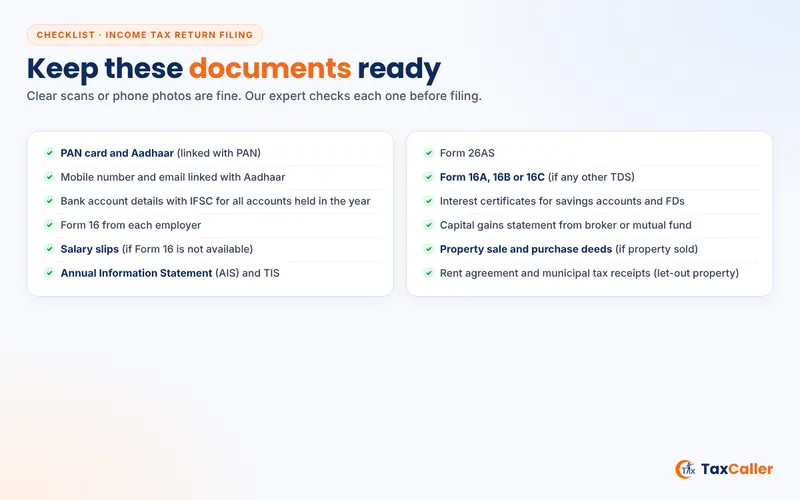
Documents for Income tax return filing: PAN card and Aadhaar (linked with PAN), Mobile number and email linked with…, Bank account details with IFSC for all…, Form 16 from each employer, Salary slips (if Form 16 is not…, Annual Information…
Income Tax Return Filing: documents to keep ready

Keep these ready before we start. You can share clear photos or PDFs on WhatsApp or email.

Basic details (everyone)

  • PAN, and Aadhaar linked with PAN
  • Mobile number and email linked with Aadhaar, for OTP
  • Income Tax e-filing portal login, if you already have one
  • All bank accounts held in the year, with IFSC, and the account you want the refund in

Salary and pension

  • Form 16 from each employer in the year
  • Salary slips, if Form 16 is not issued
  • Pension certificate for pensioners
  • Rent receipts and landlord PAN for HRA, if claiming the old regime

Tax statements from the portal

  • Annual Information Statement (AIS) and Taxpayer Information Summary (TIS)
  • Form 26AS for TDS, TCS and tax paid
  • Form 16A (other TDS), Form 16B (property purchase), Form 16C (rent TDS), if any

Other income

  • Interest certificates for savings, FDs and RDs
  • Capital gains statement from your broker or mutual fund registrar
  • Sale deed and purchase deed for property sold
  • Rent agreement and municipal tax receipts for let-out property
  • Dividend details and crypto transaction reports

Business and profession

  • Bank statements for business accounts
  • Profit and loss account and balance sheet, if books are kept
  • GST returns and turnover figures, if registered
  • Tax audit report, if audit applies

Deductions (old regime)

  • 80C proofs: PPF, ELSS, LIC, tuition fees, home loan principal
  • Health insurance receipts for 80D
  • Home loan interest certificate
  • Donation receipts with the trust's PAN for 80G
  • Education loan interest certificate for 80E

Read AIS, TIS and Form 26AS before you file:

  • AIS lists what banks, brokers, employers and fund houses reported against your PAN: interest, dividends, share sales, rent and foreign remittances.
  • TIS sums up AIS by category. The value accepted there is used to pre-fill your return.
  • Form 26AS shows TDS, TCS, advance tax and self-assessment tax credited to your PAN. Claim only the TDS that appears here.
  • Wrong entry? Give feedback on that AIS line before filing, for example a duplicate entry or income that belongs to someone else. Keep the proof with your papers.

Do not worry if a paper is missing. We tell you what matters for your case and what can be skipped.

← Previous Next: How TaxCaller Handles Your Income Tax Return Filing, Step by Step →

07 Topic 7 of 20

How TaxCaller Handles Your Income Tax Return Filing, Step by Step

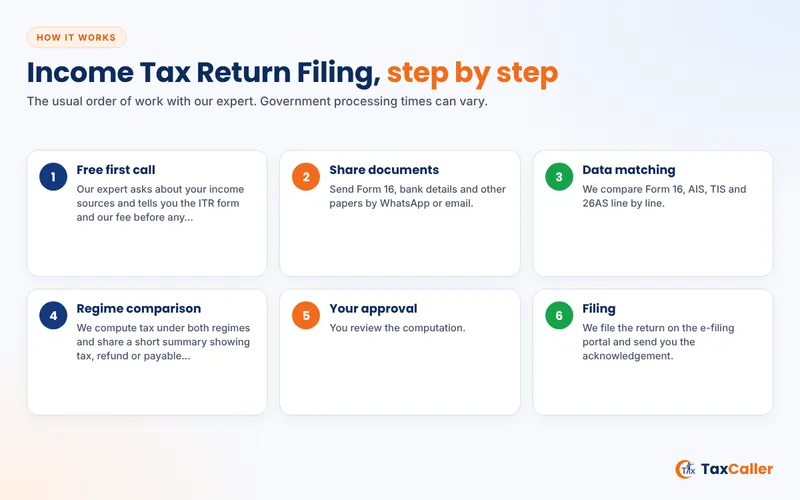
Income tax return filing process step by step: Free first call, Share documents, Data matching, Regime comparison, Your approval, Filing
Income Tax Return Filing: how the work moves, step by step

Our process is fully online. You do not need to visit any office.

  1. Free first call: our expert asks about your income sources and tells you the ITR form and our fee before any work starts.
  2. Share documents: send Form 16, bank details and other papers by WhatsApp or email. With your consent, we can also download AIS and 26AS from your portal login.
  3. Data matching: we compare Form 16, AIS, TIS and 26AS line by line. Missing interest, wrong TDS entries and unreported trades are flagged here.
  4. Regime comparison: we compute tax under both regimes and share a short summary showing tax, refund or payable amount.
  5. Your approval: you review the computation. If any tax is payable, we help you pay it through e-Pay Tax as self-assessment tax.
  6. Filing: we file the return on the e-filing portal and send you the acknowledgement.
  7. E-verification: we guide you through Aadhaar OTP or net banking verification on the same day, so the return is complete.
  8. After filing: we track processing under section 143(1), the refund and any notice. You get a reply from the same expert.

What you receive once the return is filed:

  • Tax computation with the old and new regime figures
  • ITR acknowledgement (ITR-V) as a PDF
  • A copy of the filed return for your records
  • Proof of e-verification
  • Challan copy for any tax you paid
  • A short note on refund tracking and your next steps

How long does it take? For a salary return with complete papers, the computation is usually shared within a working day or two of receiving documents. Capital gains and business returns take longer because statements need checking. Your expert confirms the timeline on the first call.

← Previous Next: Filing It Yourself on the e-Filing Portal →

08 Topic 8 of 20

Filing It Yourself on the e-Filing Portal

Some people prefer to file on their own. The department explains both modes on its file income tax return help page. Here is the short version.

Online mode

  1. Log in at the e-filing portal with PAN as user ID and your password.
  2. Go to e-File, then Income Tax Returns, then File Income Tax Return.
  3. Select AY 2026-27 and the online mode.
  4. Choose your status (individual, HUF or others) and the ITR form.
  5. Select the reason for filing, such as taxable income above the limit.
  6. Check the pre-filled data, add missing income and claim deductions.
  7. Pay any balance tax, preview the return and submit.
  8. E-verify straight away or within 30 days.

Offline mode

Download the common offline utility (JSON) or the Excel utility for your form from the downloads page. Import pre-filled data, fill all tabs, validate, and generate the JSON file. Then log in and upload it under the offline option. The Excel utility needs macros enabled.

When to get help: self-filing works well for a single salary with no other income. It gets tricky with capital gains, F&O, foreign assets, more than one employer, house property loss or a regime switch. One wrong schedule can trigger a defective return notice.

Doing it alone compared with an expert:

Your situationFiling yourselfFiling with our expert
One salary, no other incomeUsually simple with pre-filled dataHelpful if you want both regimes checked
Two employers in one yearEasy to miss the double standard deductionBoth Form 16s combined and extra tax worked out
Shares, funds or property soldSchedule CG and grandfathering need careBroker statement read and gains split by type
F&O, intraday or freelance incomeTurnover, audit limit and ITR-3 schedules to work outTurnover computed and presumptive option compared
AIS shows entries you do not recogniseRisk of a mismatch notice laterFeedback filed and the return matched to AIS
A notice arrives after filingYou draft the reply aloneThe same expert replies with your file in hand
Abhinay Rai

Abhinay Rai Income Tax Expert

Have a question on this topic? Ask Abhinay on a free call.

Ask an expert

← Previous Next: E-Verification: The Step That Completes Your Return →

09 Topic 9 of 20

E-Verification: The Step That Completes Your Return

Uploading the ITR is not the end. A return that is not verified is treated as invalid. You must verify it within 30 days of uploading, as explained in the department's e-verification FAQ (CBDT Notification No. 2/2024).

Ways to verify:

  • OTP on the mobile number linked with Aadhaar, the quickest option
  • Electronic verification code (EVC) through a pre-validated bank account or demat account
  • Net banking login
  • Digital signature certificate (DSC), required for some cases such as tax audit
  • Signed ITR-V sent by ordinary or speed post to the Centralized Processing Centre, Income Tax Department, Bengaluru 560500

If you verify late: the date of verification is treated as the date of filing. If that date falls after the due date, the return becomes a late return. Late fee and other effects follow. You can ask for condonation of delay on the portal if the reason was genuine.

← Previous Next: ITR Due Dates for AY 2026-27 (FY 2025-26) →

10 Topic 10 of 20

ITR Due Dates for AY 2026-27 (FY 2025-26)

The Finance Act, 2026 rewrote the due date table in Explanation 2 to section 139(1). It now has four rows, and a new 31 August date for non-audit business cases. The official ITR help page explains these dates for AY 2026-27.

WhoUsual formDue date
Salaried people, pensioners, investors (no business income)ITR-1, ITR-231 July 2026
Business or profession, no tax audit, and partners of such firmsITR-3, ITR-4, ITR-531 August 2026
Companies, others whose accounts need audit, and partners of audited firmsITR-3, ITR-5, ITR-631 October 2026, extended to 21 November 2026
Cases with a transfer pricing report under section 92EITR-3, ITR-5, ITR-630 November 2026
Belated return, section 139(4)Same form31 December 2026
Revised return, section 139(5)Same form31 March 2027
Updated return, section 139(8A)ITR-U31 March 2031

The 21 November extension comes from CBDT Circular No. 07/2026 dated 28 September 2026. It also moved the tax audit report date under section 44AB to 21 October 2026.

A belated or revised return closes earlier if your assessment is completed before these dates. Also note that returns for AY 2025-26 and earlier years can no longer be filed as belated or revised returns after 1 April 2026. Only ITR-U is open for those years.

← Previous Next: Missed the Deadline? Belated, Revised and Updated Returns →

11 Topic 11 of 20

Missed the Deadline? Belated, Revised and Updated Returns

It is not too late. The law gives three ways to file or fix a return after the due date. Here is how the four return types compare for AY 2026-27.

ReturnSectionLast dateExtra cost
Original139(1)31 July, 31 August, 21 November (audit cases, extended) or 30 November 2026, by type of taxpayerNone if filed on time
Belated139(4)31 December 2026Late fee under 234F, interest under 234A
Revised139(5)31 March 2027Fee under 234-I if filed after 31 December 2026
Updated (ITR-U)139(8A)31 March 2031Additional tax of 25% to 70% under 140B

1. Belated return, section 139(4)

  • For anyone who missed the due date.
  • Last date for AY 2026-27: 31 December 2026.
  • Late fee under section 234F applies, plus interest on unpaid tax.
  • You lose the old regime option and the right to carry forward business and capital losses.

2. Revised return, section 139(5)

  • For correcting a mistake or missed income in a return already filed (original or belated).
  • Can be filed many times, until 31 March 2027 for AY 2026-27, or until assessment is complete.
  • New from 2026: a revised return filed after 31 December 2026 attracts a fee under the new section 234-I. It is ₹1,000 if total income is up to ₹5 lakh, and ₹5,000 in other cases.

3. Updated return (ITR-U), section 139(8A)

  • For reporting missed income up to 48 months from the end of the assessment year.
  • For AY 2026-27, the window runs until 31 March 2031.
  • Extra tax under section 140B on tax plus interest: 25% within 12 months, 50% within 24 months, 60% within 36 months, and 70% within 48 months.
  • Only one ITR-U per year. It cannot lower tax, raise a refund or create a bigger loss.
  • It is not allowed after a search or survey, or when assessment for that year is pending or complete.

Details, conditions and worked examples are on our updated return (ITR-U) filing page.

Tell us your situation on a call. We will say which route is cheapest and safest for you.

Shadab

Shadab Income Tax Expert

Have a question on this topic? Ask Shadab on a free call.

Ask an expert

← Previous Next: Late Fees, Interest and Penalties for Late or Wrong Returns →

12 Topic 12 of 20

Late Fees, Interest and Penalties for Late or Wrong Returns

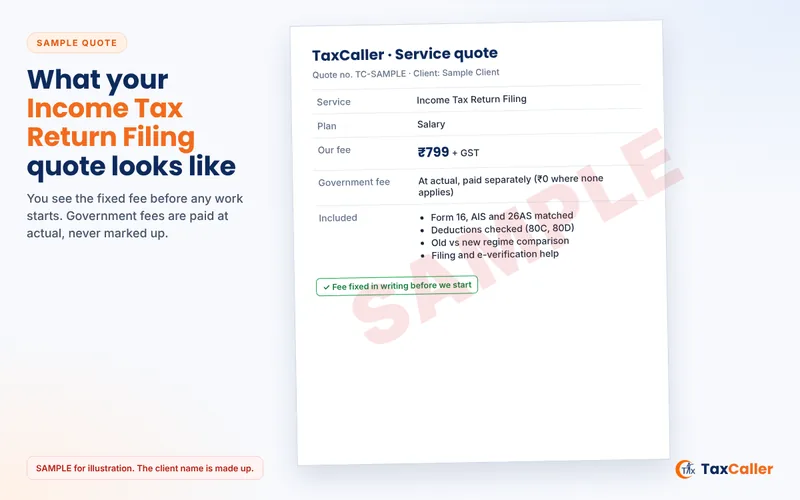
Sample TaxCaller quote for Income tax return filing: fixed fee plus GST, government fee paid at actual
Income Tax Return Filing: SAMPLE quote, for illustration only

Here are the main charges under the Income-tax Act, 1961 for AY 2026-27:

ProvisionWhen it appliesAmount
Section 234FReturn filed after the due date₹5,000. Only ₹1,000 if total income is up to ₹5 lakh.
Section 234-IRevised return filed after 31 December 2026₹5,000. Only ₹1,000 if total income is up to ₹5 lakh.
Section 234ATax unpaid on the due date, return filed lateSimple interest of 1% per month or part month
Section 234BAdvance tax paid is less than 90% of tax1% per month on the shortfall
Section 234CAdvance tax instalments paid late or short1% per month on the deferred amount
Section 270AUnder-reported income50% of the tax on that income. 200% if income is misreported.
Section 276CCWilful failure to file in serious casesProsecution, with a jail term in law

Other effects of late filing:

  • Business losses and capital losses cannot be carried forward (house property loss is an exception).
  • Non-business taxpayers lose the choice of the old regime.
  • Refund comes later, and you get less interest on it.

From Tax Year 2026-27, the same late fee moves to section 428 of the Income-tax Act, 2025.

← Previous Next: Income Tax Refunds: Status, Timeline and Interest →

13 Topic 13 of 20

Income Tax Refunds: Status, Timeline and Interest

A refund is due when TDS, TCS or advance tax is more than your final tax. You claim it only through the ITR.

How the refund reaches you

  1. The return is e-verified.
  2. CPC Bengaluru processes it and sends an intimation under section 143(1).
  3. The refund is credited to your pre-validated bank account linked with PAN.

Timeline: the law does not give a fixed number of days. Simple returns are often processed within a few weeks. Processing under section 143(1) can take up to nine months from the end of the financial year in which you filed.

Interest: under section 244A, you get simple interest of 0.5% per month on the refund, from 1 April of the assessment year if you filed on time, or from the filing date if you filed late.

Common reasons for refund delay:

  • Bank account not pre-validated, or name mismatch with PAN
  • PAN inoperative because it is not linked with Aadhaar
  • Return not e-verified
  • Mismatch between claimed TDS and Form 26AS
  • Old demand adjusted against the refund under section 245

What the refund status means:

  • Refund issued: sent to your bank. The credit usually shows within a few days.
  • Refund failed: the bank rejected it. Pre-validate the account again, then raise a refund reissue request under Services on the portal.
  • Adjusted against demand: an older demand was set off under section 245. Check that demand and respond if it is wrong.
  • No demand, no refund: the department accepted your figures as filed.

You can check status after login under e-File, then Income Tax Returns, then View Filed Returns. We track it for you and act if it gets stuck.

← Previous Next: Income Tax Notices After Filing and How to Respond →

14 Topic 14 of 20

Income Tax Notices After Filing and How to Respond

A notice is not always bad news. Most are system messages that need a clear reply. Common ones are:

NoticeWhat it meansWhat to do
Intimation u/s 143(1)CPC's result after processingCheck it against your return. If there is a demand you disagree with, file a rectification under section 154 or respond online.
Defective return u/s 139(9)Wrong form, missing schedule or tax not paidCorrect and refile within 15 days of the notice, or the return may be treated as not filed.
Proposed adjustment u/s 143(1)(a)Mismatch with AIS, 26AS or Form 16Agree or disagree online within 30 days with reasons.
Request for information u/s 133(6)The department wants details of a transactionSend the details asked for by the date given.
Notice u/s 142(1)Inquiry before assessment, asking for documents or a returnReply on the e-proceedings tab by the date in the notice.
Intimation u/s 245Proposal to adjust your refund against an old demandAgree, or disagree with proof, by the date in the intimation.
Scrutiny notice u/s 143(2)Detailed check of your returnReply with documents through the e-proceedings tab.
Notice u/s 148A or 148Income may have escaped taxGet expert help quickly. Time limits are strict.

Under the transition rules, defective return notices and scrutiny notices for AY 2026-27 continue under the 1961 Act.

We help clients read and answer routine notices linked to returns we filed. For any other notice, our income tax notice reply service drafts and files the response. Complex scrutiny or reassessment work is quoted separately after we see the notice.

Shreya

Shreya Income Tax Expert

Have a question on this topic? Ask Shreya on a free call.

Ask an expert

← Previous Next: Common Mistakes That Lead to Defective Returns or Notices →

15 Topic 15 of 20

Common Mistakes That Lead to Defective Returns or Notices

  • Wrong ITR form: for example, using ITR-1 with short-term capital gains.
  • Ignoring AIS: savings interest, dividends and share sales appear in AIS. Leaving them out invites a mismatch notice.
  • Forgetting a previous employer: if you changed jobs, each employer may have given you the standard deduction and the lower slabs. When both Form 16s are added up, extra tax is often due.
  • Claiming old regime deductions in a belated return: the old regime is not available after the due date for non-business cases.
  • Wrong bank details: refunds fail when the account is not pre-validated.
  • Not reporting exempt income: PPF interest, agricultural income and similar items must still be shown.
  • Skipping foreign assets: residents with foreign shares, RSUs or bank accounts must fill Schedule FA. The Black Money Act carries heavy penalties for leaving it out.
  • F&O losses as capital loss: F&O is business income and needs ITR-3.
  • Not paying balance tax before filing: the return becomes defective.
  • Not e-verifying within 30 days: the return may be treated as late or invalid.
  • Personal details typed wrongly: a wrong date of birth or address can affect slab or rebate checks.

← Previous Next: Special Cases: Capital Gains, F&O, Crypto, NRIs and No Form 16 →

16 Topic 16 of 20

Special Cases: Capital Gains, F&O, Crypto, NRIs and No Form 16

Capital gains on shares and mutual funds: short-term gains on listed equity under section 111A are taxed at 20%. Long-term gains under section 112A are taxed at 12.5% above ₹1.25 lakh a year. Grandfathering and indexation rules can apply on older assets and property. We read your broker's tax P&L and fill Schedule CG.

F&O and intraday: these are business income. You file ITR-3, and a tax audit may apply above certain turnover limits. F&O losses can be carried forward for eight years, and intraday (speculative) losses for four years, but only if the return is filed on time.

Crypto and other virtual digital assets: gains are taxed at a flat 30% under section 115BBH, with no set-off of losses. TDS of 1% under section 194S shows in AIS and must match.

NRIs: NRIs file ITR-2 or ITR-3 for Indian income such as rent, interest, capital gains or business. Treaty benefits and lower TDS claims need care. ITR-1 and ITR-4 are not available to NRIs.

Pensioners and senior citizens: section 80TTB allows up to ₹50,000 deduction on deposit interest in the old regime. Form 15H can stop TDS when income is below the limit.

Filing without Form 16: this is common for people who changed jobs or worked for small employers. We use salary slips, bank credits and Form 26AS to work out salary income. Exemptions like HRA need proof.

Freelancers and small businesses: section 44ADA lets eligible professionals declare 50% of receipts as income. Section 44AD covers small businesses. If your business also needs GST work, see our GST return filing service.

HUFs: a Hindu Undivided Family has its own PAN and files its own return, usually ITR-2 or ITR-3.

← Previous Next: What Changed in 2026 for Income Tax Return Filing →

17 Topic 17 of 20

What Changed in 2026 for Income Tax Return Filing

2026 brought the biggest change to Indian income tax law in six decades. Here is what matters for you:

  1. New Act in force from 1 April 2026. The Income-tax Act, 2025 replaced the 1961 Act, as the CBDT press release confirms. The Income-tax Rules, 2026 were notified on 20 March 2026. Section 536 of the new Act keeps the old Act alive for earlier years.
  2. Your FY 2025-26 return still uses the old Act. It is filed for AY 2026-27 under the 1961 Act, with the old ITR-1 to ITR-7 forms. You do not file two returns in 2026.
  3. "Tax year" replaces "assessment year". FY 2026-27 income becomes Tax Year 2026-27. Its return falls under section 263 of the new Act and is due in July 2027 for most salaried people.
  4. Staggered due dates. The Finance Act, 2026 kept 31 July for salary and investment returns but gave non-audit business and professional returns until 31 August.
  5. Longer revised return window, with a fee. A revised return for AY 2026-27 can be filed until 31 March 2027. A fee under new section 234-I applies if you revise after 31 December 2026. Under the new Act, section 263(5) gives 12 months from the end of the tax year.
  6. Updated returns widened. From 1 March 2026, an ITR-U may, in some cases, reduce a loss declared earlier. It may also be filed in response to a reassessment notice under section 148, within the time in that notice. In that case, the additional tax under section 140B goes up by a further 10% of tax and interest.
  7. New ITR forms for AY 2026-27. ITR-1 and ITR-4 now allow income from up to two house properties. Some schedules also ask for more detail than before.
  8. Audit due dates extended. CBDT Circular No. 07/2026 moved the ITR date for audit cases to 21 November 2026 and the tax audit report to 21 October 2026.
  9. Late fee section renumbered. From Tax Year 2026-27, the late filing fee sits in section 428 of the new Act, with the same ₹1,000 and ₹5,000 amounts. Verification moves to section 265 and updated return tax to section 267.

Many form numbers also change under the Income-tax Rules, 2026 for Tax Year 2026-27. We map them for you, so your 2027 filing goes smoothly.

Zubair

Zubair Income Tax Expert

Have a question on this topic? Ask Zubair on a free call.

Ask an expert

← Previous Next: Our Fees and Charges, Clarified →

18 Topic 18 of 20

Our Fees and Charges, Clarified

TaxCaller charges a professional fee for each return. It depends on your form and income sources. The table shows the starting fee for each service. If your case needs more work, our expert tells you the exact fee before anything starts.

Starting professional fee (+ GST), government fee extra

ServiceSuited toStarts at
ITR-1 filingSalary or pension, up to two houses, interest; income up to ₹50 lakh₹799 + GST
ITR-2 filingCapital gains, NRIs, directors, foreign assets, income above ₹50 lakh₹1,874 + GST
ITR-3 filingBusiness or profession with books, F&O and intraday₹2,999 + GST
ITR-4 filingPresumptive income under 44AD, 44ADA or 44AE₹1,999 + GST
ITR-5 filingPartnership firms, LLPs, AOPs and BOIs₹2,999 + GST
ITR-6 filingPrivate and public companies₹3,999 + GST
ITR-7 filingTrusts, institutions and political parties₹4,999 + GST
Updated return (ITR-U)Missed income from up to four earlier years₹1,799 + GST
Income tax notice replyIntimations, defective return and mismatch notices₹2,099 + GST
TDS return filingQuarterly salary TDS return (24Q) for small employers₹999 + GST
Tax consultantA 30-minute call with a tax expert, answer in writing₹799 + GST

What every ITR plan includes: Form 16, AIS and 26AS matching, old vs new regime comparison, filing, and help with e-verification. Higher plans add capital gains working, presumptive income, advance tax checks, P&L and balance sheet, and loss carry-forward where allowed.

Government fees are separate. The Income Tax Department charges no fee to file a return on time. Any amount payable to the government is paid by you directly at actual. This includes tax, interest under sections 234A, 234B and 234C, late fee under section 234F, revised return fee under section 234-I and additional tax on ITR-U. These are never part of TaxCaller's fee.

Work outside these services, such as tax audit, scrutiny or reassessment, or many years of back filing, is quoted in writing before we begin.

← Previous Next: Why People Choose TaxCaller for ITR Filing →

19 Topic 19 of 20

Why People Choose TaxCaller for ITR Filing

  • One expert, start to finish: the person who reads your documents files your return and answers your questions later.
  • Fee told upfront: you know the TaxCaller fee and the government dues before we file.
  • Both regimes checked: every return is computed under both regimes before filing.
  • Support after filing: we help with e-verification, refund tracking, revisions and routine notices.
  • Registered firm: TaxCaller India LLP (LLPIN AAQ-7388), serving clients since 2018.
  • Local office, national reach: our office is in Patel Nagar 3, Ghaziabad, Uttar Pradesh. We file returns online for clients across India and for NRIs abroad.
  • Legal review: this page is reviewed by Abhinay Rai, Advocate and founder of TaxCaller.
  • Your data stays private: documents are used only to prepare your return. Ask us to delete them once your work is done.

Have a broader tax question beyond the return? Speak to our tax consultant team.

← Previous Next: After Filing: Ongoing Tax Compliance and Related Services →

Why TaxCaller

Real experts, not a call centre

Your work is handled by experienced professionals who explain every step, check your documents and keep you updated.

Registered company

TaxCaller is run by TaxCaller India LLP (LLPIN AAQ-7388), serving clients since 2018.

Fee told upfront

You know the complete fee, our professional fee and the government fee, before any work starts. No hidden charges.

Support after the work

Notices, renewals, returns and compliance reminders: we stay with your business after the registration is done.

Reviewed By

Abhinay Rai

Reviewed & Verified Income Tax Return Filing

Abhinay Rai

Advocate

Abhinay Rai is a Advocate specialising in Income Tax Return Filing. The process, documents, timelines and fees on this page are checked against the current rules and government portals, and updated whenever the law, forms or fees change.

Reviewed byAbhinay Rai
Content updated
Verified on
View LinkedIn Profile

Income Tax Return Filing: your questions answered

What is the last date to file ITR for FY 2025-26?

For AY 2026-27, salaried people and investors had to file by 31 July 2026. Non-audit business and professional cases had until 31 August 2026. Audit cases now have until 21 November 2026 under CBDT Circular 07/2026. Transfer pricing cases have until 30 November 2026. Anyone who missed their date can file a belated return until 31 December 2026.

Can I still file my ITR after the due date?

Yes. You can file a belated return under section 139(4) until 31 December 2026 for AY 2026-27. You pay a late fee of ₹5,000, or ₹1,000 if income is up to ₹5 lakh. Interest applies on unpaid tax. You also lose the old regime option and the carry forward of most losses. After that, only ITR-U remains.

Do I need to file ITR if my income is below ₹12 lakh?

Usually yes. The ₹12 lakh figure is the rebate limit under section 87A in the new regime, not the filing limit. Filing is required when income before deductions is more than ₹4 lakh in the new regime. So a person earning ₹10 lakh may owe zero tax but must still file a return on time.

Which ITR form should a salaried person file?

Most salaried residents with income up to ₹50 lakh use ITR-1. From AY 2026-27, it allows up to two house properties. It also accepts long-term gains on listed shares up to ₹1.25 lakh. You need ITR-2 if you sold shares within a year, hold foreign assets, are a company director or earn above ₹50 lakh.

Can I file my ITR without Form 16?

Yes. Form 16 is helpful but not compulsory. We work out your salary from salary slips, bank credits and the TDS shown in Form 26AS and AIS. If your employer cut no TDS, the salary still has to be reported. Exemptions like HRA need rent receipts and other proof, which you should keep safely.

How long does an income tax refund take?

Simple, e-verified returns are often processed within a few weeks, but the law sets no fixed time. Processing under section 143(1) can take up to nine months from the end of the year of filing. Delays usually come from a bank account not pre-validated, an inoperative PAN or a TDS mismatch. Interest is paid under section 244A.

What happens if I do not e-verify my return?

An unverified return is treated as invalid, as if you never filed. You must verify within 30 days of uploading. If you verify later, the verification date counts as the filing date. If that is after the due date, the late fee and other late filing effects apply. Aadhaar OTP is the quickest way to verify.

Can I change from the old to the new tax regime every year?

If you have no business or professional income, yes. You choose the regime each year in the return, but the old regime is allowed only in a return filed by the due date. With business income, you opt out using Form 10-IEA. You can come back to the new regime only once, and then the old regime stays closed.

What is the penalty for filing ITR late?

The late fee under section 234F is ₹5,000, or ₹1,000 if total income is up to ₹5 lakh. Interest under section 234A runs at 1% per month on unpaid tax. If income is under-reported, penalty under section 270A can be 50% of the tax, and 200% for misreporting. Serious failures can lead to prosecution.

How do I correct a mistake in a filed ITR?

File a revised return under section 139(5). For AY 2026-27, you can revise until 31 March 2027 or until assessment is complete. A revision after 31 December 2026 carries a fee under section 234-I of ₹1,000 or ₹5,000. If the window has closed, an updated return can report missed income, with extra tax.

Is AY 2026-27 the same as Tax Year 2026-27?

No. AY 2026-27 covers income earned from April 2025 to March 2026, filed in 2026 under the Income-tax Act, 1961. Tax Year 2026-27 covers income from April 2026 to March 2027, filed in 2027 under the Income-tax Act, 2025. They are different years and need separate returns at different times.

What is AIS and why should I check it before filing?

The Annual Information Statement shows what banks, employers, brokers and others reported about you, such as interest, dividends, share sales, rent and TDS. The department compares your return with it. Any income in AIS left out of your ITR can bring a notice. You can give online feedback if an AIS entry is wrong.

Do NRIs need to file an income tax return in India?

An NRI must file if Indian income is above the basic exemption limit, such as rent, interest, capital gains or business income. NRIs also file to claim refunds of extra TDS, which is common on property sales and NRO interest. They use ITR-2 or ITR-3, since ITR-1 and ITR-4 are only for residents.

Can someone else file my ITR for me?

Yes. A tax professional can prepare and upload your return with your consent, using your login or as an authorised intermediary on the portal. You still need to share correct details and verify the return yourself, usually through Aadhaar OTP. TaxCaller's experts prepare the computation, take your approval, file it, and guide you through verification.

How much does TaxCaller charge to file an income tax return?

Our starting fee is ₹799 + GST for a salary return in ITR-1. ITR-2 starts at ₹1,874, ITR-4 at ₹1,999, ITR-3 and ITR-5 at ₹2,999, ITR-6 at ₹3,999 and ITR-7 at ₹4,999, all + GST. Filing on the portal has no government fee, but any tax, interest or late fee is paid separately at actual.

File your income tax return with a tax expert today

Book a free call. We tell you the right ITR form, the better regime and our fee upfront, then file and help you e-verify.

Mon–Fri 9:00 AM – 6:00 PM, Sat 10:00 AM – 4:00 PM · Your trust is our biggest fee.

Request a callback

+91

No spam calls. Your details stay 100% private. Privacy Policy